 Follow Us on Google News


 Follow Us on Google Discover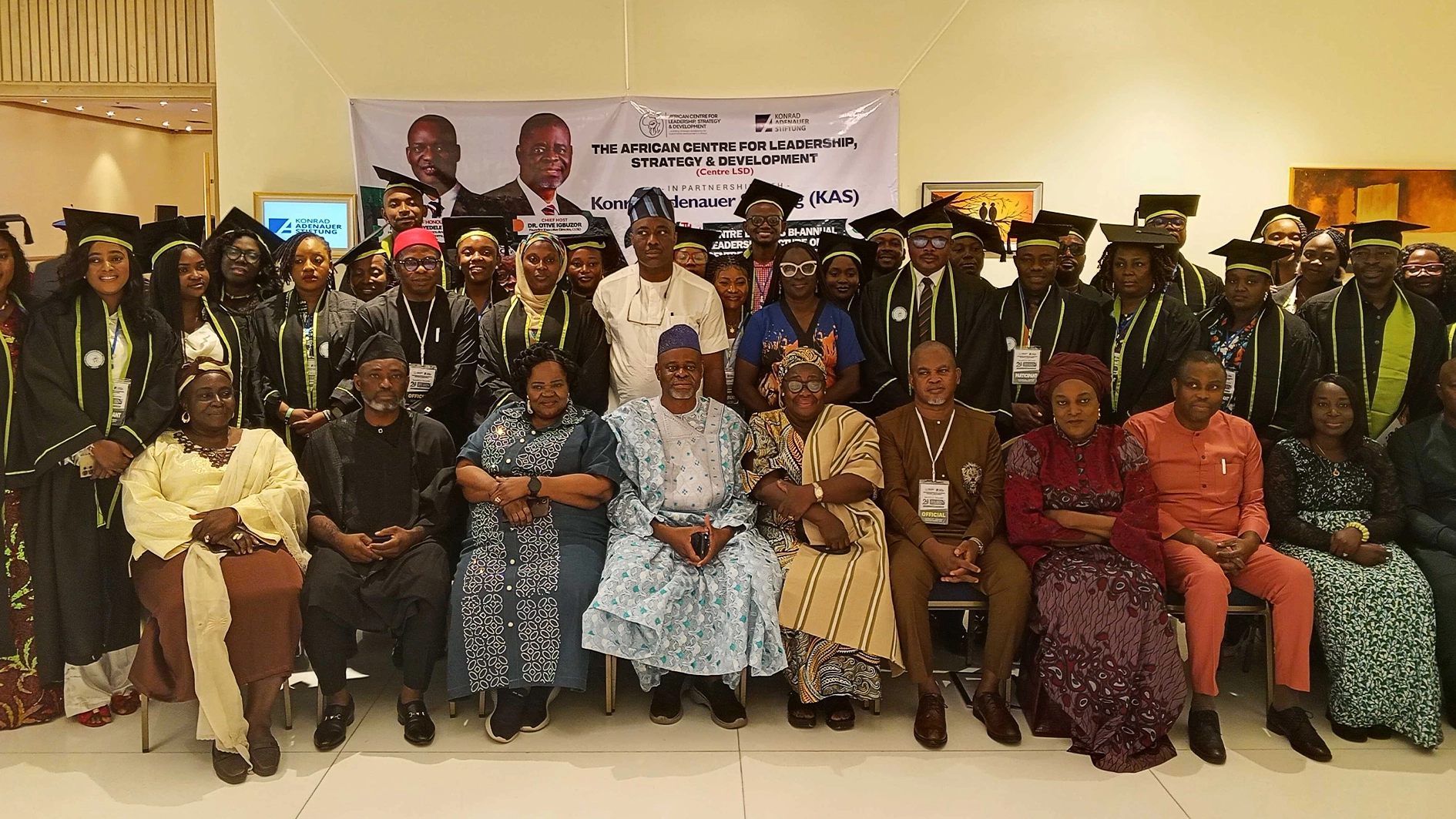
…Says nation, continent must build service-oriented leaders
….As Centre LSD graduates 3,406 leaders in 16 years
Nigeria and Africa will not transform by accident but through deliberate efforts to build a critical mass of leaders committed to service, integrity, excellence and national development, the Founding Executive Director of the African Centre for Leadership, Strategy and Development (Centre LSD), Dr. Otive Igbuzor, has said.
Igbuzor spoke on Saturday in Abuja at the graduation ceremony of Set 24 where 90 students graduated, bringing the total number of graduates produced by the institution over the past 16 years to 3,406.
He said the 3,406 graduates had become part of a growing network of leaders working across government, civil society, the private sector, academia, professional organisations, faith-based institutions and communities.
The good governance activist explained that the latest graduation marked another milestone in Centre LSD’s sustained effort to develop a new generation of dynamic, strategic, transformational and visionary leaders capable of responding to Nigeria’s development challenges.
According to him, the Leadership School was established from the conviction that leadership remains one of Africa’s greatest challenges, particularly because many people assume leadership positions without adequate preparation.

He said the programme was deliberately designed to make quality leadership education accessible to a wide range of Nigerians, including people who might otherwise be excluded by the cost of conventional leadership programmes.
Igbuzor explained that the decision to keep the Leadership School free was based on the belief that leadership development should not become the preserve of the wealthy and powerful.
The Centre LSD founder disclosed that the Leadership School, which began in Abuja, had expanded to Warri, Benin City, Port Harcourt, Abakaliki, Jos and Kano, while maintaining common standards and its commitment to quality leadership education.
He, however, stressed that the success of the institution should not be measured merely by the number of certificates awarded but by the impact of its graduates on society.
Igbuzor urged the graduates to participate actively in politics and public life, saying Nigeria needed leaders who would place integrity, competence, service and the national interest above personal ambition.
He cited the Community Development Service projects undertaken by Set 24 as evidence of the practical approach to leadership promoted by the School.
The 90 graduates, comprising 57 females and 33 males, implemented 10 community development projects in Abuja, focusing on sanitation, environmental sustainability, security, gender-based violence, gender equality, menstrual health, drug abuse prevention, peacebuilding, violence-free elections, civic engagement and digital inclusion.
“Leadership is not about position; leadership is about service, influence, responsibility and impact,” Igbuzor said, urging the graduates to translate the knowledge and skills acquired at the School into practical solutions to societal problems.
He also announced a new phase in the development of the Leadership School, disclosing that Centre LSD had entered into Memoranda of Understanding and partnership arrangements with Trinity Western University, Canada; the University of Jos; and Delta State University, Abraka.
According to him, the partnerships would create opportunities for greater academic and professional recognition of leadership education, including pathways to certificates, postgraduate diplomas and degree programmes in Leadership Studies and related disciplines.
He said the arrangements would also provide opportunities for recognition of prior learning, enabling graduates of the Centre LSD Leadership School to receive appropriate exemptions or academic credits for equivalent courses already completed.
The development, he said, would reduce duplication and provide a smoother pathway for graduates seeking recognised academic qualifications.
Igbuzor added that the long-term vision was to contribute to making leadership a recognised field of study, practice and professional development across Africa reminding the graduating students that their certificates should represent a call to greater responsibility rather than an end in themselves.
He urged them to lead with integrity, competence, courage, compassion and vision, saying society would ultimately judge them by the problems they solve, institutions they strengthen and people they empower.
He similarly welcomed the new Set 26 students into what he described as a growing leadership community, urging them to approach their studies with open minds, question assumptions, read widely and translate knowledge into action.
Igbuzor commended Centre LSD faculty members and facilitators who volunteer their time and expertise, as well as the organisation’s board, management, staff and alumni for sustaining the leadership development initiative.
He also acknowledged the longstanding partnership between Centre LSD and the Konrad-Adenauer-Stiftung (KAS), saying the collaboration had helped sustain a platform for developing successive generations of leaders committed to democratic governance and sustainable development.
He urged the new graduates and alumni to remain actively involved in the Centre LSD Leadership School Alumni Association and the Transformative Leadership Forum.
According to him, graduation should not mark the end of the leadership journey but the beginning of a new phase of collective action aimed at transforming society.
The event also featured a Leadership Lecture on the theme, “Leadership, Taxation and Development in Nigeria.”
Delivering the keynote address, public finance strategist Austin Ndiokwelu said Nigeria could not achieve sustainable economic growth simply by extracting more taxes from citizens without ensuring that public revenues were transparently managed and converted into tangible development.
Ndiokwelu, whose keynote was titled “Beyond Revenue: How Accountable Leadership Transforms Taxation into National Development,” said taxation was more than a mechanism for funding government, describing it as a fundamental component of the fiscal social contract between citizens and the state.
He explained that citizens surrendered part of their income through taxation with the expectation that government would provide security, justice, infrastructure, healthcare, education and an enabling environment for businesses and individuals to prosper.
He warned that when citizens paid taxes without seeing corresponding public value, taxation could increasingly be perceived as an unjust burden rather than a civic responsibility.
Ndiokwelu cited Nigeria’s historically low tax-to-GDP ratio as an indication of the country’s fiscal challenge, saying figures referenced in his address put the ratio at 7.9 per cent in 2025, compared with a Sub-Saharan African average of 16.5 per cent.
He argued, however, that increasing tax collection alone would not solve Nigeria’s development challenges, stressing that the quality of leadership managing public resources was equally important.
“A country cannot achieve sustainable growth merely by extracting more taxes from its people,” he said, insisting that ethical and competent leadership must steward public revenues with strict accountability and deliver tangible value to citizens.
The public finance strategist identified what he called the “Micro-Government Syndrome” as another factor undermining tax compliance in the country.
According to him, many Nigerian households and small businesses effectively provide services that should ordinarily be supplied through public institutions, including electricity, water, security, education and healthcare.
He said taxpayers could therefore question the value of paying taxes when they were already financing essential services privately.
Ndiokwelu added that perceptions of corruption and poor management of public funds further weakened institutional trust, encouraged tax resistance and contributed to informality in the economy.
He cautioned against excessive reliance on coercive tax enforcement and multiple taxation, saying overlapping charges imposed by different levels of government and informal collectors could undermine the survival and growth of micro, small and medium enterprises.
He called for a shift from revenue extraction to value-driven tax administration, citing reforms in sub-national tax administrations, including Lagos and Kaduna, as examples of how institutional reform, effective communication and visible infrastructure delivery could improve tax morale and voluntary compliance.
On ongoing fiscal reforms, Ndiokwelu said Nigeria’s tax system was being repositioned towards what he described as a “tax right, not tax more” philosophy.
He said the reforms were aimed at simplifying taxation, reducing duplication, protecting vulnerable earners and modernising revenue administration.
He highlighted measures including the transition from the Federal Inland Revenue Service to the Nigeria Revenue Service, the introduction of a Tax Ombud and changes to corporate and personal income taxation.
He cautioned, however, that policy changes on paper would only produce meaningful results if they were translated into transparent, fair and effective institutions.
Ndiokwelu also urged government to strengthen public financial management through open budgeting, transparent expenditure reporting, digital procurement and improved audit trails.
He tasked civil society organisations, the media and citizen groups with monitoring public spending, promoting participatory budgeting and conducting social audits to ensure that government projects delivered value to communities.
Addressing the graduating fellows, he urged them to apply the leadership skills acquired at Centre LSD to rebuilding public institutions and strengthening social trust.
He charged those entering government and politics to protect public funds and champion open budgeting, while urging civil society actors and journalists to continue scrutinising public expenditure and holding public officials accountable.
He similarly called on private-sector leaders and entrepreneurs to operate with integrity, fulfil their tax obligations and demand transparency in the business environment.
Ndiokwelu said Nigeria’s prosperity would ultimately depend not on the volume of revenue extracted from citizens but on the integrity, vision and accountability with which public resources were managed.
He thereby urged the Set 24 graduates to emerge as change-makers and champions of fiscal justice and accountable governance.

