
 Get Guardian on Google
Welcome. The first time a stranger in London asked me whether I had ever seen a lion on my way to school in Lagos, I laughed. The fifth time, I stopped laughing and started asking a better question: where did African stereotypes come from, and why do they cling so stubbornly? This article is the conclusion of months of research through travel books, colonial records and newspaper archives, and years of experience explaining Nigeria to people who pictured it as one long safari. Behind every lazy assumption sits a long and well-documented history of how outsiders have pictured the continent, and once you see that history, the jokes stop being funny and start being interesting.
So pull up a chair. Put the kettle on (or the zobo in the fridge, if that is more your style).
Here is what I have learnt. African stereotypes were not born from careless ignorance alone. They were built, layer upon layer, by people who had reasons to want Africa to look a certain way: slave traders who needed a moral excuse, philosophers who needed a ladder of humanity with Europe at the top, colonial officers who needed a mission, and later, charities and broadcasters who needed a picture that would open wallets. Rather like sediment in a riverbed, each layer settled on the one before it.
And here is the part that surprised even me. Nigeria’s own government now measures how the world sees us. At the Nigeria Reputation Summit in January 2026, the Information Minister described a national reputation score of 35.2 per cent, which places the country in a low-trust band, and he called the figure a mirror rather than a verdict. A mirror of what, exactly? Partly of real problems, certainly. But partly of very old pictures that were painted long before any of us were born.
Let us go and find out who painted them.
Where Did Stereotypes Originate, and Why Do Our Minds Rely on Them?
Before we get to Africa, it helps to understand the word itself.

“Stereotype” began life in a print shop. In the 1790s, French printers developed a way of casting a whole page of type as a single solid metal plate, so the same page could be stamped out again and again without a single letter changing. The plate was called a stereotype, from the Greek for “solid” and the French for “type”. In 1922 the American journalist Walter Lippmann borrowed the word for a book about public opinion, describing stereotypes as the pictures in our heads that we use to understand people we have never met.
I find that origin story rather beautiful, because it explains the problem perfectly. A stereotype is a printing plate for the mind. Once it is cast, it reproduces the same image of a group endlessly, whatever the real people in that group happen to be doing that day.
Why do our minds work like this? Psychologists generally point to three things:
- Shortcuts: the brain sorts the world into categories to save effort, which is useful when deciding whether a dog will bite and much less useful when deciding what a whole continent is like.
- Roles: when people mostly see a group in one role (as servants, as refugees, as footballers), they start assuming the role is the group’s nature.
- Transmission: families, schools, books, films and news reports pass the pictures down, often without anyone stopping to check them.
That third point is where Africa’s story begins, because for several centuries almost all the books, maps and films about Africa that reached a mass audience were made by people who were not African.
It also explains something closer to home. We Nigerians run our own stereotype printing presses (ask any Ijebu friend how tired they are of jokes about stinginess, or any Igbo trader how often they hear that all they think about is money). Our ethnic jokes follow exactly the same mechanics: one trait, noticed in a few people, stamped onto millions. I am not saying this to scold anybody. I am saying it because recognising how we do it ourselves makes it easier to see how it was done to all of us.
Schooling matters enormously here. For years, Nigerian pupils grew up without studying their own history as a subject, after it was removed from the basic curriculum in the 2009/2010 session, and the result, as the education writer Iyabo Lawal argued in her feature on bringing history back to Nigerian classrooms, was a generation with patchy knowledge of where it came from. In September 2025 the Federal Ministry of Education finally made Nigerian History compulsory again from Primary 1 to JSS 3, with topics running from origins and traditional institutions to colonial administration.
Why does that matter for stereotypes? Because a people who do not learn their own story end up absorbing somebody else’s version of it.
Which Country Has the Most Stereotypes, and Where Does Nigeria Stand?
Ah, the competitive question. Google tells me people ask it often, and I understand why. We all suspect our own country gets the worst of it.
The honest answer is that nobody has a reliable league table. Researchers measure national reputation, trust and “brand” through surveys, but there is no global census of stereotypes, and any website claiming to rank countries by how stereotyped they are is guessing. What we can say is that large, visible countries attract the most stereotypes, simply because more people talk about them. The United States, Russia, France, Mexico and India all carry heavy loads of clichés. So does Nigeria.
Within Africa, I would argue Nigeria is near the very top, and the reason is our size. With well over 200 million people, the continent’s busiest film industry, the loudest music and a diaspora on every continent, Nigeria is often the first African country foreigners meet, which makes it the place where general African stereotypes and specific Nigerian ones pile up together. I unpacked the Nigerian layer in detail in my piece on the stereotypes about Nigerians, from the “419” fraud label (named after a section of the old Criminal Code) to the idea that we are all loud and aggressive.
Have you ever noticed how the stereotype of Nigeria changes depending on who is speaking? In London, I was asked about lions. In Accra, a friend teased me about jollof and noise. In Johannesburg, a taxi driver asked, quite seriously, whether I was “one of those businessmen”. Same passport, three different printing plates.
But there is a more hopeful side to where Nigeria stands. Some of the oldest and most damaging stereotypes about Africa, the claim that we had no art, no history and no civilisation before Europeans arrived, are being dismantled object by object. In November 2025 the Museum of Fine Arts in Boston returned two Benin Bronzes, and the Director-General of the National Commission for Museums and Monuments called the return the restoration of a significant part of Nigeria’s history. Those bronzes date back to the 1500s and were seized when British forces sacked Benin City in 1897.
Think about that for a moment. The same expedition that produced headlines about “savage” Benin also shipped thousands of sophisticated bronze and ivory works to European museums, where they were admired as masterpieces while the people who made them were described as primitive. If you want a single example of how African stereotypes were manufactured, it is hard to find a better one.
The columnist Sinem Bilen-Onabanjo captured the everyday version of this in her reflection on enduring the single story, describing well-travelled British colleagues who treated one holiday as a complete account of the continent. I laughed in recognition when I read it. Then I sighed.
What Are 7 Common Misconceptions About Africa, and Where Did Each Begin?
Lists of “myths about Africa” are everywhere online. What they rarely tell you is where each myth started, which is the part that actually helps you answer it. So before I give you the full historical answer, let me take the seven misconceptions I hear most often and trace each one back.
The first is that Africa is a country. You hear it in “I’m going to Africa for a holiday” and in news reports that say “in Africa” when they mean one village in one state. This one goes straight back to the European habit, from the 1600s onwards, of describing the continent as a single mass, reinforced by colonial maps that showed Africa coloured in by empire rather than by its own peoples. The reality is 54 countries, from Egypt to Lesotho, with about 1.5 billion people.
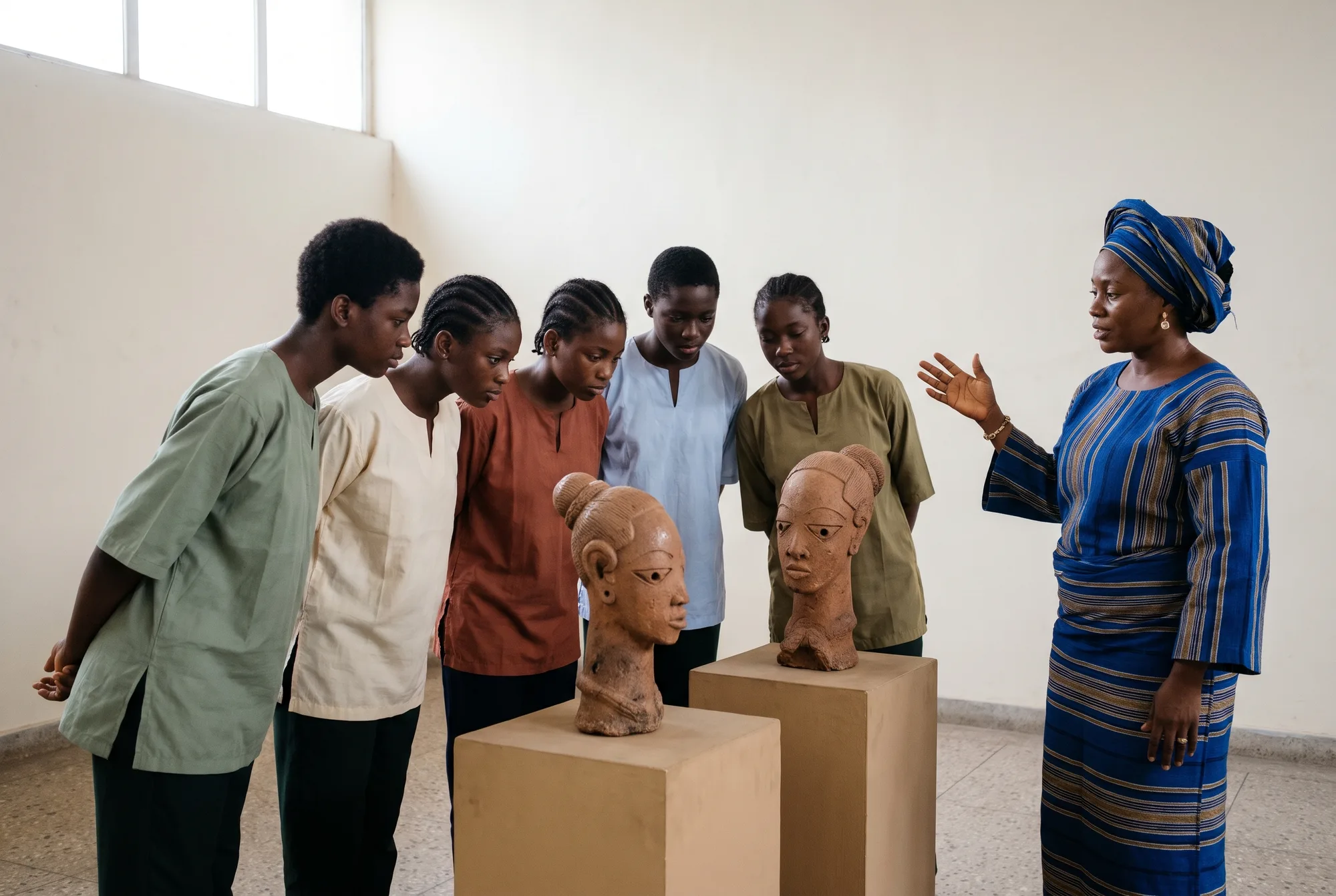
The second is that Africa had no history before Europeans arrived. This came from the German philosopher Georg Hegel and was repeated by the Oxford historian Hugh Trevor-Roper, and it was useful to empire because people without a past can be told they need a guardian. Nigeria alone answers it several times over: Nok terracotta sculptures more than 2,000 years old, the Igbo-Ukwu bronzes from around the ninth century, the Ife heads and the Benin court art that so astonished European museums.
The third is that Africans live in jungles among wild animals. Thank the explorers, then the jungle films of the 1900s, then the wildlife documentaries that still dominate British and American television. My London lion question came from this one. The reality is that a large share of Africans now live in towns and cities, Lagos, Kinshasa and Cairo are among the biggest cities on Earth, and most Nigerians have never seen a lion outside a zoo (I have seen exactly one, asleep, at the University of Ibadan zoo).
The fourth is that Africa is uniformly poor and starving. This is the newest of the big myths, built largely after 1968, when photographs from the Biafran war reached the world, and then cemented by the Ethiopian famine of 1984 and the Live Aid concerts of 1985. Charity adverts kept it alive for decades. Poverty in Africa is real and serious, but so are Seychelles’ high-income status, Botswana’s diamond-funded growth and Lagos’s billionaires.
The fifth is that Africans speak “African”. This one came from colonial officials who learnt one or two languages, if any, and from foreign media that never bothered to name them. The reality is somewhere between 1,500 and 2,000 languages across the continent, and more than 500 in Nigeria alone, which I explored in my guide to the languages Nigerians speak.
The sixth is that Africa is dangerous and always at war. News values do much of the work here, because conflict gets airtime and quiet prosperity does not, and Cold War proxy wars gave the 1970s and 1980s plenty of grim footage. The reality is that violence is concentrated in particular regions, while countries such as Mauritius, Botswana and Ghana regularly rank among the more peaceful nations in global peace rankings.
The seventh is that Africans are primitive and cannot innovate. This is the oldest and ugliest, descending directly from race science and the colonial “civilising mission”. Kenya’s M-Pesa mobile money service launched in 2007, years before most Europeans paid with their phones, and Nigerian fintech firms now move billions of naira a day through payment systems built in Lagos.
I should add one honest note. Every one of these misconceptions contains a grain of something true, which is precisely what makes it persuasive. There is conflict in parts of Africa, and there is poverty, and there are lions. The stereotype works by taking a true detail and pretending it is the whole picture, rather like describing London only by its pickpockets.
Seven Misconceptions About Africa and Where Each Began
| Misconception | Where it began | Approximate era | The reality |
|---|---|---|---|
| Africa is one country | European printers, mapmakers and trading companies | 1600s onwards | 54 countries and about 1.5 billion people |
| Africa had no history | Hegel’s lectures, repeated by Trevor-Roper | 1820s to 1963 | Nok terracottas over 2,000 years old; Benin bronzes from the 1500s |
| Africans live in jungles with wild animals | Explorers’ books, jungle films, wildlife documentaries | 1799 to today | Lagos, Kinshasa and Cairo are among the world’s biggest cities |
| Africa is poor and starving everywhere | Biafra and Ethiopia famine images, Live Aid, charity adverts | 1968 to 1985 onwards | Seychelles is high income; Botswana grew for decades on diamonds |
| Africans speak “African” | Colonial officials and foreign media | 1800s to today | 1,500 to 2,000 languages; more than 500 in Nigeria |
| Africa is always at war | News values and Cold War coverage | 1960s to today | Violence is regional; Mauritius and Botswana rank among the more peaceful |
| Africans cannot innovate | Race science and the “civilising mission” | 1758 to the 1950s | M-Pesa launched in 2007; Nollywood is among the world’s busiest film industries |
The table shows that the oldest misconceptions came from people with a direct interest in conquest, while the newer ones came mostly from media and charity imagery. That difference matters, because the old myths need history to answer them, while the new ones need better pictures and better reporting.
Where Did African Stereotypes Come From? The Short Answer
Here is the direct answer, as plainly as I can put it. African stereotypes came mainly from Europe and its colonies between the 1500s and the 1900s, when traders, philosophers, explorers, missionaries and colonial governments described Africa as a single, dark, primitive place in order to justify the transatlantic slave trade, rank humanity by race and defend colonial rule; those images were then carried into the modern era by novels, films, news coverage and charity campaigns that kept showing Africa through war, famine and wildlife. Ancient Greek and Roman writers and medieval travellers had already circulated strange tales about the African interior, but it was the slave trade, so-called race science and colonialism that turned scattered myths into a fixed and useful picture.
Broken down into its main layers, the history looks like this:
- Ancient and medieval tales: Greek and Roman writers such as Herodotus and Pliny passed on stories of monstrous peoples at the edges of the known world, and Leo Africanus’s Description of Africa, printed in Europe in 1550, became a standard reference for centuries.
- The European print market of the 1600s: historians at Leiden University are now studying how Dutch printers, mapmakers and trading companies between about 1590 and 1720 helped invent a single “African” identity, flattening hundreds of kingdoms into one negative image.
- The transatlantic slave trade: roughly 12.5 million Africans were forced onto ships bound for the Americas, many from the Bight of Benin and the Bight of Biafra on Nigeria’s coast, and slavery needed a story that made its victims seem less than fully human.
- “Scientific” racism: in 1758 Carl Linnaeus classified humans into types with supposed temperaments attached, and later writers ranked those types, with Africans placed at the bottom.
- Philosophers who wrote Africa out of history: in lectures delivered in the 1820s, Hegel declared Africa no historical part of the world, an idea that still echoed in 1963 when the Oxford historian Hugh Trevor-Roper said there was only the history of Europeans in Africa.
- Explorers and missionaries: Mungo Park’s travels on the Niger, published in 1799, and Henry Morton Stanley’s Through the Dark Continent in 1878 sold Africa to European readers as an adventure into darkness, while missionary reports needed heathens to save.
- Colonial rule and literature: after the Berlin Conference of 1884 to 1885 carved up the continent, Rudyard Kipling’s 1899 poem described colonised peoples as “half devil and half child”, Joseph Conrad’s Heart of Darkness appeared the same year, and Joyce Cary’s 1939 novel Mister Johnson presented a Nigerian clerk as a lovable fool.
- Exhibitions, cinema and aid campaigns: “human zoos” displayed Africans in European cities into the 1900s, jungle adventure films sold Africa as a set, and the famine images of Biafra and Ethiopia, followed by Live Aid in 1985, made a starving child the continent’s best-known face.
For Nigeria in particular, the colonial layer was decisive. Lord Lugard’s administration, which I discussed in my explainer on whether Nigeria was a British colony, justified itself with the language of a “civilising mission”, which only works if the people being ruled are first described as uncivilised.
The Nigerian writer IK Ngene put this sharply in his column on Chinua Achebe’s social allegory of Nigeria, pointing out that Kipling and Conrad wrote with great confidence about Africans they barely knew. Achebe himself said that reading Mister Johnson as a student in Ibadan helped push him to write Things Fall Apart in 1958, and in a famous 1975 lecture he accused Conrad of reducing Africa to a backdrop for a European’s breakdown.
What strikes me most, after all those months in the archives, is how practical every layer was. Nobody invented these images for fun. Each one did a job for somebody. That is also the most hopeful lesson, because a picture built for a purpose can be taken apart once the purpose is exposed.
Where Did African DNA Come From, and Why Does It Undo the Race Myths?
This is the question that turns the whole history upside down. Where did African DNA come from? From Africa, of course, but the deeper answer is that everyone’s DNA came from Africa.
Fossils found at Jebel Irhoud in Morocco suggest that our species, Homo sapiens, was already living in Africa around 300,000 years ago. For most of human history, all humans were Africans. Then, roughly 60,000 to 70,000 years ago, a relatively small group left the continent, and their descendants went on to populate Asia, Europe, Australia and the Americas.
That has a striking consequence. Because the people who left carried only part of Africa’s genetic variety with them, Africa still holds most of humanity’s genetic diversity. Two people from different parts of Africa can be more genetically different from each other than a European is from an East Asian. The idea of a single “African race”, so central to every stereotype in this article, simply does not survive contact with genetics.
Nigeria has its own chapter in this story. At Iho Eleru, a rock shelter near Akure in Ondo State, the archaeologist Thurstan Shaw’s team excavated a human skeleton in 1965. A 2011 study dated it to about 13,000 years ago and found that its skull shape sat between archaic humans and modern ones, suggesting that older human forms lingered in West Africa far longer than scientists once assumed. In other words, West Africa was not a backwater of human history. It was one of its laboratories.
I remember standing in a lecture hall in Ibadan years ago when a visiting geneticist explained this, and a student behind me muttered, “So the race scientists had it backwards.” She was right. The thinkers who ranked Africans at the bottom of humanity were, in genetic terms, describing the root of the tree as if it were a stray branch.
If this sparks your curiosity about Nigerian ancestry specifically, my longer piece on who Nigerians are descended from follows the migrations and origin stories behind our many peoples.
Does genetics end racism? Sadly not. Stereotypes were never really about evidence; they were about usefulness. But it does mean that anyone who still believes in a fixed, inferior “African type” is arguing with the science, not with you.
How to Spot and Answer African Stereotypes: A 7-Step Guide
Knowing the history is satisfying. Using it is better. Here is the method I have refined over years of dinner-table debates, office conversations and, once, a rather heated exchange in a hotel lift in Frankfurt.
- Keep a one-week log of every African stereotype you notice in films, adverts, news and conversation, using a simple note on your phone, and aim for at least 10 entries before you judge which ones come up most.
- Run the “one country” test on each entry by asking whether the speaker would say the same sentence about Europe or Asia, and if the sentence collapses when you swap the continent, you have found a stereotype.
- Ask for the date and source of any image used to represent Africa, because many famine and conflict photographs still circulating online are 20 to 40 years old and come from one specific place.
- Answer with one precise fact rather than a lecture, keeping your reply under 30 seconds, for example “Nigeria alone has more than 500 languages” or “the Benin Bronzes were made in the 1500s”.
- Set aside ₦5,000 to ₦10,000 a month for books by African writers, starting with Achebe, Adichie and Wainaina, and pass each book on to one friend when you finish it.
- Visit a museum or heritage site at least twice a year, such as the National Museum in Onikan, Lagos, or the Benin City National Museum, and take a young person with you.
- Spend 15 minutes a week going through your children’s or younger relatives’ new history lessons with them, so the next generation grows up with its own story rather than a borrowed one.
The point of all seven steps is to stop being a passive audience. Stereotypes depend on repetition, and every time someone hears a confident, specific correction, the printing plate gets a small scratch.
Final Thoughts on Where African Stereotypes Came From
So, where did African stereotypes come from? From a long chain of people who needed Africa to look a certain way. Slave traders needed Africans to seem less than human. Philosophers needed a bottom rung for their ladder of civilisation. Explorers needed darkness to make their adventures sell, colonial governments needed savages to justify their rule, and, much later, broadcasters and charities needed suffering to fill airtime and collection tins. Each group added its own layer, and the layers hardened into the picture my London acquaintance carried when he asked about lions.
The good news is that we now know far more than the people who built those pictures. Genetics tells us all humans share African roots. Archaeology, from Nok to Iho Eleru, tells us West Africa has one of the deepest histories on Earth. Returned bronzes, a restored history curriculum and a generation of African writers, filmmakers and coders are redrawing the image from the inside. None of that erases real problems such as insecurity or poverty, and pretending otherwise would simply create a new stereotype. But it does mean the old picture can be answered, calmly and with evidence, every single time it appears.
A few ideas to carry forward:
- Trace one family story back three generations by interviewing your oldest living relative, because private histories are the best antidote to public caricatures.
- Follow at least five African journalists, historians or museums on social media, so your feed shows the continent through its own eyes as well as foreign ones.
- When you travel abroad, bring one small object from home (a piece of adire, a Nok replica postcard, a book of Yoruba proverbs) as a conversation starter that tells a fuller story.
Related Articles
If this history has you thinking about how stereotypes work inside Nigeria, my piece on the stereotypes of Fulani people shows the same mechanics at home, where a real conflict involving some herders has been stretched into a label for millions of Fulani Nigerians. And if you enjoyed the section on misconceptions, my article on the African food stereotype takes one of the most common clichés, that Africans either starve or eat strange things, and sets it against what Nigerians actually cook and eat.
Key Takeaways
- African stereotypes were built mainly between the 1500s and the 1900s by slave traders, race scientists, explorers and colonial rulers, then kept alive by novels, films, news and charity imagery.
- Most common misconceptions, from “Africa is a country” to “Africa has no history”, started as convenient justifications for conquest rather than honest observations.
- Genetics shows that all humans descend from Africans and that Africa holds most of humanity’s genetic diversity, which undermines the idea of a single inferior African type.
Frequently Asked Questions About Where African Stereotypes Came From
Where did African stereotypes come from?
African stereotypes came mainly from the transatlantic slave trade, European race science, explorers’ accounts and colonial rule between the 1500s and the 1900s. Novels, films, news coverage and charity campaigns then carried those images into the modern era.
What is an African stereotype?
An African stereotype is a fixed, oversimplified belief about Africa or Africans, such as the idea that the continent is one country, uniformly poor or full of wild animals. It takes a detail that is true somewhere and presents it as the whole truth about 54 countries.
Where did stereotypes originate?
The word stereotype comes from a printing plate invented in the 1790s that reproduced the same page again and again. The journalist Walter Lippmann gave it its modern meaning in 1922, describing stereotypes as fixed pictures in our heads about groups of people.
What country has the most stereotypes?
No reliable ranking exists, because nobody measures stereotypes country by country in a consistent way. Large and visible countries such as the United States, India and Nigeria tend to attract the most, simply because more people talk about them.
What is the stereotype of Nigeria?
The best-known stereotypes of Nigeria are that Nigerians are fraudsters, that they are loud or aggressive and that the country is too dangerous to visit. Most of these grew from a few high-profile cases and from the 1980s and 1990s email scams, not from the lives of most Nigerians.
Where did African DNA come from?
African DNA comes from the populations of Homo sapiens that emerged in Africa around 300,000 years ago, making Africa the birthplace of all modern humans. Because only a small group left the continent about 60,000 to 70,000 years ago, Africa still holds most of humanity’s genetic diversity.
What are 7 common misconceptions about Africa?
Seven common misconceptions are that Africa is one country, that it had no history before Europeans, that Africans live among wild animals and that the whole continent is poor and starving. The others are that Africans speak one language called African, that Africa is always at war and that Africans cannot innovate.
Who started the idea that Africa has no history?
The German philosopher Georg Hegel spread the idea in lectures in the 1820s, declaring Africa no historical part of the world. The Oxford historian Hugh Trevor-Roper repeated a version of it as late as 1963, long after archaeologists had found evidence such as the Nok and Igbo-Ukwu cultures.
How did the slave trade shape stereotypes of Africans?
The transatlantic slave trade forcibly moved roughly 12.5 million Africans, and its defenders needed to portray them as less than fully human to justify it. Many of the images of Africans as childlike, savage or naturally suited to servitude were created or hardened during this period.
How does the media keep African stereotypes alive?
News outlets tend to cover Africa mainly during wars, famines and disasters, while charity adverts and wildlife documentaries fill the gaps with suffering and animals. The repetition makes those images feel like the whole story, even when most Africans live ordinary urban or rural lives.
Do Africans stereotype each other?
Yes, Africans hold many stereotypes about one another, from Nigerian ethnic jokes to rivalries between Nigerians and Ghanaians over jollof. These work through the same mental shortcuts as foreign stereotypes, which is why recognising them at home helps in answering the ones from abroad.
How can Nigerians challenge stereotypes about Africa?
Nigerians can challenge stereotypes by answering them with short, specific facts, sharing African books and films and learning their own history properly. Visiting museums, supporting African journalism and teaching children the new history curriculum all help replace the borrowed picture with a fuller one.