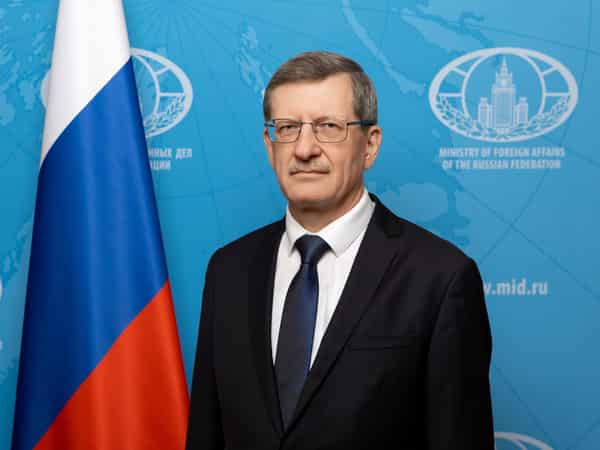
Russia’s Ambassador to Nigeria, Andrey Podelyshev, has explained that Moscow’s broad foreign policy vision relies on the pillars of multipolarity and multilateralism.
He said this at the Ambassadorial Forum titled “Russia’s Foreign Policy and its Priorities: Prospects for Multilateral Diplomacy,” organised by the Nigerian Institute of International Affairs (NIIA) in Lagos yesterday.
In his remarks, the Director-General, NIIA, Prof. Eghosa Osaghae, said the session was timely, noting that Nigeria’s foreign policy community was seeking a deeper understanding of Russia’s strategic posture, especially amid rising geopolitical tensions, the war in Ukraine, and Moscow’s expanding footprint in parts of Africa, including the Sahel.
“Nigeria wants to put this into perspective and say what exactly is going on and what Russia will do for us,” Osaghae said.
Podelyshev argued that the world is undergoing an irreversible transition to multipolarity, one defined by multiple centres of power in Europe, Asia, Latin America, Africa and the Global South. He said Russia does not seek domination but aims to serve as “one of the supporting pillars of balance” in international affairs.
He reiterated President Vladimir Putin’s position that Russia does not claim exceptional status but would firmly defend its interests and those of its partners “within the framework of international law”.
The ambassador said Moscow sees the United Nations as the primary platform for global governance. As one of the authors of the UN Charter, he said Russia rejects attempts to replace its mandate with narrow coalitions, and actively promotes initiatives on peace, information security and anti-terrorism.
Podelyshev described BRICS as a key platform for fair global development, including efforts to reform the international financial architecture, expand the use of national currencies and build institutions such as the New Development Bank.
He said the Shanghai Cooperation Organisation had evolved from a regional security arrangement into a major Eurasian platform combining counter-terrorism with economic cooperation through infrastructure and energy projects.
On the G20, he argued that the forum better reflects global economic realities than the G7. He noted that Russia, China, and others championed the African Union’s admission as a permanent member in 2023, saying it improved the G20’s legitimacy.
Across these bodies, he said, Russia promotes “open, multilateral diplomacy” rather than bloc competition, insisting that military alliances and “bloc thinking” are relics of the Cold War. He acknowledged that Africa has emerged as a global growth stronghold with increasing geopolitical agency.
He highlighted continental initiatives such as Agenda 2063, the African Continental Free Trade Area (AfCFTA), and African-led mediation efforts, including the 2023 visit of seven African heads of state to Ukraine and Russia.
“Africa is not a pawn in someone else’s game but a player in its own right,” he said, adding that many African countries had demonstrated a developed sense of dignity by maintaining neutrality in global disputes.
He noted that Russia supports Africa’s push for permanent representation on the UN Security Council and reforms to global financial institutions.
Identifying Nigeria as a potential anchor of regional stability, Podelyshev said Russia regards the country as a strategic partner whose demographic strength, economic potential and diplomatic weight will make it a global centre of influence in the emerging world order.
He recalled that Nigeria and Russia marked the 60th anniversary of diplomatic ties in November and outlined areas of cooperation, including military-technical support, education, nuclear research, upstream energy operations, infrastructure, digital technology and grain and fertiliser trade.
“Nigeria has all the prerequisites to move beyond purely African missions and become one of the global centres of power,” the ambassador said. He added that Russia sees Nigeria’s rise as beneficial to global stability and consistent with its own vision of a balanced international system.