
 Get Guardian on Google
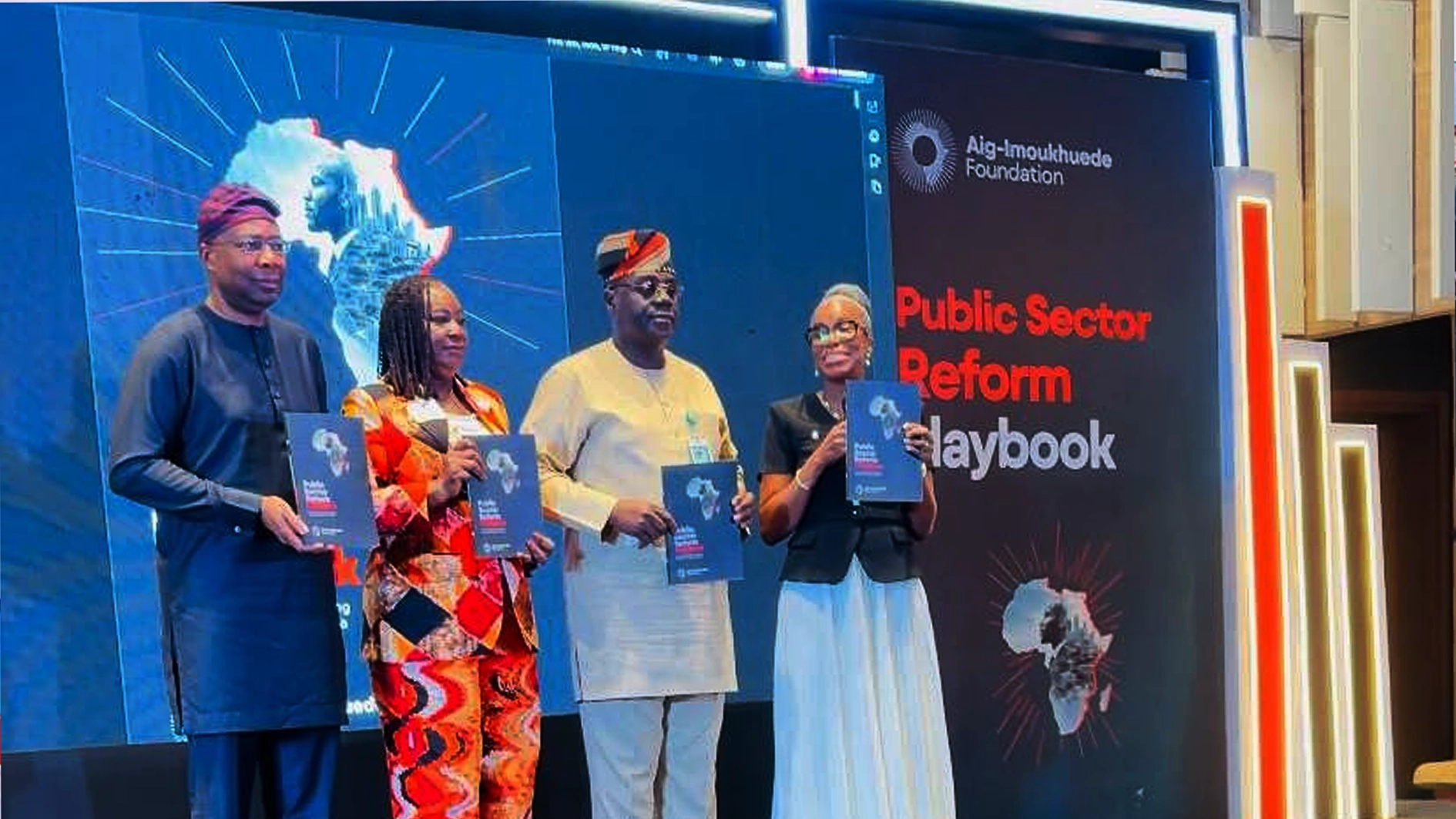
President Bola Ahmed Tinubu has challenged public servants to translate government policies into measurable results, warning that the Aig-Imoukhuede Foundation’s newly launched Public Sector Reform Playbook must not become another policy document that is celebrated at its unveiling and subsequently abandoned.
Tinubu, who spoke on Thursday in Abuja through the Head of the Civil Service of the Federation, Abel Olumuyiwa Enitan, at the launch of the playbook, said the effectiveness of public sector reforms should be judged by their impact on ordinary Nigerians rather than the number of policies formulated or documents produced.
He called on ministries, extra-ministerial offices and agencies to take ownership of the playbook, establish clear implementation targets and translate its recommendations into tangible improvements in public service delivery.
The President said Nigeria’s ambition of building a $1 trillion economy by 2030 could not be achieved without an efficient, responsive and accountable public sector capable of supporting economic growth and national development.
“A modern economy cannot be built on an inefficient public administration. Investors need confidence in government processes, businesses need timely decisions and predictable policies, and citizens deserve efficient, transparent and accountable public services,” he said.
Tinubu noted that his administration had undertaken difficult but necessary reforms to strengthen public finances, improve the investment climate, encourage domestic production and unlock economic opportunities. He, however, acknowledged the challenges associated with the reforms, insisting that meaningful transformation required courage, consistency and determination.
He identified digital transformation, human capital development, strategic workforce planning, continuous learning and leadership development as priorities in repositioning the Federal Civil Service.
The President also urged permanent secretaries, directors and other public servants to embrace institutional reforms, stressing that their responsibilities extended beyond routine administrative procedures.
“Let me emphasise that this playbook must not become another policy document that is launched with enthusiasm and subsequently forgotten. It must be put to work,” he said.
Earlier, Chairman of the Aig-Imoukhuede Foundation, Aigboje Aig-Imoukhuede, said Nigeria’s persistent difficulty with public sector reforms was not necessarily a shortage of ideas or technical expertise, but a failure to develop and document the practical skills required to implement institutional changes.
He identified change management, negotiation, communication and the ability to navigate institutional relationships, interests and influence as critical but often overlooked competencies in driving reforms.
Aig-Imoukhuede explained that the foundation’s decision to develop the playbook followed extensive engagements with public servants and stakeholders, particularly during a 2024 national workshop themed around rethinking reforms and examining why many initiatives fail in Nigeria.
According to him, the discussions revealed that public servants possessed considerable practical knowledge about implementing successful reforms, but such experiences were rarely documented or systematically transferred to younger generations.
He argued that reform was not exclusively a government responsibility but a continuous process through which societies reinvent themselves and improve their institutions.
He noted that public servants must understand the formal structures of government alongside the informal relationships, patronage systems, interests and power dynamics that influence institutional decisions.
“The noble duty that you carry on and the expectation that it is good for Nigerians is not enough. You must have the capacity to take Nigerians from where they are to where they ought or we desire to be. And that is what this playbook is all about,” he said.
He further observed that citizens were increasingly demanding accountability from governments, particularly as political promises were preserved and scrutinised through social media.
According to him, a country’s ability to implement reforms successfully was increasingly becoming a measure of its international reputation, affecting how its institutions, currency and citizens were perceived.
In her keynote address, former Head of the Civil Service of the Federation, Dr Folasade Yemi-Esan, described the playbook as a timely intervention in addressing the persistent gap between policy intentions and implementation.
Speaking on the theme, Ideas to Impact: Advancing Public Sector Transformation in Africa, Yemi-Esan, who drew on more than three decades of experience in the Nigerian public service, including almost five years as Head of Service, said the country needed to shift attention from generating new policy ideas to executing existing ones.
She described the public sector as a system that frequently celebrates the unveiling of new policies and reform programmes without sustaining the commitment required to implement them.
According to her, public servants must take responsibility for translating government pronouncements and campaign promises into practical programmes rather than distancing themselves from the process.
“In my experience, reforms falter because we pour all our energies into the design while neglecting the institutional machinery required to carry them out,” she said.
She identified unclear ownership, inadequate personnel, insufficient resources, poor coordination and weak accountability as some of the factors undermining reform implementation.
Yemi-Esan also challenged public servants to distinguish between administrative activities and actual results, arguing that attending workshops and organising training sessions should not be presented as evidence of improved institutional performance.