 Follow Us on Google News


 Follow Us on Google Discover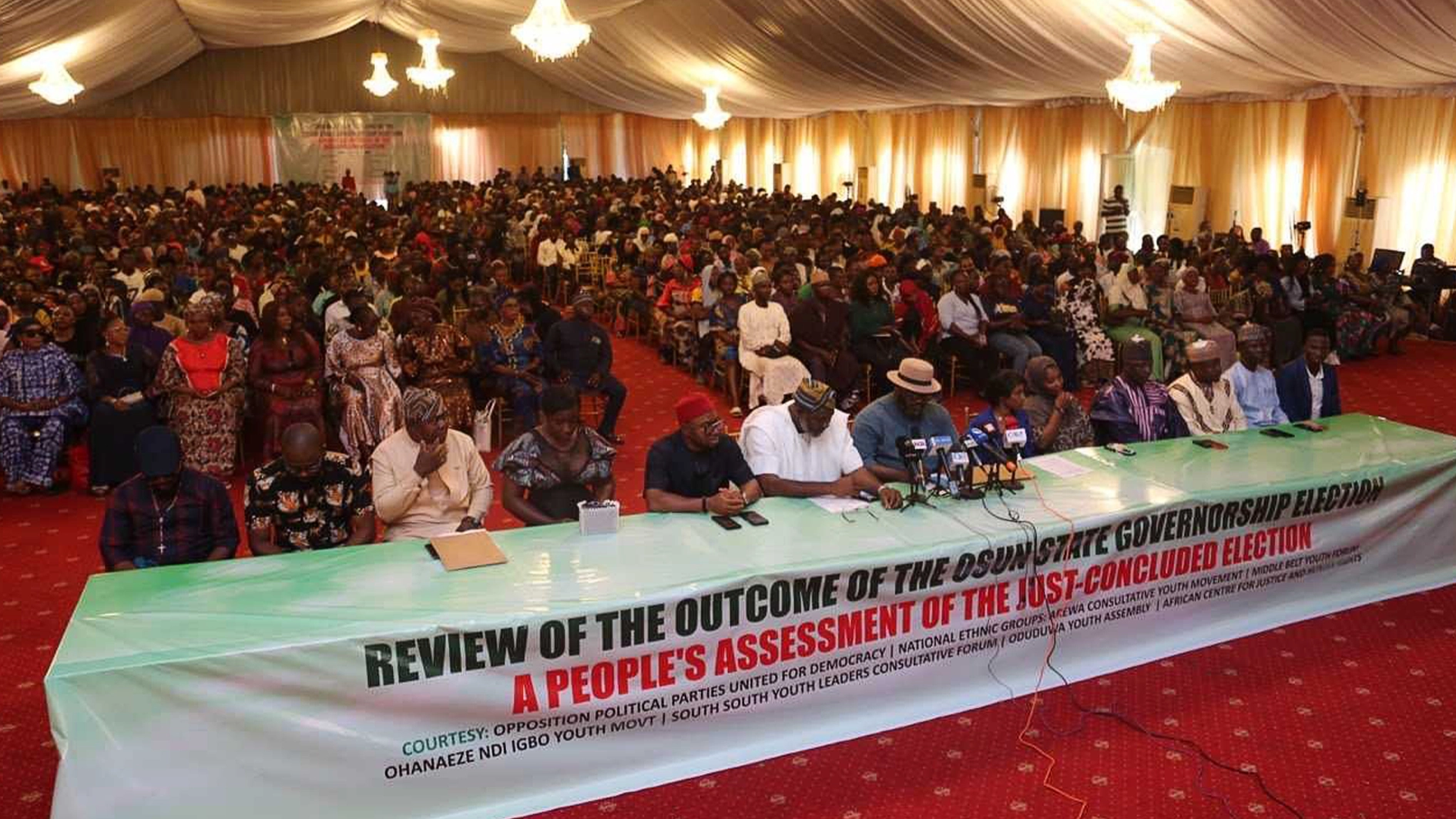
Opposition political parties, ethnic youth leaders and civil society organisations have passed a unanimous vote of confidence in President Bola Tinubu, the Prof. Joash Amupitan-led Independent National Electoral Commission (INEC) and heads of Nigeria’s security agencies for their roles in the conduct of the recently concluded Osun State governorship election.
The groups, comprising the Arewa Consultative Youth Movement, Ohanaeze Youth Movement, Middle Belt Youth Forum, Oduduwa Consultative Youth Movement, PBAT Door-2-Door Movement, African Centre for Justice and Human Rights (ACJHR) and opposition political parties, described the election as a significant victory for democracy and credible elections in Nigeria.
The groups, which participated in or monitored the electoral process, said the conduct of the poll demonstrated that Nigeria could organise competitive elections in which voters were allowed to freely express their choices.
They, however, challenged the Federal Government and INEC to ensure that the standard witnessed in Osun State was not an isolated development but became the foundation for an even more credible 2027 general election.
Speaking at a press conference in Abuja on Thursday, the groups, through the National Chairman of the Action Peoples Party (APP), High Chief Uchenna Nnadi, said the significance of the Osun election went beyond the victory or defeat of individual political parties and candidates.
They singled out INEC, its Chairman, Prof. Joash Amupitan, President Tinubu, heads of security agencies and the people of Osun State for their contributions to what they described as a peaceful and credible electoral process.

The groups said the real test of any election was whether citizens could vote without intimidation and have their choices respected.
They said the Osun experience had strengthened confidence in Nigeria’s democratic process and provided important lessons ahead of the 2027 elections.
The groups reserved special commendations for INEC and Amupitan, saying the commission’s conduct in Osun demonstrated the importance of an electoral umpire operating with independence and integrity.
They argued that the credibility of an election depended largely on the ability of the electoral commission to resist political pressure and allow voters to determine the outcome.
“The most important achievement of any election is not necessarily who wins or who loses. It is whether the people believe that they had a genuine opportunity to determine their leadership through the ballot,” they said.
According to them, the Osun election had helped strengthen that confidence by creating an environment in which voters could exercise their constitutional rights and have their votes counted.
The groups described INEC as an impartial referee whose responsibility was not to determine winners but to establish conditions under which the electorate could freely determine the outcome.
They consequently hailed Amupitan for what they described as his courage and integrity, urging him to consolidate the gains recorded in Osun.
“Mr Chairman, you have demonstrated through the Osun election that the credibility of an electoral institution ultimately depends on the courage, independence and integrity with which its leadership performs its constitutional responsibilities,” they said.
They further described the INEC chairman as a “new democratic hero” following the Osun exercise, urging him not to rest on the achievement.
Rather, they demanded that the lessons from the election be institutionalised and replicated in subsequent elections across the country.
The opposition parties and youth leaders also commended President Tinubu for what they described as the Federal Government’s decision to provide a level playing field for political parties during the election.
They argued that democracy required more than the mere conduct of periodic elections, insisting that those in power must demonstrate the political maturity to allow citizens to freely choose their leaders even where the outcome might not favour the ruling party.
The groups said the President deserved commendation for resisting what they described as the temptation to deploy federal power to influence the outcome of the Osun election.
“He allowed the electoral process to take its course. He allowed INEC to operate with the necessary independence. He allowed political parties to compete. And, most importantly, he demonstrated that the Federal Government can permit a genuinely competitive electoral process without seeking to predetermine the outcome,” they said.
They urged Tinubu to sustain the approach ahead of 2027, arguing that the Osun election could serve as an important democratic precedent for the country.
According to them, Nigerians were already looking towards the 2027 general elections, which they said would provide a major test of the Federal Government’s commitment to democratic principles.
“The Osun experience provides an opportunity for the President and the Federal Government to establish a clear democratic precedent: that electoral power belongs ultimately to the Nigerian people, and that the government must respect the sanctity of their votes,” they said.
The groups added that if the Federal Government could provide such an environment in Osun, there should be no justification for the 2027 elections to fall below that standard.
The opposition parties and ethnic youth leaders also praised the security agencies deployed for the election, particularly the Nigeria Police Force, Nigerian Army and Department of State Services (DSS).
They said the role of security agencies was fundamental to the credibility of any election, stressing that voters could not freely exercise their franchise in an atmosphere of fear and intimidation.
“Elections cannot be credible where voters are afraid to come out, electoral officials are threatened, materials cannot move safely, or political actors are allowed to intimidate their opponents,” they said.
The groups said security agencies contributed to the protection of voters, electoral officials and materials during the Osun election.
They, however, urged the agencies to maintain the same level of professionalism, neutrality and restraint in future elections.
The groups also shifted attention from institutions to the electorate, describing the people of Osun State as the “real owners of democracy.”
They commended voters for turning out to participate in the election and for demonstrating that political competition did not necessarily have to degenerate into violence.
According to them, political parties might nominate candidates, INEC might conduct elections and security agencies might provide protection, but it was the people who ultimately conferred democratic legitimacy through their votes.
They also congratulated Governor Ademola Adeleke on his electoral victory and urged him to govern in the interest of every resident of Osun State, irrespective of political affiliation.
“In a democracy, an election ends the contest but begins the responsibility to govern,” they said.
The groups urged the governor to see his victory as a mandate to unite the state and provide effective governance rather than as an opportunity to settle political scores.
Despite their commendation of the electoral process, the opposition parties and ethnic youth leaders cautioned against portraying the Osun election as flawless.
They acknowledged that challenges might have occurred in the areas of logistics, administration, technology and election-day operations, insisting that credible democracy required continuous improvement.
They therefore called on INEC to conduct a comprehensive post-election review and engage political parties and other stakeholders to identify weaknesses and develop mechanisms for preventing their recurrence.
The groups specifically demanded improvements in the management of electoral materials, voter accreditation, results management, collation procedures, communication with political parties and the deployment of technology.
They also called for the consistent and impartial application of electoral regulations to all parties and candidates.
According to them, the credibility of an election should not be judged solely by what happens on election day but by the integrity of the entire electoral cycle.
The groups said perhaps the most important lesson from the Osun election was its implication for the 2027 general elections.
They warned that the next general election would attract intense scrutiny from Nigerians and the international community, stressing that the standard established in the coming months would determine public confidence in Nigeria’s democracy.
They identified five conditions necessary for credible elections: independent electoral management, a level playing field, professional security agencies, freedom for voters to cast their ballots and an outcome that reflects the will of the electorate.
“If political parties can compete, if INEC can operate independently, if the Federal Government can provide a level playing field, if security agencies can remain professional, if voters can cast their ballots without intimidation, and if the outcome can reflect the will of the electorate, then Nigeria has demonstrated that credible elections are possible,” they said.
“There is therefore no justification for lowering the standard in 2027. Osun must not be an exception. Osun must become the benchmark.”
The opposition parties and youth leaders called on INEC to build upon the Osun experience, the Federal Government to sustain what they described as the principle of non-interference, security agencies to maintain neutrality and professionalism, and political parties to respect democratic rules.
They also urged Nigerians to defend their votes and reject violence, intimidation and electoral manipulation.
The groups further argued that political parties themselves must embrace internal democracy if they wanted to credibly demand transparent national elections.
They said parties could not demand credible elections from INEC and government institutions while denying their own members transparent processes for choosing candidates and leaders.
“The sanctity of the ballot must begin with the internal democracy of political parties,” they said.
They called for transparent nomination processes and urged political parties to resolve internal disagreements through established democratic and legal mechanisms rather than violence or intimidation.
The opposition parties and ethnic youth leaders also appealed to Nigerians not to become cynical about democracy despite the challenges confronting the country’s political system.
They said there were legitimate concerns about Nigeria’s electoral process but maintained that there were also reasons for optimism.
They argued that every improvement in the conduct of elections strengthened democracy, just as every acceptance of electoral outcomes by political leaders reinforced democratic culture.
“Every time an election is conducted more credibly than the one before it, our democracy becomes stronger,” they said.
“Every time a political leader accepts the will of the people, democracy becomes stronger. Every time an electoral umpire refuses to compromise the integrity of the ballot, democracy becomes stronger.
“And every time security agencies protect voters rather than intimidate them, democracy becomes stronger.
“And every time citizens insist that their votes must count, Nigeria becomes stronger.”
They said the significance of Osun therefore transcended individual political parties and candidates.
“That is why the Osun election matters. It is bigger than one state. It is bigger than one political party. It is bigger than one candidate. It is about whether Nigerians can continue to believe that their votes can determine who governs them.”
The groups said the country now had an opportunity to use the Osun experience to strengthen its democratic institutions ahead of 2027.
They urged INEC, the Federal Government, security agencies, political parties, civil society organisations and citizens to collectively ensure that the next general elections were conducted with an even higher standard of transparency, neutrality, professionalism and respect for the people’s will.
According to them, “Osun has shown us what is possible. Now, Nigeria must build on it.”
“The 2027 elections must be conducted with an even higher standard of transparency, neutrality, professionalism and respect for the will of the people,” they said.
They pledged to support legitimate institutional efforts aimed at deepening democracy, protecting the sanctity of the ballot and ensuring that political power in Nigeria was obtained through the consent of the people and exercised in their interest.
“This is not about one political party. This is about Nigeria. A victory for the people. A victory for democracy. A victory for Nigeria,” they added.

