 Follow Us on Google News


 Follow Us on Google Discover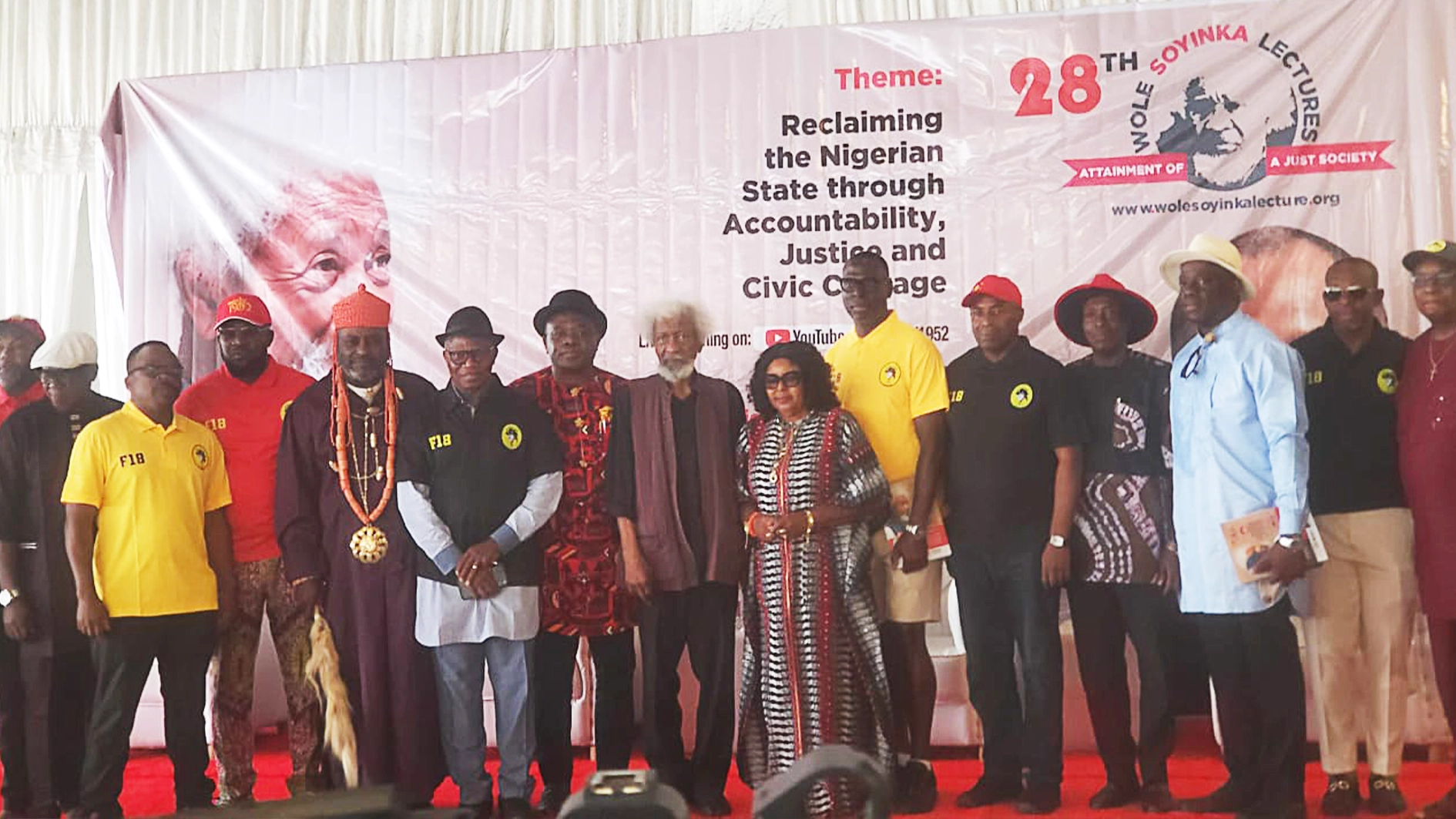
Nobel Laureate, Prof. Wole Soyinka, has condemned the growing culture of silence surrounding extrajudicial killings and other abuses by state actors, warning that public inaction is allowing impunity to thrive in Nigeria.
Soyinka spoke in Port Harcourt at the 28th Wole Soyinka Lectures, held with the theme, “Reclaiming the Nigerian State through Accountability, Justice and Civic Courage.”
The Nobel laureate, who dedicated his 2026 public lecture to victims of alleged state excesses and mob violence, said the tragedy confronting Nigeria goes beyond the loss of lives to the failure of citizens and institutions to demand accountability.
He said the devaluation of human life was being reinforced whenever Nigerians remained silent after people were killed or abused without justice.
“Today is dedicated to the 18 Ughelli residents butchered by state agencies for no reason at all, simply for minding their own business; to the young man shot dead in broad daylight by a policeman while under suspicion; and to Deborah, the youth hunted through the city by her own classmates, necklaced and set ablaze,” Soyinka said.
He described the silence surrounding such incidents as a greater danger to society, stressing that perpetrators must not be allowed to escape accountability.

“The crime is the silence of the rest of us, that such a thing is possible and that the killers of that girl can actually go on television, hold up a match and say, ‘This is the match with which I set her on fire.’ And there the system of justice fails us completely,” he said.
Soyinka also dismissed criticisms that his interventions on cases involving alleged abuses could inflame religious tensions, insisting that conversations on justice and human dignity were necessary to preserve the value of citizenship.
He urged Nigerians to remain vigilant and demand justice in cases of alleged unlawful killings, particularly that of the policeman accused of shooting a young man in southern Nigeria.
According to him, forums such as the annual lecture are important because they remind citizens that the human being remains the most fundamental unit of society.
In his keynote address, former Minister of Aviation, Chief Osita Chidoka, said justice in Nigeria begins long before a case gets to the courtroom.
Chidoka argued that the first test of justice occurs when law enforcement officers decide whether a citizen’s complaint will be heard or ignored, stressing that such decisions must be based on merit rather than status or other external considerations.
He also raised concerns over prolonged pre-trial detention in Nigeria, saying a large proportion of inmates in custodial centres have not been convicted of any crime.
According to him, 64 per cent of inmates in custodial centres are awaiting trial, with more than 50,000 Nigerians caught in the process.
“Each of these 50,000 is a life in suspension, a job lost, a family destabilised, someone’s health failing. When the state causes that delay, and the citizens pay for it in lost liberty, the delay is not inefficiency. It is a form of violence carried out by the state itself,” Chidoka said.
The former minister said genuine justice requires a system where the rules apply equally to all citizens, regardless of their identity, political affiliation or social standing.
He added that prosecutions must be driven by evidence, while persons in detention should retain meaningful access to their lawyers.
“A citizen who defeats government in court must not face a second battle to compel obedience. Justice is also tested by how society treats those it dislikes.
“The law is not established when it protects only our friends. Justice must defend the accused, the unpopular, the political opponent, and the minority, because citizenship does not depend on agreement. Where justice is negotiable, citizenship becomes hierarchical,” he said.
Earlier, chairman of the occasion and former Managing Director of the Niger Delta Development Commission, Chief Timi Alaibe, said sustainable development could not be achieved in an environment where accountability was weak.
Drawing from his years in public service, Alaibe said weak institutions ultimately erode public confidence and replace hope with cynicism.
He noted that accountability could enable institutions to achieve meaningful results even when resources were limited.
Alaibe urged participants drawn from government, the private sector, academia and civil society not to treat the 28th Wole Soyinka Lectures as merely another ceremonial gathering.
Rather, he called for honest reflection and renewed commitment to rebuilding Nigeria through stronger institutions and responsible citizenship.
“Nations are not reclaimed by rhetoric alone, they are reclaimed when conscience triumphs over confidence. When institutions are stronger than individuals. When citizens summon the courage to do what is right, even when it is difficult,” he said.

