
 Get Guardian on Google
Hello, and welcome! If you have ever left a Nigerian reception clutching a foil pack of rice “for the road”, you already know half the answer to today’s question: what kind of food is served at African weddings? This guide is the conclusion of months of research into wedding menus across the continent and years of experience eating (and, I confess, occasionally queueing for) party food from Lagos to Kano. It starts, naturally, with the West African one-pot rice dish that every caterer in Nigeria is secretly judged by, but it goes a good deal further than that.
Here is the truth nobody prints on the invitation card. Guests forget the colour scheme within a week, but they will discuss the food for years.
I learnt this the hard way at a cousin’s wedding in Ibadan, where the hall was gorgeous, the band was superb and the amala ran out at half past four. Half the guests from Ogbomoso had not eaten. I still hear about it at family gatherings, and I was not even the one who planned it! Food at an African wedding is hospitality, family pride and social credit served on one plate, which is why couples agonise over it more than almost anything else.
Money makes the question sharper than ever. Food is the biggest line in most wedding budgets, and the bureau’s latest consumer price figures put food inflation at 19.13 per cent year on year in October 2026, even as headline inflation eased to 14.06 per cent. A plate that cost a caterer ₦2,500 to fill a few years ago now costs several times that.
So in this guide I will walk you through the dishes you are likely to see, who gets served first (and why it matters more than you think), what each menu tier costs per guest in naira, and the foods I would quietly leave off any wedding menu. Pull up a chair. Rather like a good reception, there is plenty to get through.
What Are 10 Popular African Dishes Served at Weddings?
Africa is a continent of 54 countries and thousands of food traditions, so no single menu covers everything. Still, after years of attending ceremonies and quizzing caterers, I keep seeing the same ten dishes (or close cousins of them) at receptions from Lagos to Nairobi.
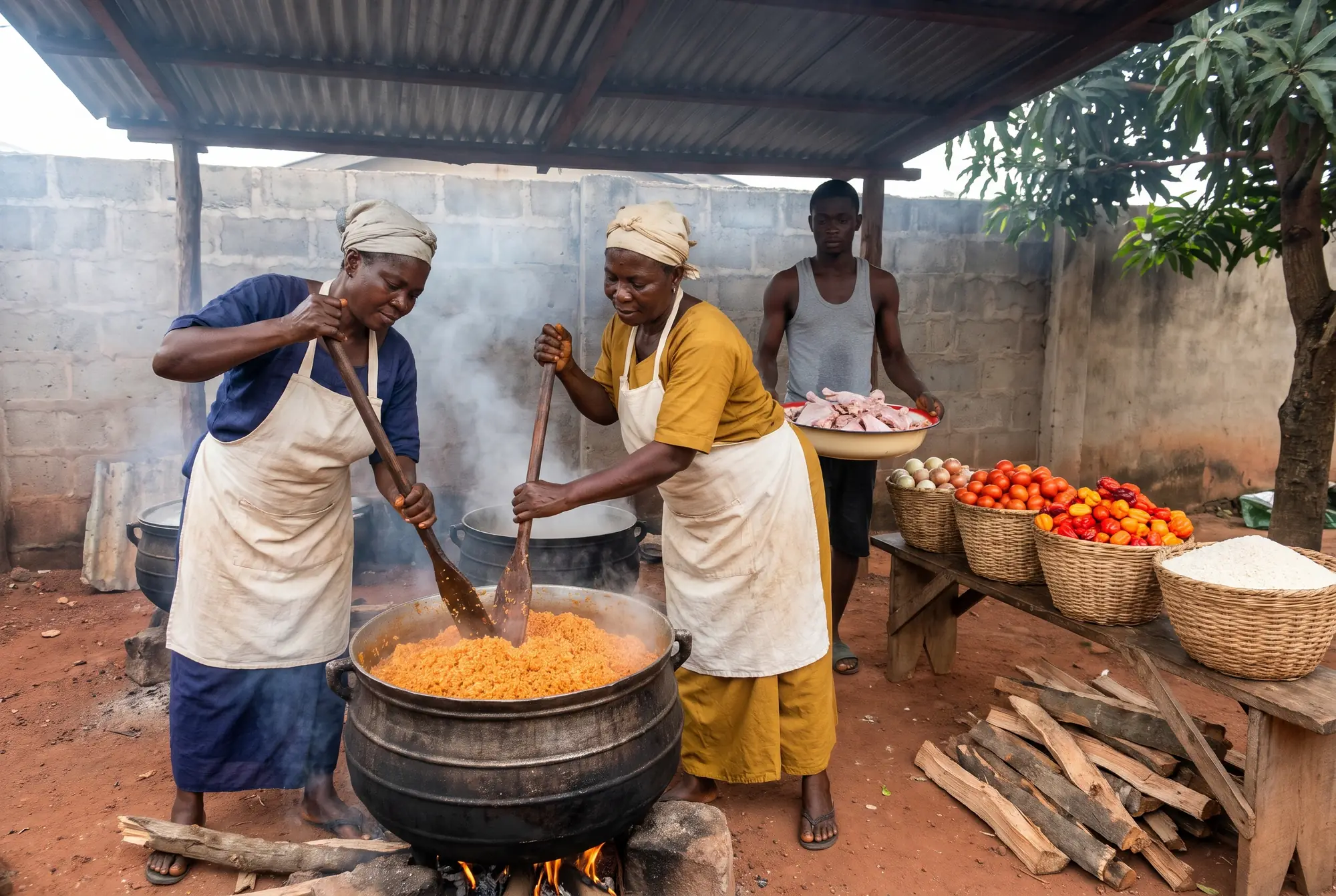
Jollof rice comes first, and it is not close. Rice simmered in a pepper, tomato and onion base until each grain turns orange-red, it is the dish against which Nigerian and Ghanaian weddings are measured. The “party” version gets its smoky edge from cooking over firewood in huge pots, letting the bottom catch slightly. Nigeria takes this so seriously that chef Hilda Baci cooked 8,780kg of it at Eko Hotels and Suites in Lagos, earning a Guinness record for the largest serving in September 2025. I am not suggesting you cook that much for your wedding, though some aunties would try.
Fried rice is jollof’s permanent companion. A standard Nigerian wedding plate puts a scoop of each side by side, with diced carrots, green beans, sweetcorn and liver giving fried rice its confetti look.
Moin moin is steamed bean pudding made from peeled black-eyed beans blended with peppers, onions and oil, then steamed in leaves, foil or tins. At a good wedding it arrives with a boiled egg or a flake of fish hidden inside, rather like a small edible gift.
Pounded yam with egusi soup is the “swallow” option for guests who believe rice is a snack. Smooth pounded yam (true pounded yam, not powdered “poundo”, if the hosts want praise) sits beside melon-seed soup thick with leafy greens, stockfish and assorted meat.
Amala with ewedu and gbegiri belongs at almost any Yoruba wedding. The dark yam-flour swallow comes with slippery jute-leaf soup and a bean soup, finished with a ladle of pepper stew. If you are hosting in Ibadan, Osogbo or Abeokuta, leaving this out is an act of courage.
Small chops are the starter course of Nigerian celebrations: puff puff, samosas, spring rolls, peppered gizzard, chicken wings and sometimes plantain skewers, served in a small pack or a tray. Their arrival is the moment the whole hall relaxes.
Asun and peppered meats are where hosts show generosity. Smoked goat meat tossed with scotch bonnet and onions, peppered turkey, fried beef and grilled fish tend to travel round the tables in a second wave.
Head west to Senegal and the centrepiece is often thieboudienne (ceebu jën), broken rice cooked in a tomato and fish sauce with cassava, carrots and cabbage. Many food historians trace jollof itself back to this region, so it is fair to call it the grandparent of the Nigerian party plate.
In Ethiopia, the wedding feast revolves around injera with doro wat, a sour, spongy flatbread spread with a deep-red chicken stew cooked slowly in berbere spice and finished with hard-boiled eggs. Guests eat with their hands from shared platters, and feeding a friend a mouthful (gursha) is a gesture of affection.
East and southern Africa round off my ten with nyama choma and pilau (roasted goat or beef with spiced rice, common at Kenyan and Tanzanian weddings) and pap with chakalaka and braaied beef at South African celebrations, where a cow is frequently slaughtered for the occasion and sorghum beer is passed around. The thread connecting all ten? A starch, a sauce and plenty of meat, in quantities designed to feed far more people than were formally invited.
If you want the deeper story behind several of these dishes, my piece on what food Nigeria created traces where jollof, suya and moin moin fit in the country’s culinary history.
Who Should Eat First at an African Wedding?
This is the question that causes more quiet arguments behind the scenes than the seating chart.
In most Nigerian receptions, the high table is served first: the couple, both sets of parents, the chairman of the occasion and the most senior guests. Elders follow, then the general hall, with the youth and the “uninvited cousins of the photographer” (every wedding has them) last. It mirrors a wider cultural rule. Age and status are honoured publicly, and food is one of the clearest ways to show it.
There are lovely regional variations. At an Igbo traditional wedding (igba nkwu), the bride searches the crowd for her groom and offers him palm wine; only once he drinks does the celebration properly begin. In many Hausa and Fulani households, men and women are fed in separate spaces, and the women’s side is often where the best-kept dishes appear. At Yoruba engagements, the two families eat together after the formal exchanges, and refusing the food offered by the bride’s family can be read as a slight.
My professional advice, after watching dozens of couples skip their own dinner? Make sure the couple actually eats. Brides and grooms are pulled away for photographs, greetings and dances, and many leave their own wedding hungry. Ask the caterer to plate their food first and hold it somewhere quiet.
Feed your vendors early too. A photographer who has not eaten since 8am is a photographer who takes weaker pictures by 6pm (I have seen it happen). Budget for the DJ, the MC, the security team and the ushers in your headcount.
Timing matters for safety, not only manners. The longer service drags on, the longer cooked food sits in coolers and warmers in a hot hall. National food hygiene guidelines from NAFDAC set out how food preparation businesses should handle, store and hold cooked food, and any caterer worth hiring should be able to talk you through how they follow them. A reception that serves the high table at 3pm and the back row at 7pm is not just rude; it is a risk.
And for guests reading this, a little etiquette goes a long way. Queue politely at the buffet, do not demand a third plate before others have had one, and take a look at this owambe guide to party manners by Itoro Oladokun before your next invitation. If you are unsure what to wear while you eat all this, my article on what guests wear to Nigerian weddings will spare you a lace-and-egusi disaster.
So, What Kind of Food Is Served at African Weddings?
Let me answer the question directly, because that is why you are here.
African weddings serve abundant, shared, celebration-scale meals built around a starch, a rich sauce or soup and plenty of meat, with the exact dishes shaped by the country, the ethnic group and the family’s faith. In Nigeria and Ghana, that means jollof rice and fried rice with chicken, beef or turkey, moin moin, fried plantain (dodo), coleslaw and small chops, followed by swallow such as pounded yam, amala or eba with egusi, ewedu, ogbono or banga soup. In Senegal it is thieboudienne, in Ethiopia injera with doro wat, in Kenya pilau with nyama choma and in South Africa pap, chakalaka and slow-cooked beef. Drinks typically include soft drinks, malt, bottled water, zobo (hibiscus), Chapman and, at non-Muslim weddings, palm wine, beer and spirits, with a tiered cake to close.
That is the summary. The detail lives in the regional twists, which is where the real fun is.
At a Yoruba wedding in Lagos or Ibadan, you can expect ofada rice with ayamase (green pepper stew), asun, amala with gbegiri and ewedu, and dodo on the side. An Igbo celebration in Enugu or Owerri brings out abacha (African salad), nkwobi (spiced cow foot), ofe onugbu (bitterleaf soup) and generous pots of palm wine. Head north to Kano or Kaduna and the menu may feature tuwo shinkafa with miyan kuka, masa (fermented rice cakes), kilishi and fura da nono. South-South weddings in Warri, Benin City or Calabar shine with banga soup and starch, owo soup, edikang ikong and afang.
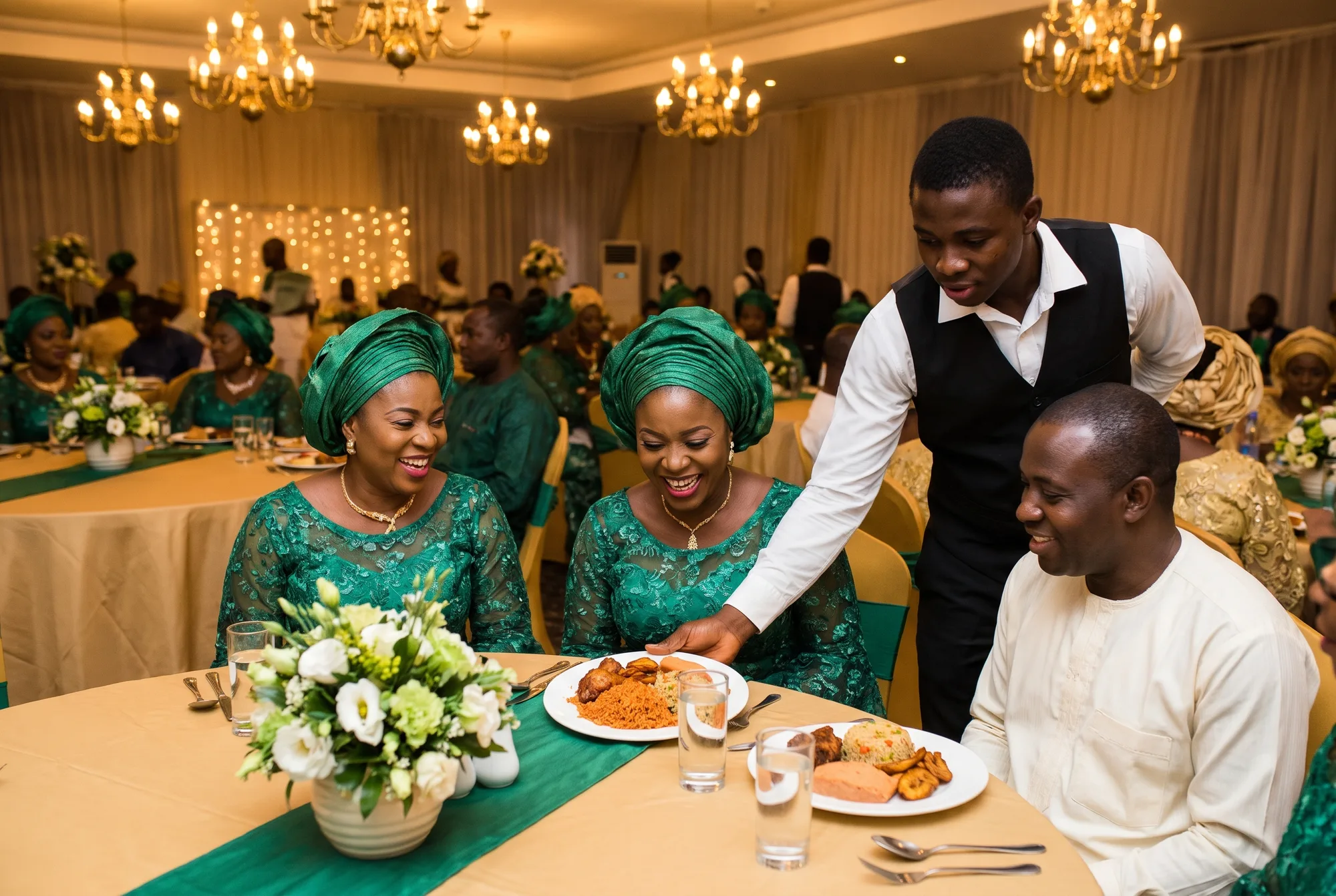
The format varies as much as the food. Lagos weddings lean towards plated service with waiters in matching uniforms, while many village and northern weddings serve buffet-style or from communal trays. Increasingly, I see “stations”: a suya grill, a pasta bar, a pepper soup corner and even an ewa agoyin stand serving mashed beans and bread.
Guest numbers explain the quantities. A Nigerian wedding commonly hosts 300 to 1,000 people, and families plan for gatecrashers as a matter of course. If you want the full picture of what happens around the meal, from the dancing to the spraying, my explainer on why Nigerians spray dollars sets the scene, and my piece on how long a Nigerian wedding lasts explains why caterers plan for a full day of eating.
What Is the Cheapest Food to Serve at a Wedding Reception in Nigeria?
Rice is the cheapest way to feed a large Nigerian crowd well, and it is not even close.
A 50kg bag averaged ₦79,207 across 37 markets in early November 2026, according to one widely reported market survey, with Lagos’s Mile 12 nearer ₦85,744. One bag, cooked into jollof or fried rice, feeds roughly 300 guests at sensible portions. Compare that with pounded yam, which needs dozens of tubers, hours of pounding labour and a soup loaded with stockfish and meat, and you can see why budget menus lean on rice.
The protein is where costs balloon. Chicken pieces are usually the most affordable option per plate, turkey and goat cost more, and fish varies wildly by season. For big Igbo and Hausa weddings, families sometimes buy a whole cow; recent market reports put a cow at ₦1.2 million to ₦2 million depending on size, which can still work out cheaper per portion than buying beef by the kilo if you have the space and the butchers.
Caterers have felt every naira of food inflation. In this Guardian Life report on wedding costs, Musa Adekunle quotes a Lagos caterer who estimates that feeding each guest properly now costs about ₦35,000, against ₦15,000 not long ago, which puts food alone at around ₦7 million for 200 guests. That is at the comfortable end of the market, and many couples spend far less, as the table below shows.
Wedding Catering Cost Per Guest in Nigeria by Menu Tier (2026)
| Menu tier | What is on the plate | Typical cost per guest | Food bill for 200 guests | Best suited to |
|---|---|---|---|---|
| Budget | One rice dish, one protein, water or a soft drink | ₦3,000 to ₦5,000 | ₦600,000 to ₦1,000,000 | Family-cooked village or court wedding receptions |
| Standard | Jollof and fried rice, moin moin, chicken or beef, dodo, soft drinks | ₦6,000 to ₦12,000 | ₦1,200,000 to ₦2,400,000 | Most church and mosque receptions in town halls |
| Mid-range | Standard menu plus small chops, one swallow and soup, asun | ₦12,000 to ₦20,000 | ₦2,400,000 to ₦4,000,000 | City weddings with 200 to 400 guests |
| Full service | Several stations, small chops, swallow, desserts, drinks and uniformed waiters | ₦25,000 to ₦40,000 | ₦5,000,000 to ₦8,000,000 | Lagos and Abuja event-centre weddings |
| Luxury | Hotel ballroom menus, premium proteins, cocktails and imported wines | ₦45,000 and above | ₦9,000,000 and above | High-profile and destination-style weddings |
The pattern is clear: moving from a budget to a full-service menu multiplies the per-guest bill by roughly eight, so the cheapest lever is not a cheaper dish but a shorter guest list and fewer extras. These ranges are my estimates from caterer quotes and published surveys in 2026, so always get at least three written quotes for your own city.
Want to stretch your budget without anyone noticing? A few swaps work beautifully. Replace a full small chops pack with puff puff and plantain mosa, which cost a fraction of samosas and prawns. Choose chicken over turkey. Offer one swallow and one soup rather than three of each. And consider a “buka-style” stand (ewa agoyin, ofada or a suya grill), which guests remember fondly and which often costs less per head than a third rice dish.
Here is the process I give friends who ask me to look over their wedding food budget:
- Count your heads honestly, then add 10 to 15 per cent for the guests who will arrive without a card, because they always do.
- Decide your food budget per guest before speaking to any caterer, so the conversation starts with your number rather than theirs.
- Pick one anchor dish everyone expects (usually jollof) and one regional dish that reflects both families.
- Book a tasting before you pay a deposit, and taste the party jollof cooked in a large pot rather than a small sample.
- Put portion sizes in writing, including the number of serving spoons of rice and the size of each piece of protein.
- Agree the order and timing of service, with small chops on arrival and the main meal served within an hour of guests sitting down.
- Decide in advance what happens to leftovers, whether takeaway packs for elders, meals for staff or a donation to a nearby orphanage.
Follow those seven steps and you will usually save more than any single ingredient swap could manage.
What Not to Serve at an African Wedding
Some dishes look lovely on a Pinterest board and fail spectacularly in a hot Nigerian hall. After years of watching menus succeed and stumble, here is what I would leave off.
Anything that spoils fast in the heat. Mayonnaise-heavy salads, cream sauces, rare meat and seafood that sits out for hours are all asking for trouble when the hall is 32°C and service runs into the evening. Food safety is a serious public health issue in Nigeria; as Nkechi Onyedika-Ugoeze reports in her feature on the country’s food safety crisis, foodborne disease costs Nigeria an estimated $3.6 billion a year, and one guest she interviewed fell ill after eating a meat pie from an event snack pack. Ask your caterer how long food sits between cooking and serving.
Pork and alcohol at a Muslim or mixed-faith wedding. This seems obvious, yet it still happens. If there is any chance that Muslim guests will attend, keep pork off the menu entirely, label any dish with alcohol in it and make sure the meat is halal where needed. At a northern wedding, a generous table of zobo, kunu and fura da nono will be far more welcome than a bar.
Only one option. A single rice dish with a single protein might be cheap, but it leaves out vegetarians, guests avoiding red meat and the elderly guest who cannot manage tough beef. One extra choice (moin moin with plantain, say) solves most problems.
Dishes that wreck expensive clothes. Whole crabs, bony fish in pepper soup and anything eaten with a lot of oil are wonderful at home and a nightmare when guests are wearing ₦150,000 lace. Serve fish in fillets and keep the messiest soups for the traditional ceremony where the dress code is more forgiving.
Untested experiments. Your wedding is not the day to discover that the caterer’s “fusion” suya pasta is chewy. If a dish has not been tasted at full scale, it does not go on the menu.
Food that clashes with the event’s rhythm. Heavy swallow served at 11am before a long church service will send half the hall to sleep. Light small chops early, rice in the afternoon and swallow later in the day tends to suit how Nigerian receptions actually flow.
Final Thoughts on What Kind of Food Is Served at African Weddings
So, what kind of food is served at African weddings? Generous, shared, deeply regional food, from Nigerian jollof and pounded yam to Senegalese thieboudienne and Ethiopian injera, served in quantities that say “you are welcome here” louder than any speech. In Nigeria, that usually means two rice dishes, moin moin, a good protein, small chops and at least one swallow, adjusted to reflect the families’ ethnic roots and faith.
The cost question is real, but it is manageable. Rice-based menus remain the most affordable way to feed a crowd, swaps like chicken for turkey save meaningful sums, and the biggest saving of all usually comes from an honest headcount rather than a cheaper menu. Serve the high table and your elders first, feed your vendors, protect your guests from food that spoils in the heat, and you will have done right by everyone who came to celebrate with you.
Before you sign anything with a caterer, try these three things this week:
- Ask both mothers which single dish they would consider a family embarrassment to leave out, and treat that dish as fixed.
- Add a short dietary line to your RSVP form or WhatsApp invitation (halal, no pork, allergies) so you are not guessing on the day.
- Name one calm, trusted relative as your “food marshal”, with authority over the coolers and the serving order while you enjoy your reception.
Related Articles
If you are planning the bigger day around the meal, my guide to what Nigerian weddings are like walks you through each ceremony, from the introduction to the white wedding, so you know where food fits into the whole occasion. And because the catering bill rarely lands on one person, my explainer on who pays for a wedding in Nigeria sets out how the bride’s family, the groom’s family and the couple traditionally share the costs.
Key Takeaways
- Jollof rice, fried rice, moin moin, a protein and small chops form the backbone of most Nigerian wedding menus, with a regional dish signalling each family’s identity.
- Catering in 2026 ranges from about ₦3,000 per guest for a simple rice menu to ₦45,000 or more for hotel ballroom service, and rice remains the cheapest dish to serve at scale.
- Good wedding food etiquette means serving the high table and elders first, feeding vendors early and avoiding dishes that spoil in heat or clash with guests’ faith.
Frequently Asked Questions About What Kind of Food Is Served at African Weddings
What kind of food is served at African weddings?
African weddings usually serve celebration-scale meals of a starch, a rich sauce or soup and plenty of meat, such as jollof rice, fried rice, moin moin, pounded yam with egusi and small chops in Nigeria. Other countries have their own centrepieces, including thieboudienne in Senegal, injera with doro wat in Ethiopia and pilau with nyama choma in Kenya.
What to expect at an African wedding?
Expect a long, lively celebration with music, dancing, colourful traditional attire and far more food than you think you can eat. In Nigeria, guests are often greeted with small chops and drinks before rice dishes, proteins and swallow arrive later in the day.
What food is normally served at a Nigerian wedding?
A typical Nigerian wedding plate includes jollof rice and fried rice with chicken, beef or turkey, moin moin, fried plantain and coleslaw. Many receptions also offer a swallow such as pounded yam or amala with egusi, ewedu or ogbono soup.
What is Africa’s most eaten food?
Staple starches such as maize, cassava, rice and yam are eaten more than any single dish across Africa. At celebrations in West Africa, jollof rice is the most widely served party dish.
What are some examples of African dishes served at receptions?
Popular reception dishes include Nigerian jollof rice, moin moin, asun and pounded yam with egusi soup. Elsewhere on the continent you will find Senegalese thieboudienne, Ethiopian injera with doro wat and South African pap with chakalaka.
What are the top 5 most popular dishes at Nigerian weddings?
The five dishes you are most likely to see are jollof rice, fried rice, moin moin, small chops and pounded yam with egusi soup. Peppered meats such as asun, turkey and chicken usually accompany them.
How much does wedding catering cost per guest in Nigeria?
In 2026, a simple rice-based menu costs roughly ₦3,000 to ₦5,000 per guest, while a standard menu with two rice dishes and moin moin runs about ₦6,000 to ₦12,000. Full-service catering in Lagos or Abuja event centres can reach ₦25,000 to ₦40,000 per guest, and hotel ballrooms charge more.
Are small chops compulsory at a Nigerian wedding?
Small chops are not compulsory, but most Nigerian guests expect them as a starter and notice when they are missing. A cheaper version with puff puff, plantain and peppered gizzard keeps the tradition alive without the cost of prawns and samosas.
What food is served at Hausa weddings?
Hausa weddings often feature tuwo shinkafa with miyan kuka or miyan taushe, masa, kilishi and rice dishes with plenty of meat. Drinks such as zobo, kunu and fura da nono replace alcohol, in keeping with Islamic custom.
What drinks are served at African weddings?
Nigerian receptions commonly serve soft drinks, malt, bottled water, zobo and Chapman, with palm wine, beer and spirits at non-Muslim celebrations. Igbo traditional weddings give palm wine a ceremonial role, as the bride offers it to the groom.
How much rice do I need for 200 wedding guests?
Plan for roughly 30 to 35kg of uncooked rice for 200 guests, which is about two-thirds of a 50kg bag when serving jollof and fried rice together. Add a buffer of 10 to 15 per cent if your guest list is likely to grow on the day.
Is it rude to take food home from a Nigerian wedding?
Taking food home is widely accepted at Nigerian weddings, and many hosts provide takeaway packs for elders and family. It is polite to wait until everyone has been served and to accept only what the hosts offer.