 Follow Us on Google News
 Follow Us on Google Discover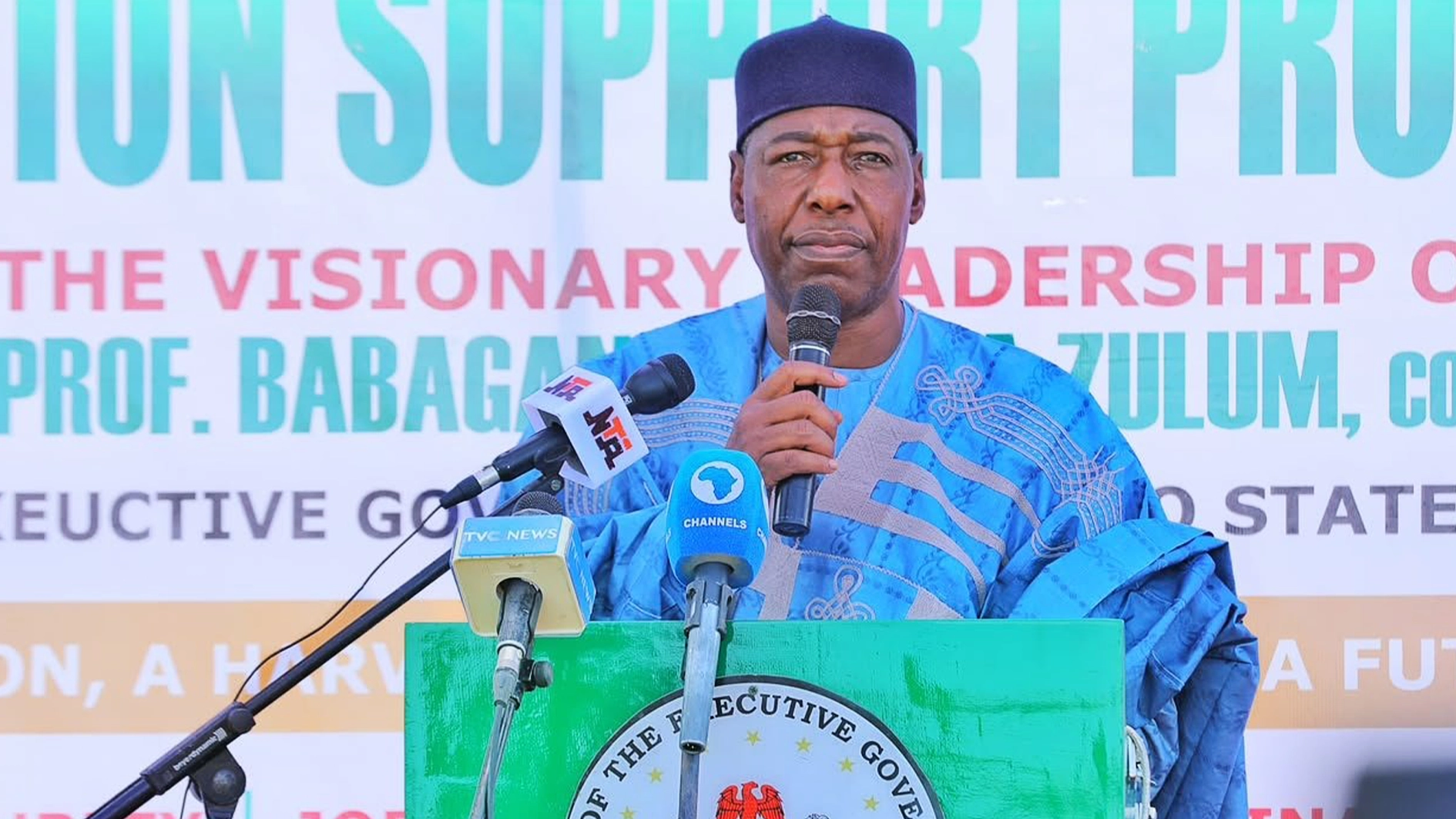
Having successfully closed the largest Bama camp for internally displaced persons (IDPs) in Borno State Governor Babagana Zulum is certainly on the path of restoring order in the post terrorism era. But the war is far from over, given that terrorists are still bent on inflicting harm on, and taking over peaceful communities forcefully. In the past, Nigerians liberated in that part of the country and handed back their communities were again forced to flee following continuous terrorists’ onslaught. This scenario should be avoided in this present effort.
Zulum, a professor, recently announced plans to close the camp at Konduga. The move follows the successful closure of Bama IDP camp and the planned shutdown of the Gwoza camp. There are enough good reasons that the IDP camps should be closed. Besides that, it is an aberration and blight on the state and on Nigeria; the camps, noted the governor, have become riddled with illegal activities and social vices.
Furthermore, IDP camps are, by all reasonable expectation, supposed to be a stopgap, temporary measure while authorities find, with a sense of utmost urgency, more permanent solutions to the situation. Alas, since the outbreak of the Boko Haram insurgency in 2009, other factors and interests have enlarged and complicated the problem of insecurity such that terrorists, motivated and supported by various causes, have exploited a containable, but poorly managed, north-east-centred problem to threaten the entire Nigerian space.
Reports in 2004 show that Nigeria, one of Africa’s leading economies, holds 3.4 million internally displaced persons, about 10 per cent of Africa’s 38.8 million IDPs.
It is understandable that, given the appalling conditions of the camps, Zulum wants the IDP camps closed and people to return to their homes to pick up the pieces of their lives. Indeed, his administration is known to have put in place the Borno State Strategy for Durable Solutions to Internal Displacement (2025-27), which is designed to solve short-term and long-term needs of displaced persons. The strategy is reportedly intended to dovetail into the Federal Government-conceptualised 2021 National Policy on Internally Displaced Persons.
While the efforts are noted, Zulum must demand the fullest assistance of the Federal Government and other local and foreign supporting bodies to ensure that his efforts to close the camps are permanent.

Several issues must be firmly addressed and laid to rest. On security, it is on record that, repeatedly, the IDPs have been attacked by the very terrorists who, in the first place, displaced them from their ancestral homes. The Internal Displaced Centre (IDC) reports that inadequate security leaves hapless citizens at the mercy of attacks by relentless terrorists. The peace required to assure the desire of the governor is largely beyond his state’s means. The three components of peace enforcement, peacekeeping, and peacebuilding require immense human and material resources. It can only be implemented in collaboration with institutions much bigger than the state government.
Also, reports indicate that many camps suffer overcrowding, food shortages, poor sanitation, limited access to health care, and inadequate school facilities for children. Furthermore, the victims face non-physical challenges such as psychological stress associated with prolonged displacement. All these have been corroborated too by research.
Akanni Olusola et al., writing in Social Science and Humanities Journal, Vol. 09, Issue 05, say, quoting from other works, that “Despite multiple efforts and commitment both nationally and internationally on policies that support displaced population in Nigeria, displacement management remains largely ineffective and overwhelming. Most IDP camps in Nigeria suffer from severe overcrowding, inadequate sanitation, poor healthcare services, and hunger…” Many displaced persons face persistent and prolonged displacement, as government-led settlement programs struggle to provide basic livelihood services and economic reintegration opportunities for them.
On healthcare and other social services, the scholars also noted that “Many IDP camps have limited medical facilities, leading to high rates of malnutrition, maternal mortality, and disease outbreak… Prolonged dwelling in displacement often results in adverse outcomes, including increased disease incidence, food insecurity, and mental health issues…”
The report also identified poor policy and implementation coordination among the various agencies supposed to alleviate the suffering of displaced persons. The study noted that “Nigeria’s displacement management is fragmented with overlapping roles among NEMA, NCFRMI and SEMAS leading to bureaucratic inefficiencies and delays. Corruption and poor accountability further hinder policy effectiveness”.
Relentless acts of terrorism against the people of Borno and elsewhere in Nigeria are also compounded by natural disasters. For example, late last year, the media reported that various parts of Nigeria suffered flooding that cost 232 lives and displaced 121,224 persons.
While countries including Nigeria have a duty to provide adequate humanitarian assistance to citizens in distress, IDPs often lack access to fundamental rights, limiting impact on internal displacement governance.
Therefore, far more needs to be done for IDPs. Notably, the Buhari administration approved a National Policy on Internal Displacement in September 2021. According to the then Minister of Humanitarian Affairs, Disaster Management and Social Development, Sadiya Umar Farouq, “the overall goal of the policy is to strengthen the institutional mechanism and frameworks for the realisation of the rights, dignity and well-being of vulnerable populations through mitigation of the impact and achievement of durable solutions to Internal Displacement in Nigeria”. The National Commission for Refugees, Migrants, and Internally Displaced Persons is also known to be working on what it terms ‘National Action Plan and Standardised Operating Procedure on Durable Solutions’.
All these policies and expressions of good intentions are well and good – as concepts, policy, and working documents. But the fundamental cause of displacement must be addressed frontally, honestly, and firmly. The hydra-headed insecurity in the land is a challenge that governments at all levels should advert their minds to. More so, Section 14(2)(b) of the Constitution provides that security and welfare of the people shall be the primary purpose of government. Therefore, the federal government must do everything within its powers to end the insecurity scourge in the land. This is one key justification for the continued existence of government at all. Indeed, that millions of Nigerians are trapped in IDP camps at all is a disgrace to the popularly acclaimed ‘giant of Africa’; it detracts terribly from the leadership of the Black race.
In his pre-2023 campaign manifesto to be elected as President, Bola Ahmed Tinubu devoted a substantial part of his ‘Action Plan for a Better Nigeria’ to security matters. He promised ‘peaceful communities, secure borders, and safe forests’. Three years into the job and despite noticeable efforts, communities are not peaceful, borders are not secure, and forests are far from safe.
The beginning of closing the IDP camps is the elimination by whatever means necessary of insecurity in the land. That is the purpose of government at all levels.

