 Follow Us on Google News
 Follow Us on Google Discover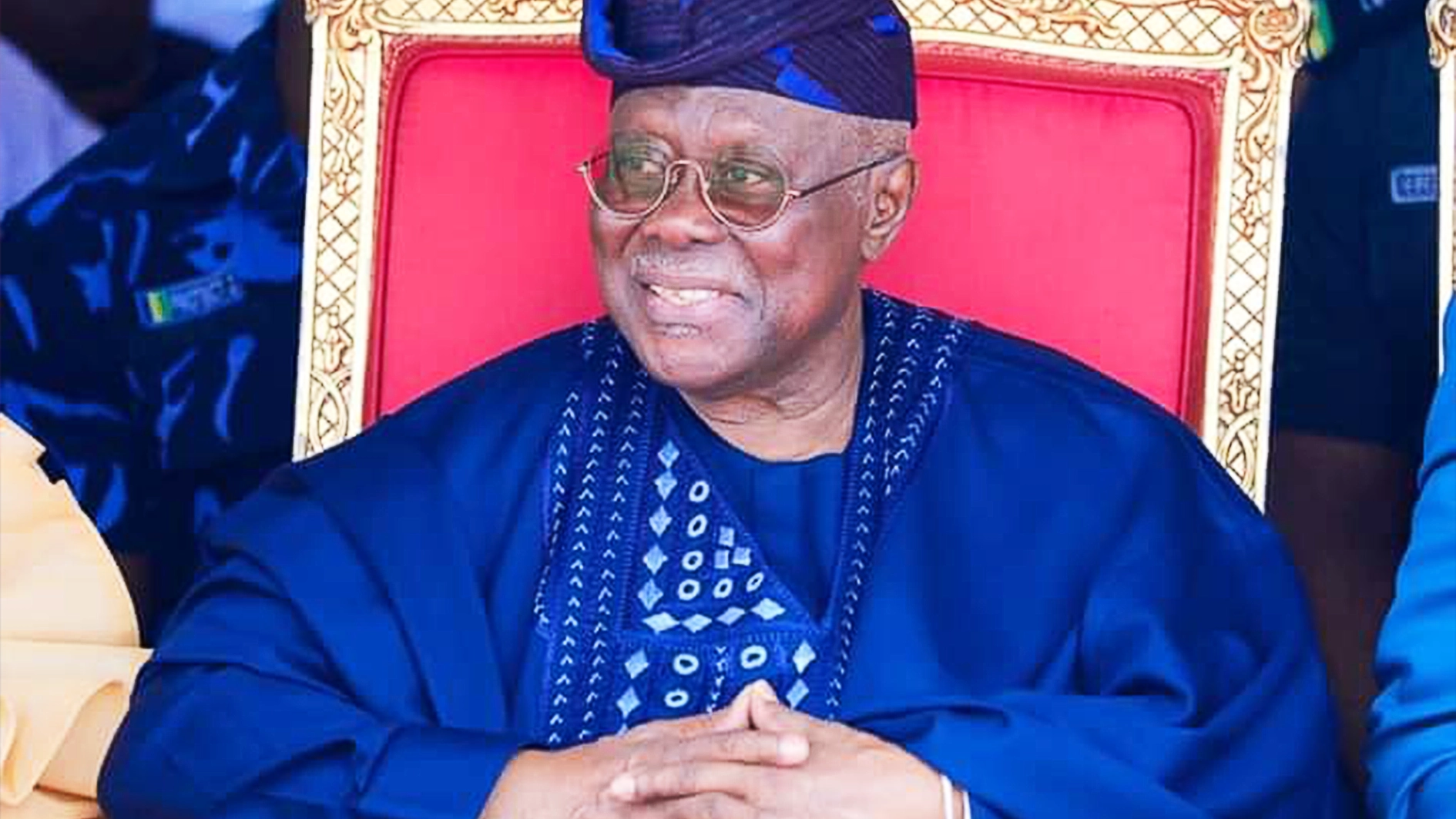
Elder statesman and former Deputy National Chairman of the Peoples Democratic Party (PDP), Chief Olabode George, spoke with KEHINDE OLATUNJI on Nigeria’s challenges of nation-building, political leadership, zoning and the need to place national interest above personal considerations.
After decades of nation-building, why has Nigeria continued to grapple with ethnic and religious divisions, and what are the underlying factors?
Over the years, we have experienced the good, the bad and the ugly. Politically, however, we have not progressed as much as we should. If 66 years of independence mean anything, Nigeria ought to be a much better and more attractive country today.
I grew up here. I was born and attended primary school on Lagos Island, so Nigeria helped to mould me. That is why I am deeply concerned about what is happening to the country.
Look at the hunger that is generating anger among the people, inadequate healthcare, and the challenges in education. Even the rich travel abroad for medical treatment. Our problems go beyond the economy. One of our greatest challenges is the failure to build a strong sense of nationhood that transcends ethnic, religious and regional identities.
Our First Republic failed partly because of the manner in which the British amalgamated the country without sufficient consideration for the different peoples, cultures and political systems. Before independence, most political parties were also largely organised along regional and ethnic lines.

The military intervened, but the fundamental problems remained. Minorities were often excluded, while successive political leaders exploited ethnic and religious sentiments for political advantage. Instead of allowing citizens to compete on the basis of ideas, competence and programmes, politics has too often revolved around where a person comes from or the religion he or she professes.
We have also failed to build institutions that inspire equal confidence among Nigerians. When people believe that access to political power, appointments, resources and opportunities depends on their connections, ethnic background or religion, they naturally retreat into their communities for protection and patronage.
Poverty, insecurity and inequality have worsened the situation. When people are hungry, unemployed or feel excluded, politicians can more easily mobilise them along ethnic and religious lines. Historical grievances and mutual suspicion have also remained unresolved.
We need a genuine sense of nationhood in which every citizen feels a sense of belonging. That was why the late former Vice President Alex Ekwueme and other political leaders, popularly associated with the G14, brought people from different parts of the country together to develop a new political arrangement.
Former governor of old Oyo State, Chief Bola Ige; Abubakar Rimi of Kano; Chief Solomon Lar of Benue; Professor Jibril Aminu and others discussed how to prevent another military intervention and promote national cohesion.
They developed the idea of six geopolitical zones: North-West, North-Central, North-East, South-West, South-East and South-South. The objective was to ensure that every part of the country had a sense of belonging and that no region felt permanently excluded from the political process.
The PDP built on this principle and emerged as a party with a strong national presence. Its zoning arrangement sought to balance political power between the North and South, recognising our diversity while encouraging different parts of the country to work together.
Even the All Progressives Congress (APC), despite initially distancing itself from zoning, adopted a similar approach to balancing key positions. President Bola Tinubu is from the South, the Vice President is from the North, the Senate President is from the South, and the Speaker of the House of Representatives is from the North.
The idea was to address tribalism and religious bigotry while strengthening national unity. However, political balancing alone cannot solve our problems. We must build institutions that treat citizens fairly, provide equal opportunities and protect everyone, regardless of ethnicity or religion.
Above all, we must reach a point where being Nigerian means more to us than being Yoruba, Igbo, Hausa, Fulani, Christian or Muslim. Until we deliberately promote that consciousness through our institutions, education system and leadership, ethnic and religious divisions will continue to undermine nation-building.
Why has the vision of national integration been difficult to sustain?
The greatest problem has been selfishness and personal ambition. People have increasingly placed individual ambitions above the broader objective of nation-building.
For the sake of peace and our love for Nigeria, why can’t political leaders put the country first? This failure has contributed to the crisis in the PDP and affected our politics generally.
I have been away for about seven weeks and have had time to reflect on what has happened to Nigeria, a country once regarded as the Giant of Africa.
We must remember our history. Nigeria played a major role in the liberation of Southern Africa, particularly the struggle against apartheid in South Africa. I was in the Navy, and part of my federal civil servants’ salaries was deducted to support the liberation struggle. We also supported liberation efforts in Angola and Zimbabwe.
The speech delivered by former Head of State, General Murtala Muhammed, in Addis Ababa demonstrated Nigeria’s influence on the continent and beyond. We had crude oil, and we used the resources and influence it provided to support liberation movements and assert our position internationally.
Nigerians must wake up and decide what kind of country we want. Nation-building is not a 100-metre race; every generation must build on the achievements of the previous one.
What we need is a genuine commitment to nationhood, where loyalty to Nigeria comes before ethnic, religious and personal interests. That is how we can begin to rebuild the stable and attractive country Nigeria ought to be.
Nigeria was once known as the ‘Giant of Africa’. Given the challenges you have highlighted, has the country lost that status?
We must first understand how Nigeria acquired that status and why its influence has diminished over the years.
Nigeria earned the description “Giant of Africa” around the time of independence in 1960 because of its large population, vast natural resources, economic potential, and strategic importance. There was also an expectation that an independent Nigeria would provide leadership on the continent.
Over the years, the country demonstrated some of that influence through its foreign policy and interventions in Africa. However, we have struggled to translate our enormous potential into sustained development, good governance and improved living standards.
Nigeria was once the Giant of Africa. In virtually every profession, no matter how highly placed, you will find a Nigerian or someone of Nigerian descent recognised as an authority.
But when these people return home, what do they see? Consider their first impression at the Murtala Muhammed International Airport in Lagos. We have been carrying out repairs and renovations there for years. An airport is often a visitor’s first impression of a country. Compare ours with the airport in Accra. What is wrong with this country?
Those of us who have experienced both military and civilian rule have witnessed different phases of Nigeria’s history. We have seen the effects of military rule on governance, but we also experienced the camaraderie among those who served together. That bond made us solid like gold.
Today, Nigeria is grappling with banditry and insecurity. The first responsibility of any government is to guarantee the safety of its people and territory. When a government cannot adequately protect its citizens, it raises serious questions about its capacity to fulfil one of its most fundamental duties.
We are also witnessing the emergence of a generation of young people involved in criminal activities. I am told that some parents even send their children to what they call “Yahoo School”. That is a disturbing direction for the country.
In my time, such behaviour would not have been tolerated. Today, however, we hear of young people becoming involved in Internet fraud and other criminal activities. Visit Panti Police Station and see some of the young people who get into trouble.
When I reflect on these developments, I think about what I would call our own Route 66. In America, Route 66 became an important symbol of the country’s history and development.
Nigeria is at a similar crossroads. We must ask ourselves where we are heading as a nation and what we must do to reclaim our standing in Africa and the world.
Would you blame Nigeria’s current predicament on leaders who place personal ambition above national interest? How is this affecting zoning and political stability?
Yes! Nigeria is bigger than any individual, and political leaders must be willing to subordinate personal ambition to national interest.
I believe zoning, as advocated by the late Alex Ekwueme and the G14, should be constitutionally recognised to help manage Nigeria’s ethnic, regional and political interests. When politicians disregard established agreements to pursue personal ambitions, they undermine trust and threaten national cohesion.
Consider Ekwueme, who aspired to become president but did not abandon the party when his ambition was not realised. I also once aspired to become party chairman, but I stepped aside when I realised that pursuing my ambition could divide the party. That is the kind of sacrifice Nigeria needs today. No individual’s ambition should take precedence over the country’s unity, stability, and national interest.
With the 2027 election approaching, what is your advice to former Vice President Atiku Abubakar and other politicians seeking the presidency?
Atiku is pursuing a personal ambition rather than putting the nation’s interests and goodwill first. There should be an open debate among the presidential candidates, and Atiku should be asked: “What exactly are you running for? You have contested several presidential elections. Must it always be you?”
This is a country of more than 200 million people. Every election cycle, you come forward to say you want to be president. What exactly are you looking for? You have had your opportunities.
I appeal to the Arewa Consultative Forum to call him to order and preserve the organisation’s respectability. He should graciously accept that enough is enough. If he does so, people will remember him for taking the right decision at the right time.
Let the competition for the presidency remain in the South for now. By 2031, when someone from the North comes forward to contest, I will be happy to lead the campaign.
Brilliant young people in the North should begin preparing themselves. Many have respected the existing arrangement. How many have come forward to insist that they must become president now? Let us allow peace to prevail in this country.
What should President Bola Tinubu do to reduce political tension and address the growing hardship among Nigerians?
I am advising the President because the buck stops at his desk. Political manoeuvrings and complicated conspiracies are not helping him or the country.
He must act in the national interest. My advice to the Commander-in-Chief is simple: get rid of those holding him back. He does not need them.
Look at the millions of Nigerian children going hungry. It is painful. I commend Nigerians for remaining calm, but their silence should concern those in authority. It should serve as a warning.
Those in government must do what is just before Almighty God and right before the people. The consequences of continued political tension could be unimaginable.
We remember the crisis in the Western Region, particularly the events in Ibadan in 1962, and the chain of events that eventually contributed to the Civil War. We do not want a repetition of our history. We must learn from it.
Aso Rock is the people’s house; it is not a private enterprise. The people’s votes put the President there, and he must govern in their interest.
The welfare of Nigerians must remain at the centre of governance. People want security, food, jobs, education, healthcare and an economy that allows them to live with dignity. Let goodwill return and reign in our nation. I beg and plead with those in authority to do what is right.
At 81, what do you consider your responsibility to Nigeria at this stage of your life?
I have experienced different phases of Nigeria’s history, from military to civilian rule. I have seen the country exercise enormous influence in Africa, and I have also witnessed the decline in public confidence in our institutions.
At 81, I am already in the departure lounge, so to speak. As long as God gives me the strength to live, whenever I see something wrong in this country, I will speak out, draw attention to it and warn those responsible.
Nigeria still has enormous potential. We have brilliant young people, abundant resources and the capacity to become a great nation. But we must stop allowing ethnic, religious and personal interests to undermine the larger national interest.
The only thing I owe this nation at this stage of my life is to speak truth to power.

