
 Get Guardian on Google
By Oluwafemi Adekoya
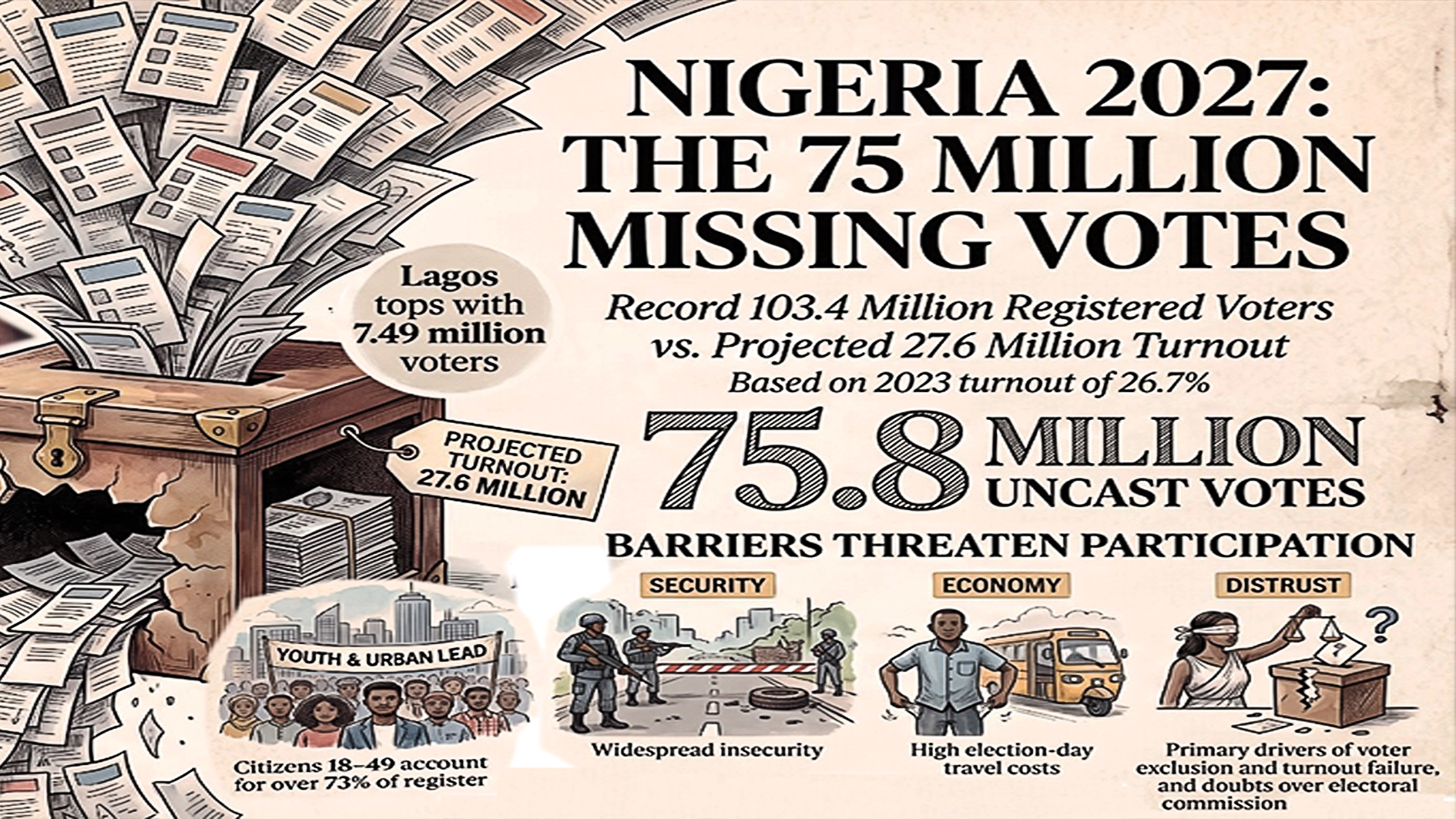
Nigeria enters the 2027 general elections with a paradox: an electorate that keeps expanding on paper, but one that has increasingly stayed away from the ballot box. The 2026 voter register now stands at 103,428,715 people (might be lower if AI incursion is addressed)—about 10 million more than before the 2023 elections—yet turnout in recent off-cycle polls has sometimes fallen below 15 per cent. The question is therefore not whether Nigerians care about their country, but whether they will believe that voting is safe, worthwhile and capable of producing change.
Earlier this month, Americans, during the 2026 midterms, turned out in near-record numbers despite deep polarisation: at least 123.5 million people voted, or 49.1 per cent of the voting-eligible population, the second-highest midterm turnout since 1914. It is apparent that citizens do not necessarily withadraw from politics when they are angry; they may vote precisely because they want to punish, reward or redirect power.
Nigeria must learn the constructive part of that lesson: credible institutions, secure polling environments and parties that mobilise rather than intimidate can convert frustration into participation. But it must reject the destructive part—normalised threats, inflammatory speech and violence—which is already threatening to depress turnout in 2027.
Nigeria’s turnout trajectory is alarming. In 2011, 53.68 per cent of registered voters participated in the presidential election; by 2015 it was 43.65 per cent, in 2019 it was 34.75 per cent, and in 2023 only 26.71 per cent. In practical terms, fewer than three in 10 registered voters cast a ballot in the last presidential election. There are concerns that the number may sink lower in 2027.
The 2023 figure was even starker in absolute terms: more than 93 million Nigerians were registered, but just over 25 million voted—about 28.63 per cent. Voter turnout has declined almost continuously since 2007, despite repeated increases in registration.
If the 2023 participation rate were mechanically applied to the new register, roughly 27.6 million people would vote in 2027, leaving about 75.8 million registered voters without a recorded vote. That is not a forecast; political campaigns, security conditions and electoral credibility can change outcomes. But it illustrates the scale of the democratic deficit Nigeria faces.
Recent state elections confirm that registration does not equal participation. Turnout in eight off-cycle governorship elections ranged from about 10.2 per cent in Anambra in 2021 to 43.2 per cent in Osun in 2026. Even in Osun, the best-performing example, more than half of registered voters did not cast a recorded vote.
Why Nigerians shun the polls
It is easy—and often unfair—to describe low turnout as apathy. Many Nigerians are not indifferent; they are discouraged, excluded or afraid.
The 2023 experience exposed logistical failures that directly discouraged voters. Election materials arrived late in some places, causing people who had waited for hours to leave polling units. The European Union observer report also found that public confidence fell after information gaps, security and logistical lapses, and the failure to make presidential results publicly accessible on INEC’s IReV portal.
Economic hardship adds another barrier. Transport costs, lost daily earnings and long distances to polling units can make voting expensive for citizens already struggling with inflation and insecurity. Many Nigerians see spending a full day travelling to and waiting at a polling unit as a civic act they can do without.
There is also a crisis of trust. Citizens who believe elections will not change governance, that results may be manipulated, or that complaints will not be fairly addressed have little reason to brave queues, heat, transport costs and possible danger. Various analyses of the 2023 election identified weak voter education, poor logistics, doubts about INEC’s capacity, election violence and disillusionment with the state as major reasons for low participation.
Today, the most urgent threat to 2027 elections is the rising use of violence and violent rhetoric as political tools, followed by AI abuse. This is not merely a security problem for the police; it is a direct attack on the right of citizens to choose freely.
Since campaigns for the 2027 elections began on August 19, 2026, there have been reported attacks on political convoys and party secretariats, disruptions of rallies and meetings, and intimidation of political opponents and supporters. The National Peace Committee recorded 109 breaches of the National Peace Accord across 26 states and the Federal Capital Territory in just 10 weeks.
The numbers are grim. Between January 1 and October 27, 2026, monitors recorded 70 physical election-related attacks across 19 states and the FCT, resulting in 27 deaths in 20 incidents. These are not abstract statistics; each death, injury and destroyed campaign vehicle narrows the space in which citizens can organise, campaign and vote.
The pattern is bipartisan and nationwide. Reports have documented attacks or disruptions involving supporters of the Nigeria Democratic Congress, African Democratic Congress and Peoples Democratic Party in states including Enugu, Benue, Delta, Edo and Sokoto. In November 2026, suspected political thugs attacked NDC supporters in the Oregun area of Lagos.
CDD-West Africa’s Election Security Tracker found that although overall security incidents fell by 22 per cent in October, election-specific incidents rose by 14 per cent, from 14 to 16. Eleven of those 16 involved direct attacks on campaign gatherings or convoys, producing two fatalities in Enugu and Ebonyi, injuries, destroyed vehicles and restricted political assemblies.
Violent rhetoric compounds the physical danger. Threats, ethnic and religious baiting, misinformation and intimidation can make citizens retreat before a single stone is thrown. The National Peace Committee reported that 57 of the 109 recorded breaches—52 per cent—did not involve physical attacks, but involved intimidation, misinformation, restrictions on expression, divisive rhetoric and voter inducement.
This matters because violence can achieve its political objective even when it does not determine the result. A voter in a community affected by banditry, insurgency or communal conflict may decide that going to a polling unit is simply too dangerous and will choose safety over civic duty. After all, the dead cannot vote. Displaced people may be far from their designated polling units. Electoral officials may also become reluctant to serve in volatile areas.
The U.S. midterms demonstrate that high turnout is possible even in a divided society. Americans did not vote because politics had become calm or consensus had broken out; they voted because the stakes were clear, parties mobilised intensely and citizens believed their choices could alter the balance of power. Democrats won control of both chambers of Congress, while turnout reached 49.1 per cent of the voting-eligible population.
The lesson for Nigeria is not that Nigerians should copy American campaign style. It is that political competition can be vigorous without becoming violent. Parties can disagree sharply over the economy, security, corruption and federalism while still protecting opponents’ right to campaign. Governors can become more tolerant of opposition campaigns.
The U.S. election also shows the value of institutional resilience. Despite a highly contentious political environment, Americans could participate through established electoral machinery, and the result produced a clear shift in congressional power. Nigeria’s challenge is to make its own institutions similarly dependable: timely distribution of materials, transparent result management, accessible polling units and rapid response to complaints. All eyes are already on INEC, notwithstanding the very low expectations they have of the umpire.
Nigeria cannot afford to treat polarisation as a campaign strategy. When political identity becomes ethnic, religious or regional warfare, violence becomes easier to justify and harder to contain. Nigeria still has time to prevent 2027 from becoming another election of abandoned polling units and fearful citizens. The response must begin now, not in the final days before voting.
First, INEC and security agencies should conduct an early security and voter-access audit. They should identify local government areas where insurgency, banditry, kidnapping, communal tension or past electoral violence could prevent citizens from reaching polling units. Security plans should be threat-based, with clear command structures, rapid-response teams and protection for voters, officials and transport routes.
Second, political parties must be held accountable for the conduct of their agents and supporters. Candidates should publicly condemn attacks, dismiss aides who incite violence and cooperate with investigations. The National Peace Committee’s call for enforceable peace commitments is sound: peace accords must not end at a photo opportunity.
Third, INEC must rebuild confidence through transparency. Nigerians should be able to follow the process from accreditation to result collation without confusion. The failures around IReV in 2023 damaged trust; the commission cannot allow a repeat. Voter education must also move beyond slogans and reach communities through local radio, community leaders, markets, motor parks and languages people actually understand.
Fourth, the state must distinguish apathy from exclusion. Urging citizens to “come out and vote” is insufficient where roads are unsafe, polling units are inaccessible or displaced voters do not know where to vote. Lawful, transparent arrangements for internally displaced persons and hard-to-reach communities are essential.
Finally, political leaders must stop treating inflammatory rhetoric as harmless mobilisation. Words that portray opponents as enemies, foreigners, traitors or religious enemies can become permission slips for thugs. The National Orientation Agency’s plan to work with INEC, security agencies, the media and community structures across all 774 local government areas is welcome, but it must be matched by consequences for those who incite or finance violence.
Nigeria’s 103.4 million registered voters represent an extraordinary democratic opportunity. But numbers alone will not save the election. If insecurity, economic hardship, logistical failure and political violence persist, 2027 could produce another record register and another disappointing turnout.
The U.S. midterms are a reminder that citizens will show up when they believe participation matters. Nigerians will show up when they can travel safely to polling units, trust the process, see credible results and believe that their vote can change their lives. The burden lies not only with voters, but with INEC, security agencies, political parties, candidates, traditional institutions, civil society and the media.
Democracy is not sustained by registration figures. It is sustained by citizens who feel safe enough to vote, confident enough to believe their ballots count, and respected enough to campaign without fear. Nigeria’s 2027 election will test whether the country can move from a democracy of registered voters to a democracy of participating citizens.