
 Get Guardian on Google
Ahead of the 2027 general election, concerns are mounting over how eligible Nigerians living with disabilities can access the polling booths and exercise their voting rights independently, writes GBENGA SALAU.
For some Nigerians, voting on Election Day begins with a journey that has little to do with the ballot itself. It begins with the question of whether they can physically reach the polling unit, enter the voting area, understand the instructions, communicate with election officials and, ultimately, cast their votes privately and independently. For millions of Nigerians living with disabilities, these seemingly ordinary steps can become significant barriers to political participation.
Nigeria has made considerable progress in recognising the rights of persons with disabilities (PWDs) to participate in elections. The legal framework has evolved; the Independent National Electoral Commission (INEC) has established structures dedicated to disability inclusion, and assistive voting materials have increasingly become part of electoral planning. However, away from the policies and programmes on paper helping to promote inclusiveness, PWDs are voicing their concerns as the 2027 elections beckon.
For Kemi Odusanya, a visually impaired person, though she did not vote in the last general election, her experience in the 2019 elections was not a bad one.
“I did not vote in the last general election but I voted in 2019. I went to my polling unit and I was attended to, though there was no Braille ballot paper, which could pose a challenge to some other persons,” she said.
She, however, stated that PWDs face some negativity while trying to vote during elections. She listed them to include inaccessible polling units, noting that a little person or dwarf could face the challenge of a higher table, while a deaf person could have communication issues because many of the election ad hoc staff cannot communicate with sign language.

“A visually impaired person would need a trusted sighted person because not all sighted people can use Braille. And you can imagine the visually impaired person telling the assistant that he wants to vote for AZ party and the assistant thumbs at AU party.
“For a physically impaired person, standing in a queue for a long time could negatively affect their health,” Odusanya said.
While she has some pleasant personal experiences to share, that is not the case with the Executive Director of Sussan’s Unique Oasis Foundation (SUOF), Sussan Kelechi Ihuoma. A physically challenged person, Ihuoma also did not vote during the last general election but she voted during the 2019 general election. She, however, said she had a cumbersome experience while voting during the 2019 elections because her polling unit was far from her house.
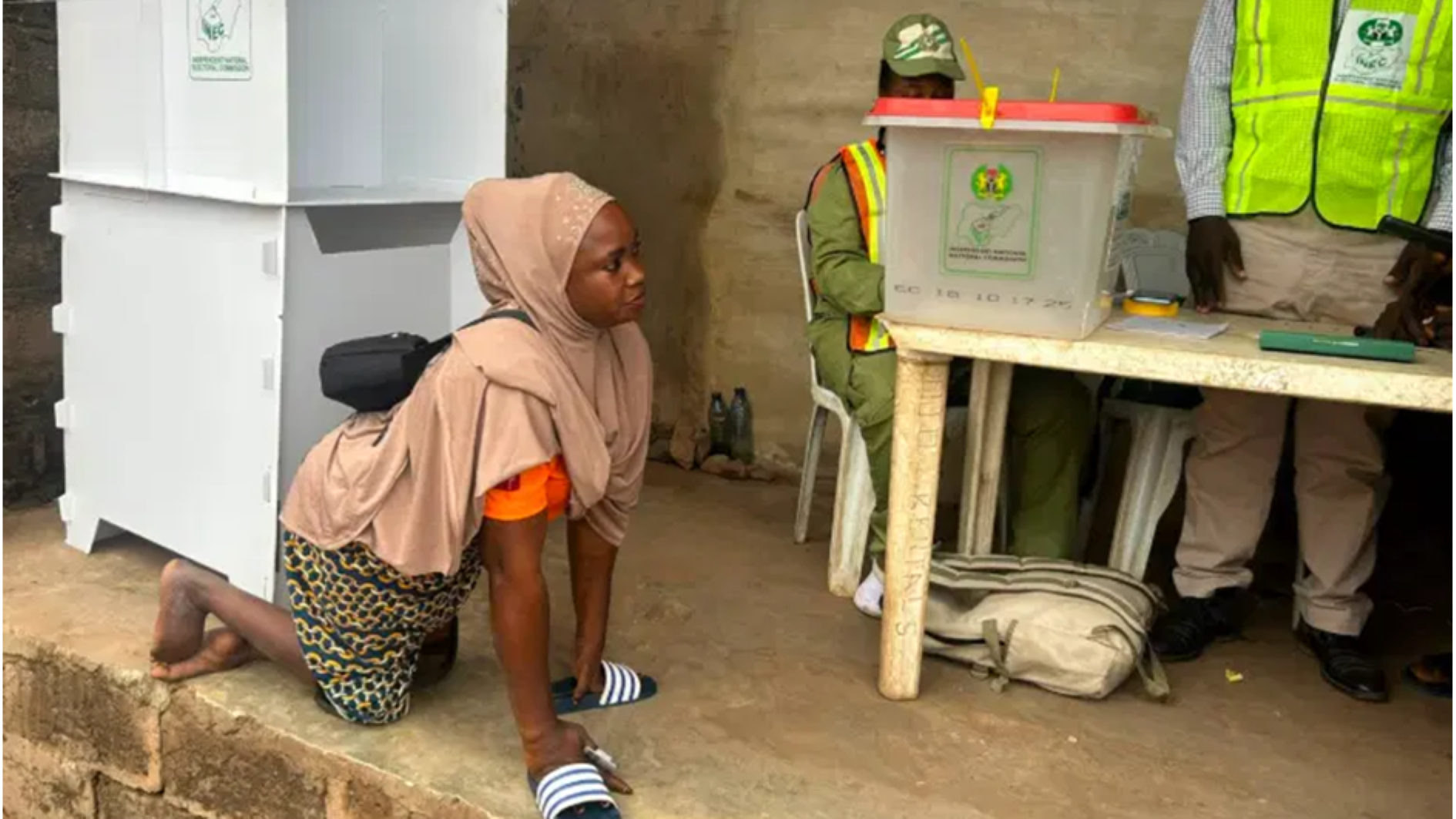
Ihuoma, who is the Vice Chairman of Joint National Association of Persons with Disabilities, Federal Capital Territory, Abuja, further said: “As a person with physical disability, getting to the polling unit was stressful aside from the fact that the voting area was not easily accessible. Out of the two elections, I only participated in the first; I could not participate in the second because I did not have the strength to repeat the experience.”
She also said that attitudinal barriers that PWDs face during elections are often less talked about. “This is one of the less visible barriers. A PWD may encounter people who assume they cannot understand the voting process; speak to their companion instead of speaking directly to them; treat them as objects of pity; question why they came to vote; assume someone else should vote on their behalf; touch or move their wheelchair without permission. These experiences can make a voter feel that the polling unit is not a place where their citizenship is respected,” she said.
On how these barriers discourage PWDs from voting, Ihuoma noted that disenfranchisement does not always look like someone being physically prevented from voting.
“Sometimes it looks like a person deciding not to attempt the journey at all. The thought process can become: ‘last time I went there, there was no ramp’; ‘I can’t stand in that queue for four hours’; ‘who will take me there?’; ‘what if the polling unit isn’t accessible?’; ‘what if I get there and they don’t have the assistive device?’; ‘what if people embarrass me again?’; ‘maybe my one vote isn’t worth all this stress.’ That is how an accessibility barrier becomes a participation barrier.”
Ihuoma argued that the conversation should move beyond “can PWDs vote to can every person with a disability get to the polling unit, enter it, understand the process, vote independently or with appropriate support, and leave with their dignity intact?”
The TAF Africa post election report on the recently held Osun State governorship election provides some insight about accessibility for PWDs during elections. TAF Africa in its report stated that election-day observation across 150 polling units showed encouraging progress in disability inclusion, with 94.3 per cent of polling units assessed as physically accessible, priority voting recorded in 91.9 per cent of cases, and 95.3 per cent reporting no harassment of PWD voters.
It added: “The provision of assistive devices was particularly weak. Braille ballot guides were available in only 22.76 per cent of observed polling units, while 77.24 per cent had no Braille ballot guide. Magnifying glasses were available in just 5.69 per cent of locations, leaving 94.31 per cent without them. Large-font graphic posters were provided in 35.77 per cent of polling units, while 64.23 per cent lacked this form of accessible information. These gaps indicate that physical access to polling units does not necessarily guarantee an equally accessible voting experience for persons with visual or other disabilities.”
Thus, more than a decade after disability advocates began pushing for more inclusive elections, questions remain about what happens when the policy meets the polling unit. Is a polling unit truly accessible simply because a wheelchair user can enter it? What happens to a blind voter who cannot independently identify where to mark the ballot? What happens to a deaf voter who cannot access verbal instructions? And how many eligible Nigerians with disabilities stay away from the polls because the journey to the ballot box is too difficult, unsafe or uncertain?
These questions have become increasingly important as Nigeria approaches the 2027 general election.
Dr. Adebukola Adebayo, a specialist in disability-inclusive development, governance and public policy, who has spent almost two decades working on electoral inclusion, said the country had come a long way since the early years of the Fourth Republic, but the progress should not be mistaken for full inclusion.
“I have been working on election issues since 1999, and we can see a lot of remarkable improvement,” Adebayo said.
He identified three major areas of progress: greater awareness of disability inclusion within INEC, the establishment of a legal framework supporting the participation of persons with disabilities, and the creation of governance structures within INEC to address disability issues.
The Electoral Act 2022 contains specific provisions on the participation of persons with disabilities and other vulnerable voters. Section 54 requires INEC to take reasonable steps to assist persons with disabilities and other vulnerable groups to vote. The law provides for voting arrangements and materials that can accommodate different disabilities, including Braille and large embossed print, electronic devices and sign-language interpretation. It also provides for assistance to voters who require help because of disability.
For Adebayo, who is visually impaired, the real test is not whether such provisions exist in the law but whether they enable a voter to participate independently and in secrecy. That represents a significant shift from the way disability inclusion was approached during earlier elections. According to Adebayo, much of the advocacy around the 2015 general election focused on what was known as priority voting.
“Persons with disabilities, older people, pregnant women and other vulnerable voters were encouraged to be allowed to vote ahead of others in the queue,” he recalled.
But while priority voting reduced the physical burden of waiting in long queues, it did not necessarily solve the deeper problems confronting voters with disabilities. For instance, a visually impaired voter could be allowed to vote first and still be unable to mark the ballot independently. Without an appropriate assistive device, the voter may have to rely on another person to guide him or her through the process. That raises the issue of ballot secrecy.
Adebayo pointed out that an assistant, even a spouse or close relative, could have a political preference different from that of the voter. He therefore said a person with a disability could technically cast a ballot but not enjoy the same degree of privacy and independence as another voter.
It was this realisation that pushed the conversation beyond priority voting. “Since 2018 when INEC developed its Disability Framework, we have shifted from just Priority Voting to issues around Accessible Polling Units,” Adebayo said.
He said the objective became broader: to ensure that persons with disabilities could reach polling units, understand the voting process, access appropriate materials and cast their ballots independently.
But another problem soon became apparent: data. For INEC to provide appropriate assistive materials, it needs to know where voters who require those materials are located.
For instance, a blind voter may require a Braille ballot guide. A voter with low vision may require a magnifying device or larger print. A deaf voter may need accessible information or communication support. A person with mobility impairment may require an accessible route to the polling unit. These materials cannot simply be distributed randomly across the country.
Adebayo stated that for years, INEC’s voter register was not sufficiently disaggregated by disability to enable the commission to determine exactly where such materials were needed.
“The consequence was a logistical problem. INEC could not reasonably produce and deploy large quantities of every type of assistive device to every polling unit. It needed to know the location and type of disability of registered voters so that resources could be targeted,” Adebayo added.
This problem remains central to the disability-inclusion debate. Data from the 2021/2022 Continuous Voter Registration exercise analysed by TAF Africa identified 85,362 registered voters with disabilities. They included 21,150 persons with albinism; 13,387 with physical impairments; 8,103 with visual impairments and 6,159 with hearing impairments, alongside voters with autism, little stature, cognitive or learning disabilities, spinal cord injuries, Down syndrome and other disabilities.
he figure is significant, but it does not represent the total number of Nigerians living with disabilities. Citing National Population Commission data, TAF Africa has put the number of Nigerians living with disabilities at 19 million.
The contrast raises a question Nigeria’s electoral system has yet to answer conclusively: how many eligible Nigerians with disabilities are actually registered to vote and how many of those registered voters eventually participate?
Founder and CEO of TAF Africa, Dr. Jake Epelle, said election-related research has traditionally focused on whether polling units are accessible rather than on understanding why eligible persons with disabilities fail to participate.
“The focus of election-related discussions has always been on accessibility for persons with disabilities, particularly physical accessibility,” Epelle said. “However, we need to widen the scope of that research and invest in understanding why eligible persons with disabilities did not participate in elections.”
His argument points to a major gap in Nigeria’s electoral statistics. Election authorities can count registered voters and votes cast; but there is no comprehensive national dataset showing how many eligible voters with disabilities failed to vote because of inaccessible polling units, insecurity, lack of assistive materials, transportation difficulties, poor communication or other barriers.
Adebayo said existing disability-focused election reports generally document whether polling units were physically accessible and whether assistive voting devices were deployed, adding that they do not adequately establish how many persons with disabilities were able or unable to vote.
“If you have not even captured my disability status in your voter register, your system cannot know whether I have come to vote or not,” he said.
This is one of the most significant blind spots in measuring electoral inclusion. The 2023 general election provides a useful illustration of the problem. TAF Africa observed 273 polling units during the election and found 234 or approximately 86 per cent accessible. Priority voting was observed in 211 polling units, approximately 77 per cent.
At first glance, those numbers suggest substantial progress but the picture changes when specific assistive materials are examined. Braille ballot guides were available in only 26 of the 273 polling units observed, approximately 9.5 per cent. Magnifying glasses were available in 60 polling units, about 22 per cent, while large-font posters were available in 90, approximately 33 per cent.
The figures show why the term “accessible” requires careful interpretation. A polling unit may have a relatively accessible physical entrance while still failing to meet the needs of a blind voter. It may have a ramp but lack accessible information. It may allow priority voting but provide no assistive device to enable an eligible voter to mark the ballot independently.
Epelle said Nigeria should therefore move away from treating accessibility as simply a question of whether a wheelchair can enter a building.
“I would not say that polling units are absolutely accessible. There has been some remarkable improvement, but we are still struggling with achieving accessibility,” he noted.
He described accessibility as a combination of physical, informational and procedural requirements, saying a voter must be able to arrive at the polling unit, enter the premises, understand the process, communicate with election officials, cast a secret ballot independently and leave with dignity.
Therefore, physical accessibility must go beyond providing a road to a polling unit. In some locations, voters encounter open gutters, uneven ground, steps or narrow pathways. In other cases, a small plank may be placed across an open gutter as an improvised crossing.
For an able-bodied voter, such an arrangement may already be uncomfortable or risky. For a wheelchair user or person with mobility impairment, it can make voting practically impossible. The problem is complicated by the fact that INEC does not own many of the buildings used as polling locations. Polling units may be situated in schools, public buildings and other facilities that were not designed to meet modern accessibility standards. But this does not mean that nothing can be done.
Epelle argued that accessible pathways should be provided where possible. “Where a polling location remains inaccessible, arrangements could be made to bring the voting process to an accessible point where the voter can participate without compromising the integrity of the election,” he said.
Adebayo, meanwhile, believed that the first step should be a systematic accessibility audit. To him, INEC already has detailed information on the location of polling units.
“Ahead of the 2023 general election, the commission reported that it had geographically located all 176,846 polling units and captured their coordinates as part of its mapping and geographic information system.
“That information could be used to conduct a nationwide accessibility assessment. Every polling unit could be assessed to determine whether it has an accessible entrance, whether voters can reach it safely, whether the voting area can accommodate wheelchair users, whether information is accessible to blind and deaf voters, and whether the required assistive devices can be deployed,” he said.
Adebayo also believed such an exercise should take place before the 2027 elections, stressing that the role of election officials must also be examined.
He, however, said INEC has included disability-inclusion issues in training materials for ad-hoc election officials, disclosing that he participated in some of the training programmes.
But can training alone cannot solve an infrastructure problem? “If you train someone and the materials that will support that person are not there, or where the polling unit is sited is not physically accessible, there is almost very little the polling officers can do.
“A presiding officer cannot simply relocate a polling unit because the location is difficult for a voter with a disability. Polling units are already designated and mapped. This makes planning before Election Day crucial.
“If INEC knows in advance that a particular polling unit is inaccessible, it can identify an alternative arrangement or make modifications before voters arrive. The same principle applies to assistive devices.”
Adebayo proposed that the National Commission for Persons with Disabilities (NCPWD) should strengthen the issuance of disability certificates, while INEC should use the Continuous Voter Registration process to verify and capture voters’ disability status. More importantly, he said INEC should capture the type of disability and the specific assistance required, which would give the commission a much clearer picture of its logistical responsibilities.
“If a polling unit has blind voters, it would know how many Braille guides may be required. If it has voters with low vision, it could determine the need for magnifying devices or large-print materials. If deaf voters are registered there, appropriate communication arrangements could be made,” Adebayo said.
He stated that the approach would also make the deployment of electoral resources more efficient.
But will better data address another major factor keeping voters with disabilities away from polling units: insecurity.
For Epelle, persons with disabilities may be particularly vulnerable to electoral violence because some may have difficulty escaping dangerous situations or accessing alternative transportation.
“When there is violence, a person with a disability or a visually impaired person will not want to risk his or her life,” Adebayo said. Epelle advocated discussions with security agencies around what he calls inclusive security: security planning that recognises the different vulnerabilities of voters.
Movement restrictions on Election Day can create another unintended barrier. Epelle said a person with a disability may depend on a family member, caregiver or driver to reach a polling unit.
“If movement is restricted, that support system may be disrupted,” he argued. “Restriction itself is a barrier.”
He said there is also the less visible barrier of information, noting that voter education is important for every citizen, but accessible voter education is particularly important for PWDs.
“Electoral information needs to reach voters in formats they can use. A deaf voter may require sign-language interpretation or accessible written information. A blind voter may need information in an accessible digital or audio format. People with visual impairments may require larger print, while voters with cognitive or learning disabilities may benefit from clear and simplified information.
“Poor communication can therefore prevent participation even when a polling unit is physically accessible.”
Epelle acknowledged that INEC has begun opening its communication channels to greater public engagement. He cited a recent opportunity to engage directly with an INEC official on air as an example of a changing approach to communication. But greater openness must be matched with accessible communication.
Epelle also argued that political parties, security agencies, civil society organisations and the media all influence whether voters with disabilities can participate.
“Political parties must ensure that their campaign and voter information reaches persons with disabilities. Security agencies need to understand their particular vulnerabilities. The media can help by reporting electoral information in accessible ways and by drawing attention to barriers that may otherwise remain invisible,” he advised.
Adebayo described PWD organisations as one of Nigeria’s most organised minority constituencies, with networks extending from national organisations to state and local government levels.
“These structures could help identify voters, disseminate information, encourage registration and support campaigns to update disability information in the voter register,” said.
For him, the foundations for inclusion are now largely in place: the law exists, INEC has a disability framework, disability desks have been established, election officials receive some training and the commission has demonstrated an increasing awareness of disability issues.
“What we need now is those two steps, and then the awareness campaign,” he said, referring to disability certification and the disaggregation of INEC’s voter register.
Attempts to get the INEC to comment on what it is doing differently going forward was not successful. A chat was sent to Mr. Dayo Oketola, the Chief Press Secretary of the INEC Chairman, asking two questions concerning the issue but he was yet to respond to them as at press time. The questions are: To what extent is INEC implementing measures to make elections more inclusive and accessible? What practical changes should INEC and other stakeholders make to ensure that no voter with a disability is left behind?