
 Get Guardian on Google
Bringing a powerful account of survival, accountability and the protection of vulnerable children to the forefront of public conversation, ‘A Tray of Locust Beans’ tells the story of a girl’s survival.
The story that began with the vulnerability of a thirteen-year-old girl and the intervention of people who refused to look away has found a new audience through cinema.
Drawn from a real case handled in Ekiti State, the film traces the importance of timely intervention and the people whose actions can alter the course of a young girl’s life.
Officially selected at the African International Film Festival (AFRIFF) 2026, the short film premiered by Lufodo Productions, in collaboration with Kinsman Studios at Film House, Landmark recently, places a deeply consequential social issue within a cinematic narrative that challenges audiences to confront the realities of sexual violence against children and the failures that often allow it to persist.
Based on a short story by renowned writer and gender advocate Mrs Bisi Fayemi, A Tray of Locust Beans follows Mabel, a thirteen-year-old girl who experiences sexual abuse and an ensuing pregnancy, navigating a system that too often fails children in vulnerable circumstances.
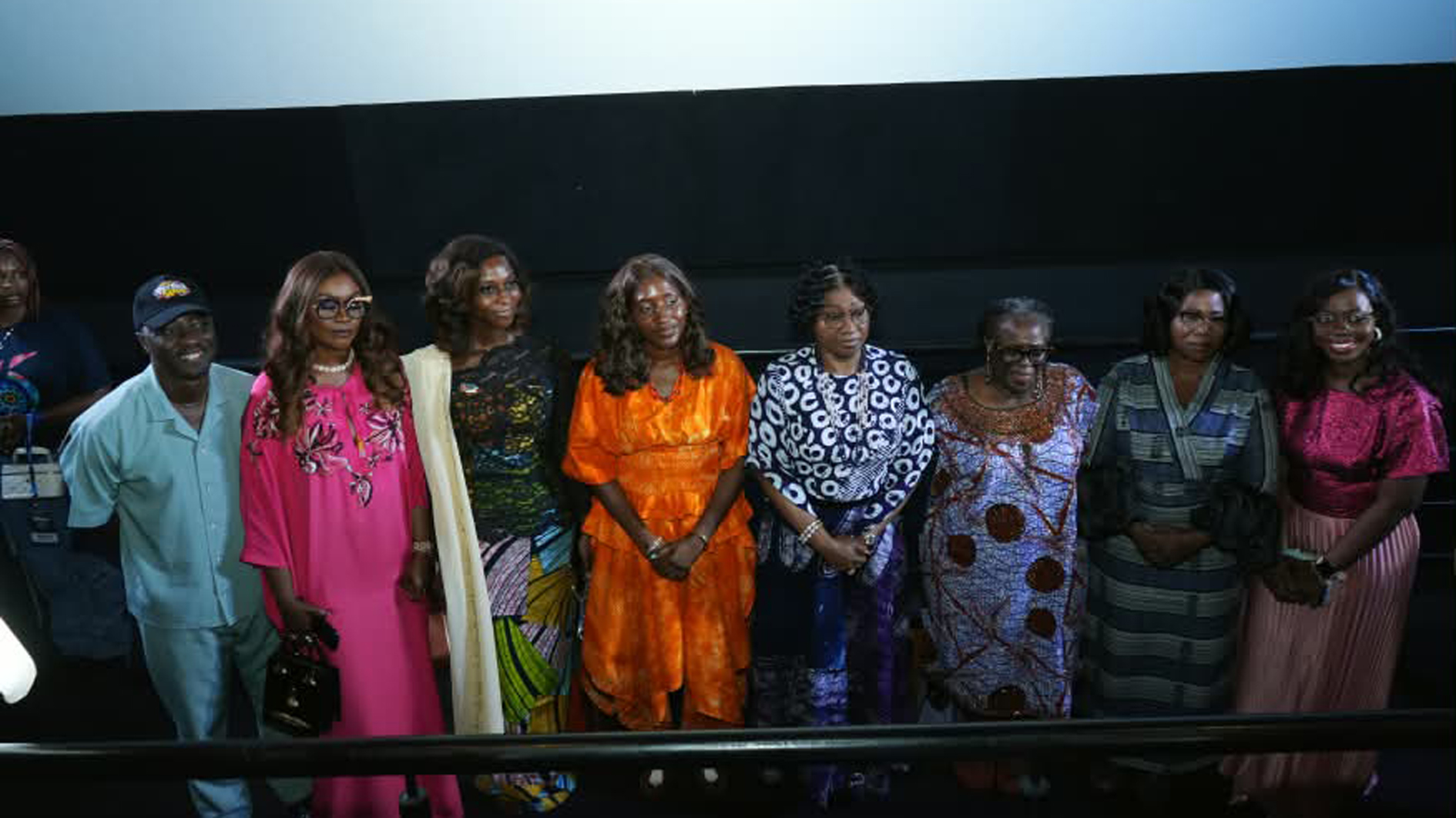
The premiere, which opened with a red-carpet reception before an exclusive screening and post-film panel discussion, attracted prominent voices from government, the development sector, gender advocacy and the Nigerian creative industry to confront child sexual abuse, institutional responsibility and the power of storytelling.
Directed by Orobosa Ikponmwen, with a screenplay by Ololade Okedare and Ayobola Eniola, the film features Somachi Chilaka, Joke Silva and Korede Lawal. Executive Produced by Joke Silva, Soji Jacobs and Mrs Bisi Fayemi, the production brings together established creative talent and a story rooted in the urgent realities of child protection.
The screening was followed by a conversation hosted by veteran broadcast journalist and publisher of TW Magazine, Adesuwa Onyenokwe. The panel brought together Mrs Bisi Fayemi, Joke Silva, director Orobosa Ikponmwen, Barrister Rita Ilevbare, a lawyer and gender-based violence advocate who coordinates the Ekiti State Sexual Assault Referral Centre, and Mrs Titilola (Lola) Vivour-Adeniyi, Executive Secretary of the Lagos State Domestic and Sexual Violence Agency (DSVA).
At the heart of the conversation was a question that extended beyond the film: what happens when the institutions and individuals entrusted with protecting children fail to act?
Reflecting on the inspiration behind the story, Mrs Bisi Fayemi, whose work in gender and development spans more than 35 years, drew attention to the recurring cycle of neglect, violence and limited opportunities that can shape the lives of girls and their children when intervention comes too late. She emphasised that social change cannot be left to public office holders or policymakers alone.
“Not all of us will be a first lady. But there’s something that you can do to ensure that we break that cycle of violence and oppression.”
Fayemi who urged individuals to recognise the responsibility that comes with the positions and platforms they occupy hopes the film will get people thinking about the roles they play based on where they are.
This captures the broader ambition of A Tray of Locust Beans: to make the protection of children a shared responsibility, rather than an issue left exclusively to advocacy organisations, government agencies or the families directly affected.
For Joke Silva, the decision to bring the story to the screen was driven by both its real-life origins and the possibility of a different outcome for the girl at its centre. Drawing attention to Mabel’s eventual academic achievement, she noted that the intervention she received was critical to ensuring that her circumstances did not define her future. “She was the best graduating student. Imagine if nothing had been done,” she said.
Director Orobosa Ikponmwen spoke about the creative intention behind the film, explaining that the camera remains closely aligned with Mabel throughout the narrative, allowing audiences to experience her journey from her perspective. For her, the value of the production lies in its ability to move viewers beyond observation and towards action. “I like stories that when you watch them, it drives action. It drives change,” she said.
The discussion also brought the conversation into the realm of institutional accountability and the practical mechanisms required to protect survivors.
Recalling the real-life case that inspired the story, Barrister Rita Ilevbare traced its origins to a petition in 2011 and the subsequent intervention of the then First Lady of Ekiti State.
She explained how the case contributed to policy developments and the establishment of the Sexual Assault Referral Centre, which she said has since served more than 630 women.
While acknowledging the importance of legislative progress, she stressed that laws must be supported by functional institutions, sustained resources and access to justice.
“Policy itself does not translate to justice, but it provides a foundation that gives us the basis to work,” Ilevbare said, while calling on the government to prioritise adequate budgetary provisions for survivor support services.
From Lagos State perspective, Mrs Titilola (Lola) Vivour-Adeniyi highlighted the existing child protection framework, including relevant laws, policies, Family Support Units and family courts. However, she noted that institutional fragmentation and weak coordination continue to undermine effective responses to abuse.
“We have the laws, we have policies, and we have institutions. But I think what is lacking is we need to strengthen those institutions,” she said.
She also encouraged members of the public to embrace a culture of reporting suspected abuse, emphasising that protecting children is a collective responsibility. Cases of domestic and sexual violence can be reported to the Lagos State DSVA through its toll-free line: 08000-333-333.
Among the distinguished guests at the premiere was former Governor of Ekiti State, Dr Kayode Fayemi.
Representing the Governor of Ekiti State, Mr Biodun Oyebanji, Prof. Rasaki Ojo Bakare, who recently served as Commissioner for Arts, Culture and Creative Economy, led a state delegation and conveyed goodwill from the government and people of Ekiti State.
In his remarks, he described the production as an example of how creative expression can advance social advocacy, noting that Mrs Bisi Fayemi had demonstrated that “advocacy can become art, and art can indeed become advocacy.”
The premiere also reinforced the importance of sustained collaboration between the creative industry, development organisations and the private sector in using storytelling to address social realities. Mrs Bisi Fayemi acknowledged the support of the Ford Foundation and called for continued investment in creative projects capable of advancing meaningful social change.
With its Lagos premiere concluded, A Tray of Locust Beans now proceeds to its scheduled festival screenings at AFRIFF 2026, carrying its message to wider audiences.