 Follow Us on Google News


 Follow Us on Google Discover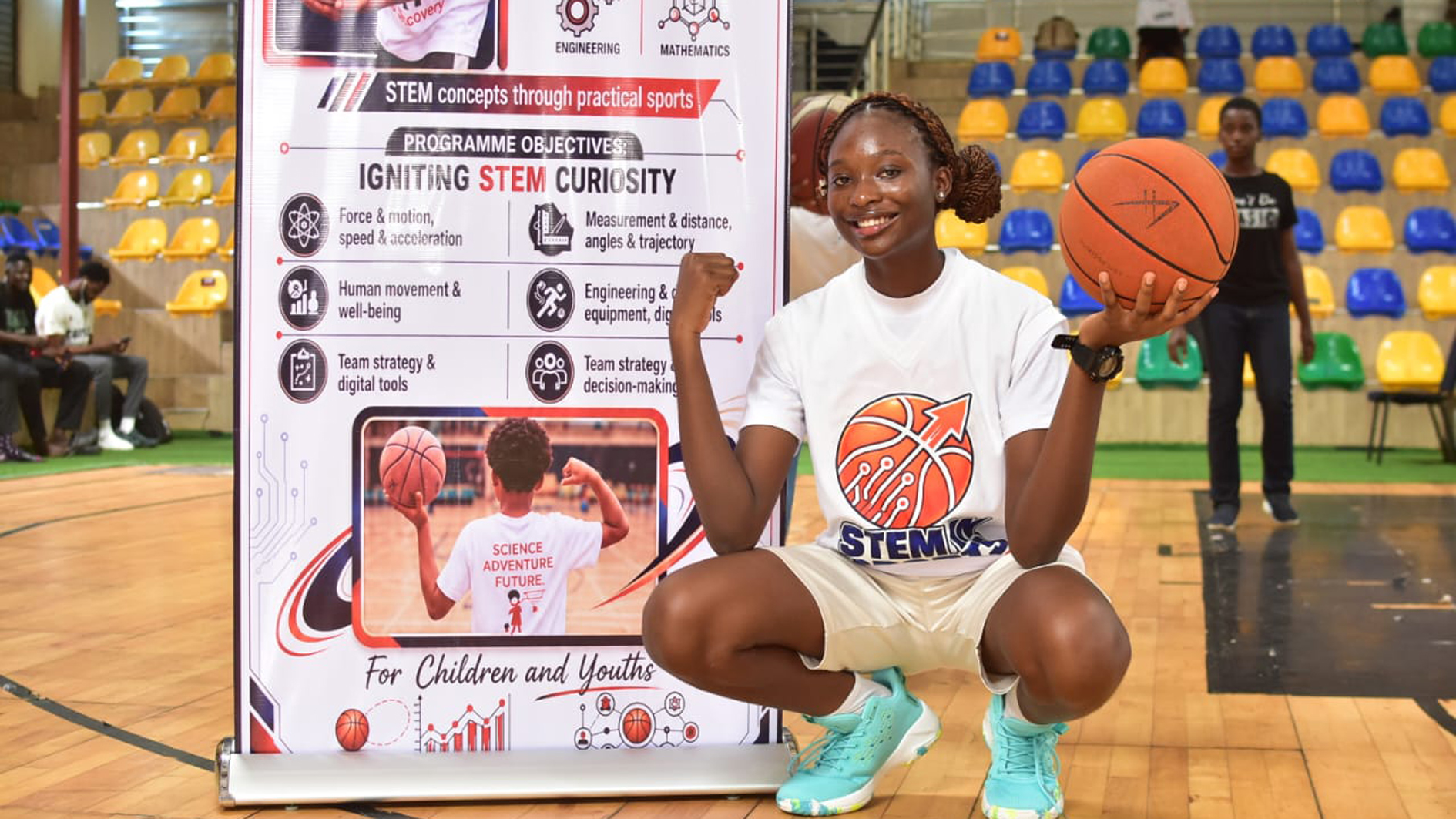
As Nigeria struggles to provide science education for vulnerable children, an initiative Dunk to Discovery is seeking to help kids in orphanage homes achieve their dreams science, technology, engineering and mathematics (STEM). KINGSLEY JEREMIAH reports
The basketball court at MO Arena in Abuja was transformed into more than a place for shooting, dribbling and competition when children from vulnerable homes gathered for an unusual learning experience earlier this week. At the centre of it was 16-year-old Olaedo Christabel Nwabueze, who believes a basketball court can also become a classroom where underserved children discover science, technology, engineering and mathematics (STEM) through an activity they already enjoy. Her initiative, Dunk to Discovery, emerged from a 21-working-day volunteering experience at an orphanage, where she encountered children with limited access to books, learning materials and even basic household items that many other children take for granted. Rather than leave with sympathy alone, Nwabueze began thinking about how she could combine her passion for science and basketball to create an opportunity for the children. “I am very good at science and I am very good at sports. Why don’t I bring my passion to help these vulnerable children?” she asked
The idea, simple but potentially powerful was to use basketball to make STEM relatable, practical and enjoyable for children who may not ordinarily have access to laboratories, technology or specialised learning resources. Nwabueze explains that the rubber grips on basketball shoes, for example, can introduce children to the principle of friction because they help players maintain contact with the court and avoid slipping, while the angle at which a ball is shot can become an introduction to mathematics and physics.
“I wanted to give them access to these things and make them more aware of science and technology things that can actually help them,” she said. Rather than treating STEM as a difficult subject confined to textbooks, the initiative encourages children to see science in ordinary activities, with the court becoming a practical environment where curiosity can be developed through play. Nwabueze believes the approach can eventually be adapted for schools and communities across Nigeria, particularly for children whose circumstances limit their exposure to STEM opportunities.
Her experiment comes against the backdrop of a much larger education challenge in Nigeria, where access, quality and inequality continue to shape the opportunities available to millions of children. UNESCO has estimated that Nigeria has one of the world’s largest out-of-school populations, while broader evidence from the World Bank points to a severe learning crisis across low- and middle-income countries, where many children reach school age without acquiring basic foundational skills. For children growing up in vulnerable circumstances, the problem goes beyond getting into a classroom; they may also lack textbooks, trained teachers, technology, stimulating learning environments and exposure to activities that encourage scientific thinking. This is why initiatives such as Dunk to Discovery, while incapable of replacing government investment or formal education, can provide an important complementary pathway by helping children develop curiosity and begin to see themselves as potential scientists, engineers, technologists and innovators.
For Stella Chidimma Nwabueze, the convener’s mother, the project began with concern over what her daughter had seen during her time at an orphanage. She recalled how Olaedo repeatedly returned home talking about children who lacked basic items such as spoons and plates and eventually suggested that her interests in science and sports could be used to help them. When her daughter explained the meaning behind Dunk to Discovery, particularly the idea of continuing to play despite obstacles, Stella saw a philosophy that could apply to the lives of vulnerable children far beyond basketball.

“Every child has the potential to be great, regardless of their environment or the resources available to them,” she said. The family’s response was not limited to encouraging words, as the first intervention included cash donations, mathematics and science textbooks, clothing, basic cutlery and other materials, with about 60 plates, forks, cups, study materials and books provided to the children.
Her father, Joseph Nwabueze, a basketball enthusiast, has equally embraced the initiative, describing his daughter’s decision to combine sport with service as something that reflects his own passion for supporting vulnerable people. “She is, in many ways, living my dreams. I am a basketballer, and she is also a basketballer,” he said, adding that the intervention should not end with the first outreach.
For him, the programme can become a continuing effort to visit other orphanages and communities, giving children not only material support but also exposure to learning and opportunities that can influence their future. His position reflects an important distinction between charity and empowerment: while donations can address immediate needs, sustained exposure to education, skills and confidence can potentially alter the trajectory of a child’s life.
The impact was visible in the children’s response to an experience that took them outside their normal routine. Peter Isaac, a staff member who teaches some of the children said they were excited because the programme exposed them to a new environment and showed them that basketball could be more than recreation.
“It has opened the children’s eyes to understand that games should not just be seen as ordinary games, but that there is science and technology behind them,” he said.
According to him, many of the children spend much of their time within the orphanage environment, making opportunities to participate in activities outside the facility particularly valuable. The initiative therefore delivered two forms of exposure at once: an opportunity to play and socialise, and an opportunity to understand that scientific principles exist within activities that children may already love.
Ndiogu Tevy, a friend of the convener who attended the programme at MO Arena, described the combination of basketball and STEM as “a very smart initiative” because it connects learning with something children can enjoy naturally. She believes similar interventions should be organised more frequently by non-governmental organisations and government agencies to reach children who may not have the resources to access such opportunities independently. Energy expert Kingsley Ehiaguina also described Dunk to Discovery as a laudable and innovative initiative, particularly because it is being driven by a 16-year-old. In his view, programmes that stimulate children’s interest in science and technology can help create a generation that is more willing to explore innovation and contribute to solving social problems. Their reactions point to the wider potential of the project: not as a substitute for Nigeria’s education system, but as an intervention capable of making learning more accessible and memorable.
For Nwabueze, however, the immediate objective is not to build a nationwide programme overnight. She plans to take Dunk to Discovery periodically to different communities, refine the approach and expose more children to the relationship between sport and STEM. She hopes that, over the next decade, the initiative will have reached thousands of children. That ambition may appear small when compared with the scale of Nigeria’s education challenges, but its significance lies in the philosophy behind it. Education reform is often framed around infrastructure, funding, curriculum reform, teacher recruitment and technology, all of which are necessary, yet education also begins with the moment a child becomes curious enough to ask a question. A child who begins to wonder why a basketball bounces, why a shoe grips the floor, why the angle of a shot matters or how technology can improve a game has already taken a step towards scientific thinking.
That is ultimately what Nwabueze is trying to achieve; not simply to put a basketball in the hands of underserved children, but to use the game to open a door to possibilities they may not have considered before. The books, clothing, cutlery and financial donations provided through the first outreach may address immediate needs, but the more enduring gift could be the idea that learning can be found beyond the classroom and that their circumstances do not have to determine the limits of their ambitions. If Dunk to Discovery succeeds, its legacy may not be measured only by the number of children who participate in its basketball sessions, but by the number who begin to see themselves differently afterwards.

