 Follow Us on Google News



 Follow Us on Google Discover
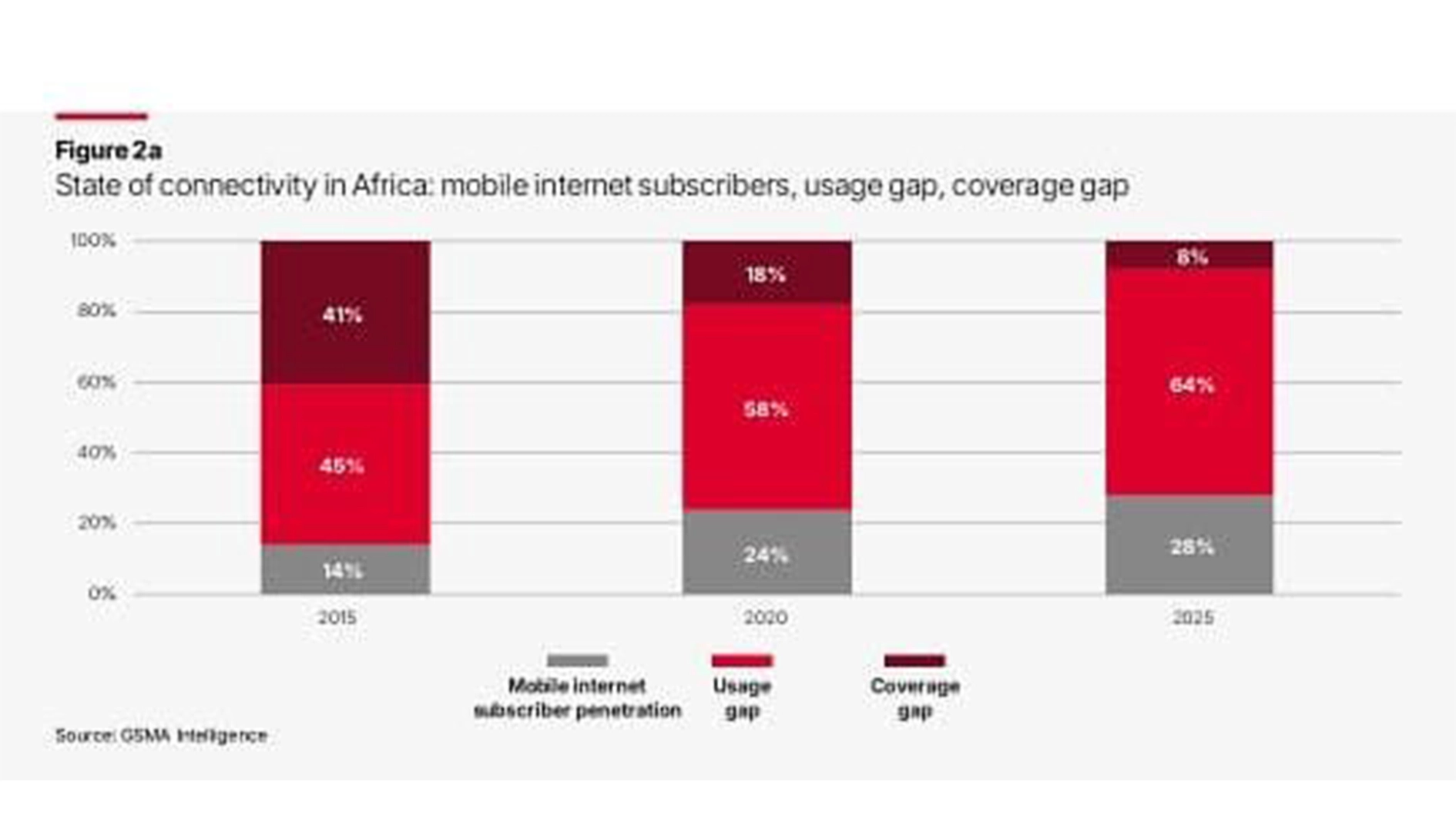
Only 28% of Africans use mobile Internet in 2025, versus 66% worldwide
Deeper digital transformation in Nigeria and Africa as a whole is at risk of stalling due to a widening 5G spectrum deficit that threatens to deepen connectivity gaps, slow economic growth, and leave millions excluded from the digital economy.
This is according to GSMA’s latest report on spectrum policy in Africa. It painted a stark picture. Despite significant investment by mobile operators, poor spectrum allocation and high costs are undermining progress.
The 56-page document, titled: ‘Spectrum Policy in Africa: Enabling investment and empowering consumers through effective spectrum pricing’, October 2026 edition, noted that between 2015 and 2025, mobile broadband coverage in Africa rose from 59 per cent to 92 per cent, while 4G coverage jumped from seven per cent to 83 per cent. It said even 5G has begun to take root, reaching 15 per cent of the population by the end of 2025. Yet adoption lags.
GSMA said only 28 per cent of Africans were using mobile Internet on their own devices in 2025, compared to 66 per cent globally. The usage gap, the share of people covered by mobile broadband but not using it, the document observed, stood at 64 per cent in Africa, double the global average. It stressed that the coverage gap, though smaller, remained significant at eight per cent, four times higher than the rest of the world.
The telecom advocacy body also noted that network quality is also behind. It said average download speeds in Africa were 27 Mbps in 2025, compared to 98 Mbps globally. Upload speeds averaged 9 Mbps, nearly half the global figure. Data consumption is equally telling: Africans use about 3 GB per month per connection, compared to 14 GB elsewhere.

GSMA observed a spectrum shortfall. It said spectrum, the invisible infrastructure powering mobile networks, is at the heart of Africa’s connectivity challenge.
According to it, by 2025, African operators had access to just 570 MHz of spectrum below 7 GHz, compared to 750 MHz globally. This 30 per cent shortfall, GSMA said, is most severe in the upper mid-bands (3–7 GHz), which are critical for 5G.
“Only 24 out of 54 countries in Africa have assigned any spectrum in the 3.5 GHz range, the band most commonly used for 5G deployment worldwide,” the GSMA report noted.
According to it, just five countries have allocated at least 300 MHz in this band, the minimum needed for robust 5G. It stressed that low-band spectrum, vital for rural coverage, is also underutilized. It pointed out that Africa should have 190 MHz available across the 700, 800, and 900 MHz bands, but operators on average have access to just 125 MHz. More than 30 countries have yet to assign the 700 MHz band, while over 10 still lack both 700 and 800 MHz allocations.
In terms of regional breakdown, GSMA observed uneven progress across Africa. According to it, Northern Africa leads with 42 per cent mobile Internet adoption, reflecting stronger infrastructure and affordability. Its usage gap, however, remains high at 56 per cent, showing that many covered citizens are still not online.
Western Africa recorded 30 per cent adoption, with a usage gap of 63 per cent. Coverage gaps are relatively small, but affordability and device access remain barriers.
Southern Africa fares better with 28 per cent adoption and a 61 per cent usage gap. Despite higher penetration, the region still struggles with quality and affordability.
Eastern Africa faces the most acute challenge: a staggering 72 per cent usage gap. Only 22 per cent of the population are mobile internet subscribers, despite coverage expansion.
Central Africa is the most underserved, with just 15 per cent adoption and the largest coverage gap at 24 per cent. This region exemplifies how spectrum scarcity and weak policy frameworks exacerbate exclusion.
These disparities underline the need for tailored policy responses. While Northern Africa is closer to global averages, Central and Eastern Africa require urgent interventions to close both coverage and usage gaps.
Further, GSMA said operators in Africa not only face spectrum scarcity but also higher costs. Spectrum prices are 24 per cent higher per unit than the global average. Licence obligations, such as coverage and quality requirements, can cost three to 45 times more than the spectrum itself.
According to the report, this financial burden comes at a time when average revenues per user have collapsed, falling nearly 50 per cent in real terms over the past decade. Revenue per gigabyte has dropped by 92 per cent, making connectivity more affordable but squeezing operator margins. Despite investing around 20 per cent of revenues into networks, operators are constrained by shrinking returns, limiting their ability to expand coverage and improve quality.
GSMA said there are consequences of inaction. It warned that high spectrum costs directly reduce connectivity outcomes. It said a 10 percentage point increase in the spectrum cost-to-revenue ratio leads to four percentage points lower 4G coverage, six points lower 5G coverage, and eight per cent slower download speeds. Conversely, a 10 per cent increase in spectrum assigned boosts 4G/5G coverage by up to 2 points and raises speeds by three to four per cent.
According to GSMA, the potential benefits of reform are enormous. It noted that 50 million more people will be covered by 4G by 2035. 170 million more people covered by 5G, raising penetration by 11 percentage points. 30 to 50 per cent faster download speeds, and over $120 billion in additional GDP across Africa between 2026 and 2035.
The GSMA called for urgent reforms to spectrum policy. It said there was a need to assign spectrum to operators who can deliver the greatest social and economic benefits, not just maximise government revenues.
It stressed the need for operators to set low reserve prices in auctions to avoid unsold spectrum and reduce financial strain. Pair licence obligations with cost discounts to preserve commercial viability. Adopt technology- and service-neutral licensing frameworks to allow operators to refarm spectrum for newer technologies.
According to it, there is a need to extend licence durations to at least 20 years, ideally 30 to 40 years or indefinitely, to encourage long-term investment. Publish transparent spectrum roadmaps to guide investment, and allocate the full upper 6 GHz band for mobile use to meet urban demand, and the 600 MHz band to ensure rural coverage.
GSMA submitted that Africa’s spectrum deficit is not just a technical issue, but a policy failure with profound social and economic consequences. It stressed that without decisive action, the continent risks locking millions out of the digital economy, stifling innovation, and slowing growth.
The telecom body warned that spectrum is the oxygen of mobile connectivity. It stressed that if Africa continues to ration it, the continent’s digital future will suffocate. “But with bold reforms, Africa can leap forward, connecting hundreds of millions more people, unlocking billions in economic value, and finally closing the digital gap that has held the continent back for too long.

