
 Get Guardian on Google
While Nigeria, Kenya, Egypt and South Africa continue to dominate Africa’s venture capital landscape, Morocco and Ghana are emerging as the continent’s most balanced and resilient secondary technology hubs, a new industry analysis said.
Deal-tracking data for the first three quarters of 2026 show that the traditional ‘big four’ markets attracted 81 per cent of all startup funding raised across Africa, broadly in line with the 78 to 89 per cent range recorded annually since 2019.
However, beneath the headline figures, startup activity is gradually spreading beyond the four dominant markets. Startups outside the Big Four accounted for 35 per cent of all companies that raised at least $100,000 between the first and third quarters of 2026, up from 24 per cent five years ago.
Their share of total capital, however, remained unchanged at 15 per cent, suggesting that although entrepreneurial activity is expanding across more African markets, access to substantial growth-stage financing remains concentrated.
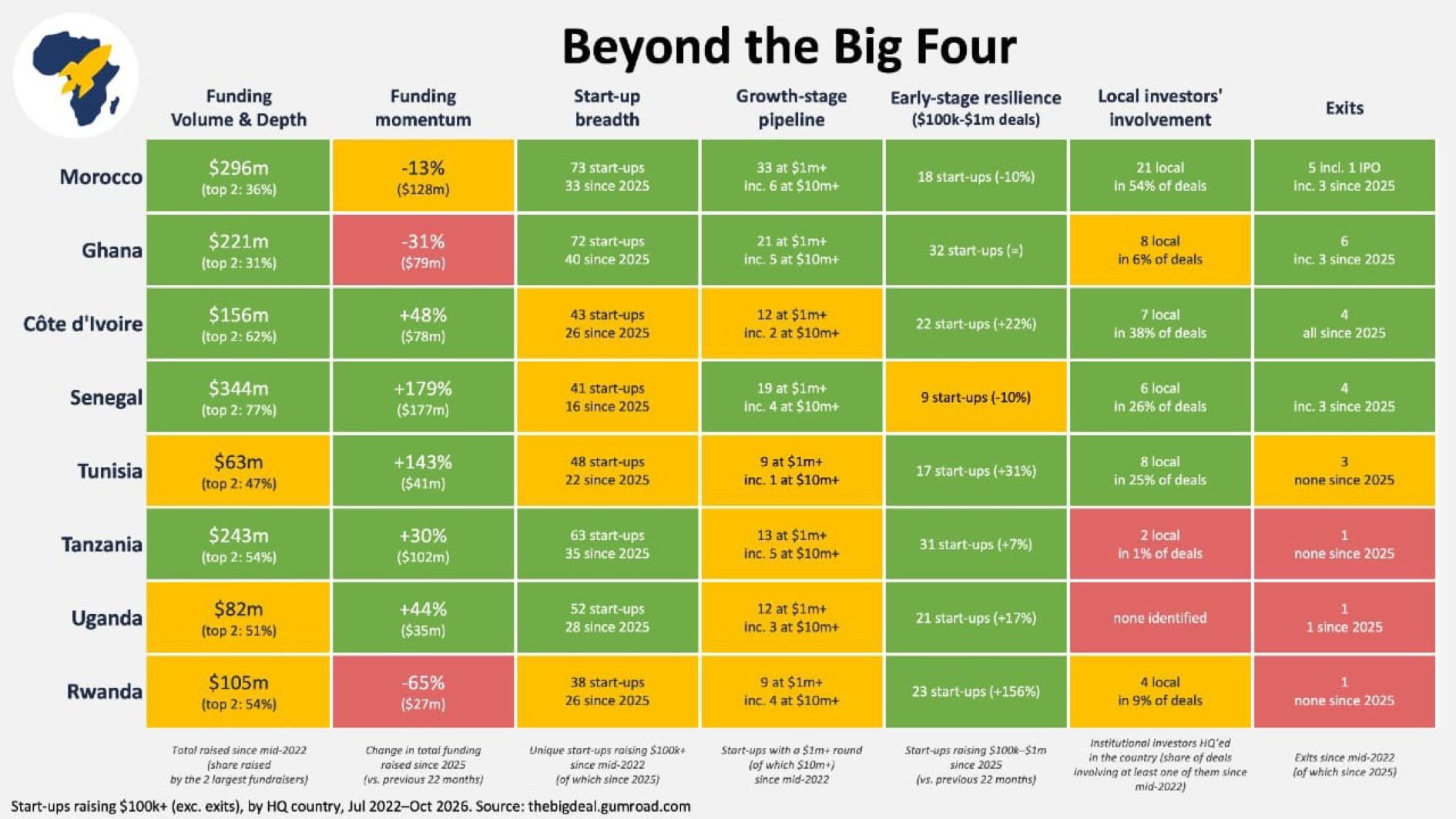
In an assessment of the 10 leading non-big four ecosystems, based on funding volume, startup maturity, domestic investor participation and exit activity since the venture capital downturn began in mid-2022, researchers identified Morocco and Ghana as leading contenders for a ‘Next Four’ group of technology hubs.
The analysis, by Africa: The Big Deal, placed Morocco at the top of the secondary markets, describing it as the most well-rounded startup ecosystem outside the big four.
The country attracted $296 million in startup funding since July 2022, with capital relatively well distributed across companies. Its two largest fundraisers, fintech firm CashPlus and travel technology company Nuitee, which raised $48 million in a Series A round, accounted for just 36 per cent of total funding.
Over the same period, 33 Moroccan startups raised at least $1 million, the highest number outside the Big Four, while six secured funding rounds exceeding $10 million. These included ABA Life, which raised $40 million in October.
Morocco’s strongest advantage, according to the analysis, is its domestic investment base. At least 21 local investors, including CDG, Azur Innovation Fund, UM6P Ventures, WitaMax and Kalys Ventures, have backed startups since mid-2022.
Local investors participated in 54 per cent of all Moroccan deals, the highest domestic participation rate recorded across African markets.
The growing domestic capital base is also supporting exit opportunities for investors. Five exits have been recorded since mid-2022, including CashPlus’s initial public offering on the Casablanca Stock Exchange in November 2025 at a valuation of $550 million. It was the only startup IPO outside the Big Four since at least 2019.
Ghana, meanwhile, emerged as the most balanced startup market outside the Big Four, attracting $221 million in funding since mid-2022.
Its two largest fundraisers, fintech company Fido and agritech firm Complete Farmer, accounted for just 31 per cent of total capital, the lowest concentration among the markets analysed.
A total of 72 Ghanaian startups raised at least $100,000 during the period, compared with 73 in Morocco. Of these, 21 raised more than $1 million, while five secured funding rounds exceeding $10 million.
Ghana also leads the secondary markets in early-stage activity, with 32 startups raising between $100,000 and $1 million since 2025.
Its exit momentum has remained relatively strong, with six exits recorded since mid-2022, including three since 2025. The trend was reinforced by the $119 million acquisition of Ghana-founded insurtech company Bima in May.
However, the ecosystem faces some structural weaknesses. Startup funding has fallen by 31 per cent since 2025 to $79 million, while local institutional investors participated in only six per cent of deals.
Beyond Morocco and Ghana, the analysis identified other markets showing strong upward momentum, although structural weaknesses continue to limit their ability to attract and sustain larger investments.
Côte d’Ivoire, for instance, has emerged as a fast-rising contender, attracting $78 million since January 2025, representing a 48 per cent increase. The growth was led by fintech company Djamo, which raised $17 million, and mobility startup GoCab, which secured $45 million.
Local investors, including Janngo Capital, Mstudio and CDC-CI Capital, participated in nearly 40 per cent of deals since mid-2022. All four of the country’s exits since 2019, involving Lapaire, Koto, Kamtar and Anka, occurred from early 2025.
Senegal recorded the highest total funding among the non-big four markets, attracting $344 million since mid-2022, including $177 million since 2025. The country also recorded three recent exits, including Peach Payments’ acquisition of PayDunya.
However, its funding remains heavily concentrated, with 77 per cent of capital going to Wave, boosted by a $137 million debt raise, and Africa REN. Only nine startups raised early-stage funding rounds since 2025.
Tunisia also recorded a significant recovery, with startup funding rising by 143 per cent since 2025 to $41 million. The growth was supported by healthy early-stage equity activity and local investment firms such as 216 Capital and UGFS North Africa, although growth-stage funding remains limited.