Nigeria’s bronze artists cling to centuries-old techniques

Centuries after the Benin Empire mastered bronze casting, as Nigeria fights to reclaim its stolen bronzes, artists in Benin City still mould molten metal by hand, preserving the centuries-old techniqu...

Centuries after the Benin Empire mastered bronze casting, as Nigeria fights to reclaim its stolen bronzes, artists in Benin City still mould molten metal by hand, preserving the centuries-old techniques that shaped the kingdom’s artistic identity.
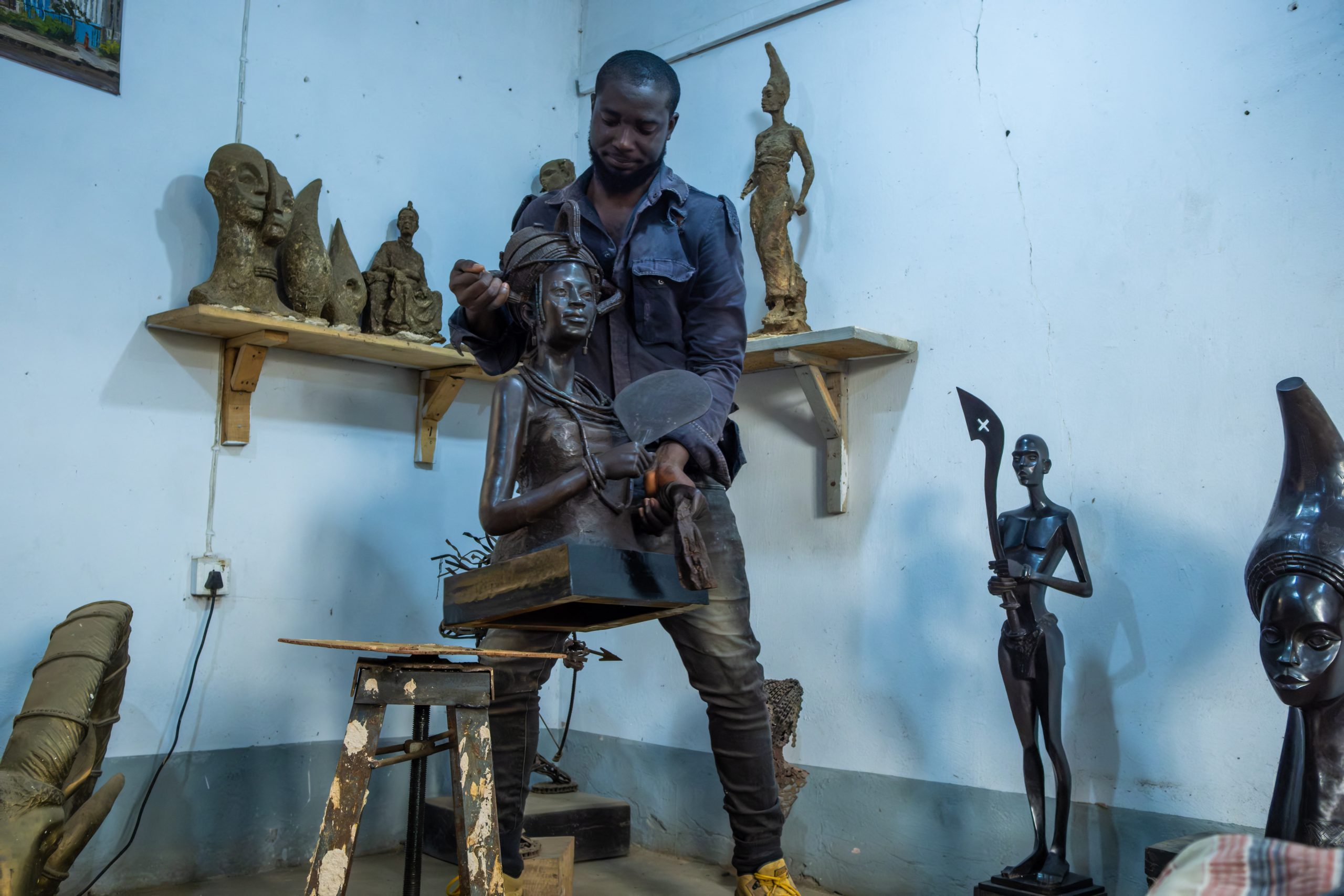
Nigerian sculptor Omodamwen Kelly, 32, holds a sculpture made of bronze in his studio in Benin City, Edo state, on November 10, 2025. Benin City has been known for centuries as the center of artisanal bronze and brass craftsmanship, the most famous emblems of which are the "Benin Bronzes," works of art that once adorned the royal palace and were looted in 1897 by the British army during a punitive expedition that resulted in the city's sacking.These works have been dispersed among various Western museums—notably the British Museum—and symbolize the struggle for the restitution to their countries of origin of art objects stolen during the colonial period. Several institutions, including German, Dutch, and Scottish ones, have already returned the "Benin Bronzes" from their collections to Nigeria. (Photo by TOYIN ADEDOKUN / AFP) / RESTRICTED TO EDITORIAL USE - MANDATORY MENTION OF THE ARTIST UPON PUBLICATION - TO ILLUSTRATE THE EVENT AS SPECIFIED IN THE CAPTION
Nigerian sculptor Omodamwen Kelly, 32, holds a sculpture made of bronze in his studio in Benin City, Edo state

Using long iron tongs, Victor Uinmwen Aduwe and Matthew Mathias pick a blazing pot from a fire and pour a thick golden liquid into a partly buried mould, using a centuries-old technique that still flourishes in Nigeria’s south.

After a short cooling period, the mould is dug up and opened, revealing three small bronze heads fashioned after an ancient monarch of the erstwhile kingdom of Benin in Nigeria’s Edo State.

The Edo capital, Benin City, has been renowned for centuries as the heart of bronze and brass craftsmanship.

Its most famous emblems are statues and plaques that adorned the royal palace and were looted after British forces captured the city in 1897.

They are scattered in museums and private collections across the world, and Nigeria is now trying to get them back. 

Museums in Britain, Germany and the Netherlands have already returned several hundreds of the artefacts to Nigeria.

‘MANY CASTERS HAVE LEFT’
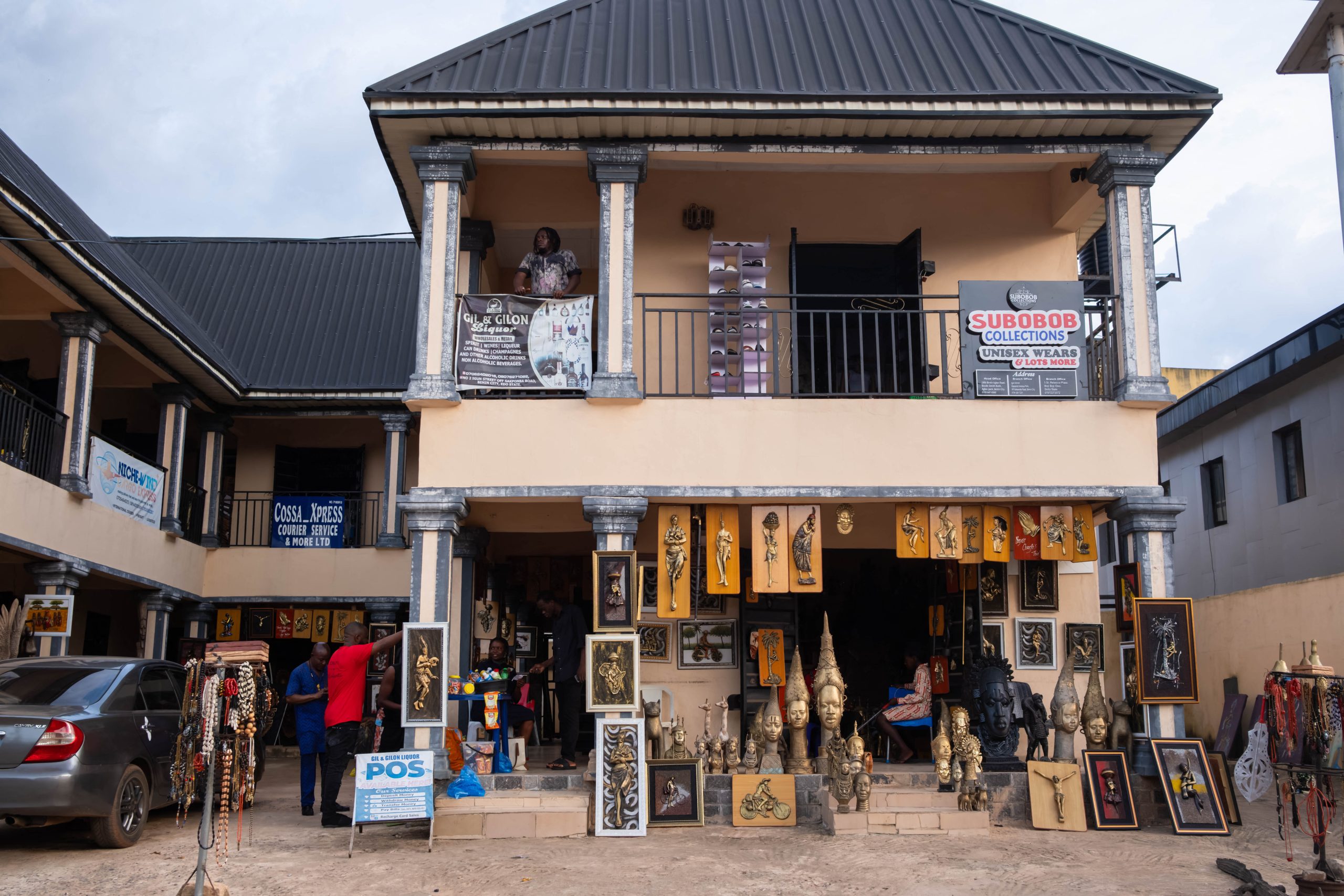
A general view of a shop displaying bronze pieces for sale on Igun Street, in Benin City on November 10, 2025. Benin City has been known for centuries as the center of artisanal bronze and brass craftsmanship, the most famous emblems of which are the "Benin Bronzes," works of art that once adorned the royal palace and were looted in 1897 by the British army during a punitive expedition that resulted in the city's sacking. These works have been dispersed among various Western museums—notably the British Museum—and symbolize the struggle for the restitution to their countries of origin of art objects stolen during the colonial period. Several institutions, including German, Dutch, and Scottish ones, have already returned the "Benin Bronzes" from their collections to Nigeria. (Photo by TOYIN ADEDOKUN / AFP)

Igun Street in Benin City houses the historic Guild of Benin Bronze Casters, an influential but declining body whose members still make bronze and brass objects using traditional methods.

The three-kilometre (two-mile) street is dotted with shops displaying statuettes of all sizes, mostly royal figures from the ancient kingdom.

They are crafted by Guild members who have passed down their expertise from father to son for generations.

Aduwe, 45, was trained by his father from the age of six. 

Although he is capable of “making anything” in bronze to meet the varied demands of customers, he loves nothing more than casting objects in the image “of our king or queen”.

Two years ago, he was part of a team that made a 10-metre (32-foot) statue of Queen Idia that overlooks one of the city’s roundabouts.

Queen Idia, the first Queen Mother of Benin, was a powerful warrior and influential figure in the 16th century, known for her role in securing the throne for her son, Oba Esigie.
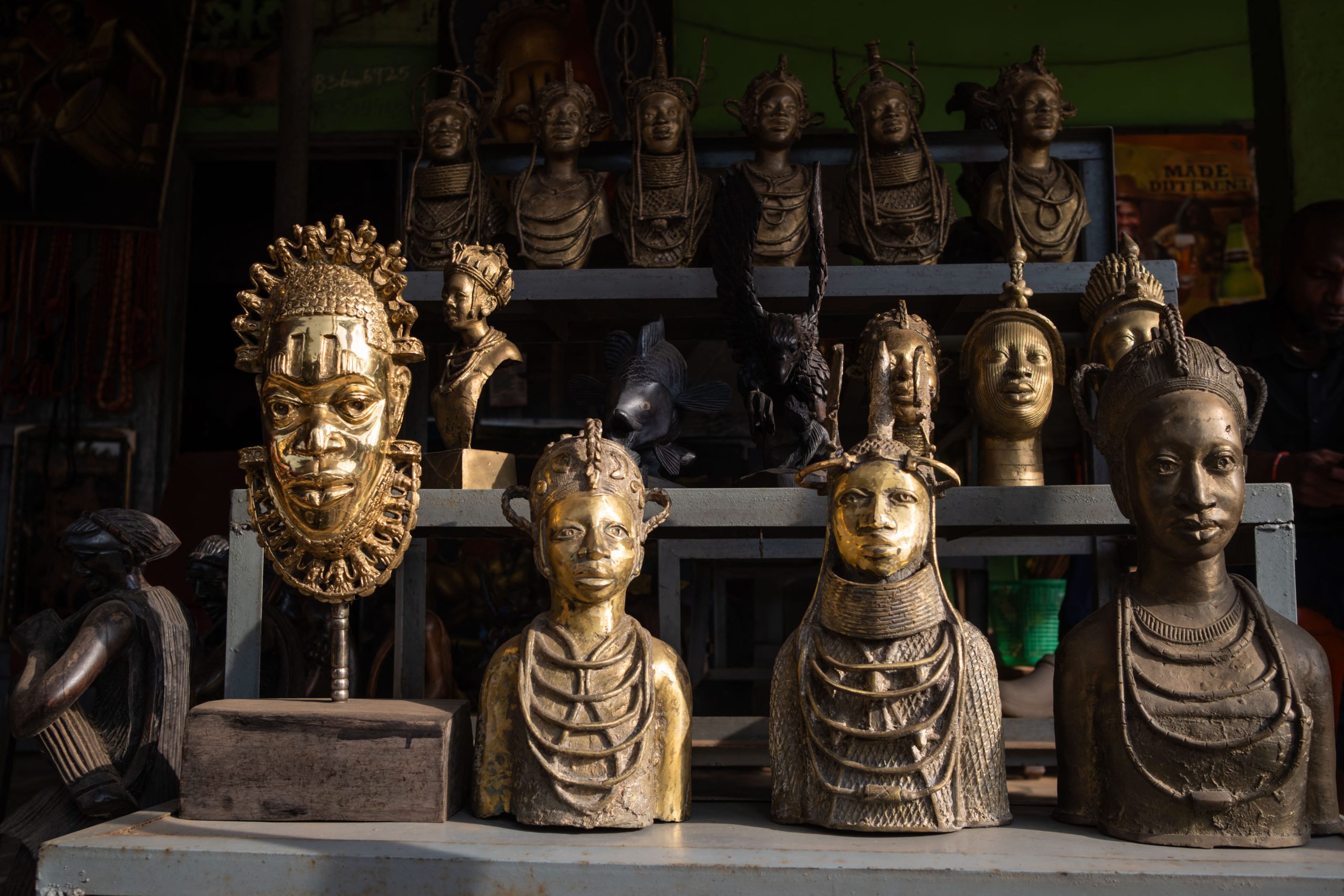
Bronze sculptures are displayed for sale on a table in a shop on Igun Street, in Benin City on November 10, 2025. Benin City has been known for centuries as the center of artisanal bronze and brass craftsmanship, the most famous emblems of which are the "Benin Bronzes," works of art that once adorned the royal palace and were looted in 1897 by the British army during a punitive expedition that resulted in the city's sacking.These works have been dispersed among various Western museums—notably the British Museum—and symbolize the struggle for the restitution to their countries of origin of art objects stolen during the colonial period. Several institutions, including German, Dutch, and Scottish ones, have already returned the "Benin Bronzes" from their collections to Nigeria. (Photo by TOYIN ADEDOKUN / AFP)
Bronze sculptures are displayed for sale on a table in a shop on Igun Street, in Benin City. Photo by TOYIN ADEDOKUN / AFP

It took six months to complete and was carried out in utmost secrecy as the Oba, the local traditional ruler who commissioned the statue, did not want anyone to see it before it was finished.

Once flourishing and funded by the Oba, who remains a very influential figure in Edo State, the guild now has only 120 members.

Its head, Aduwe’s uncle, Kingsley Osarhenhen Inneh, 65, acknowledged that “many have left for greener pastures.” 

Inneh lamented the soaring cost of materials, with a kilo of brass rising “in less than four years” from 600 naira (40 US cents) to 8,000 ($5.5), often salvaged from the carcasses of vehicles.

Inneh said he would welcome financial aid to buy modern equipment to increase output and ease the work. 

After working as an engineer all his life, the retiree is counting on his two sons, one of whom is a lawyer, to take over from him.

MASTERING THE FIRE
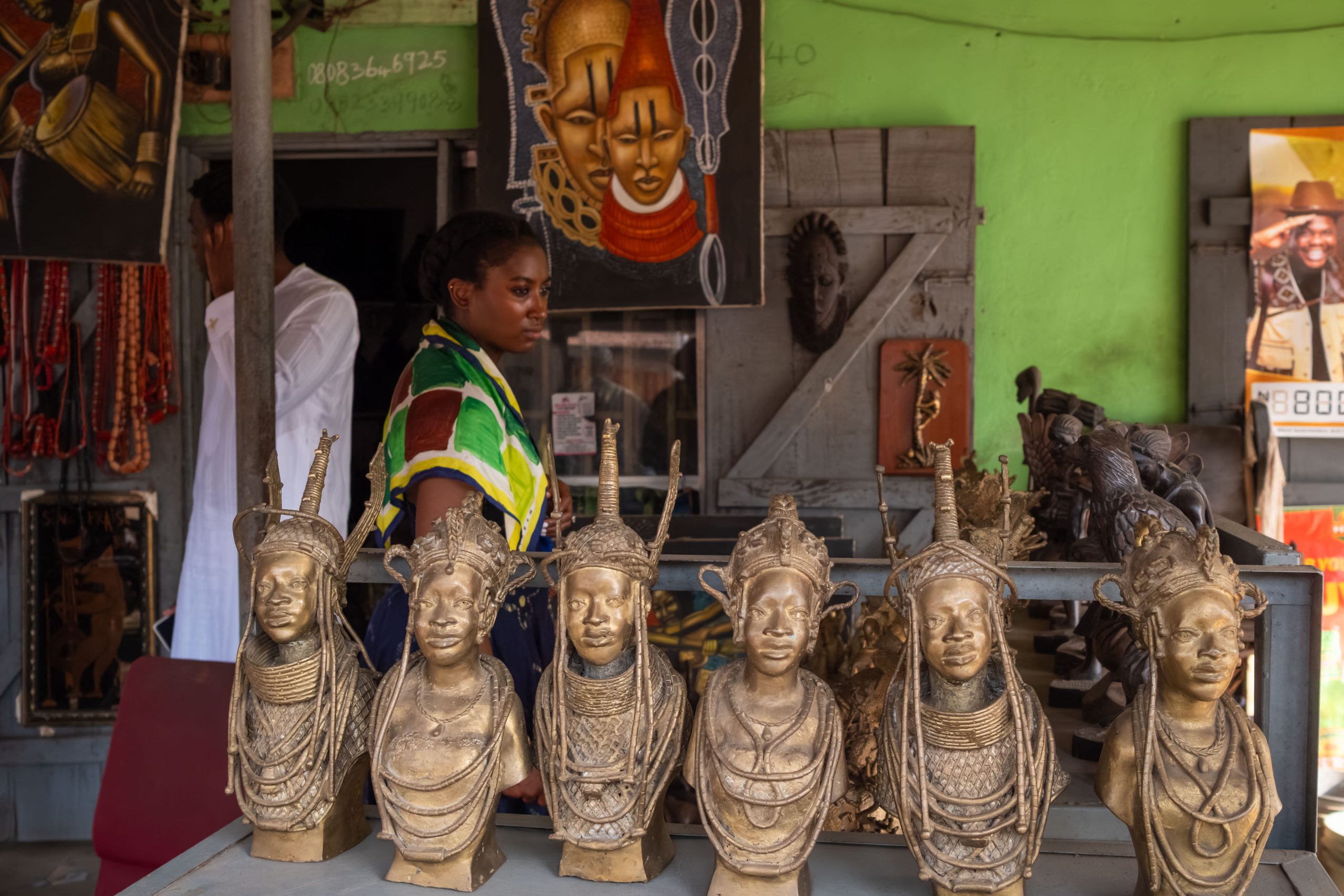
A tourist looks at bronze art pieces on display for sale in a shop on Igun Street, in Benin City on November 10, 2025. Benin City has been known for centuries as the center of artisanal bronze and brass craftsmanship, the most famous emblems of which are the "Benin Bronzes," works of art that once adorned the royal palace and were looted in 1897 by the British army during a punitive expedition that resulted in the city's sacking.These works have been dispersed among various Western museums—notably the British Museum—and symbolize the struggle for the restitution to their countries of origin of art objects stolen during the colonial period. Several institutions, including German, Dutch, and Scottish ones, have already returned the "Benin Bronzes" from their collections to Nigeria. (Photo by TOYIN ADEDOKUN / AFP)
A tourist looks at bronze art pieces on display for sale in a shop on Igun Street, in Benin City. Photo by TOYIN ADEDOKUN / AFP

Matthew Mathias, originally from northern Nigeria, arrived in Benin City about a decade ago and met a bronze caster who trained him to be a bronze artist.

“I have become like their adopted son,” said the 43-year-old.

Handling fire and boiling materials, lifting heavy loads, digging the earth under a scorching sun: the work of a caster on Igun Street is gruelling and has changed little, except that stoking the embers is now done with an electric blower rather than manually.

The fire “brings out the ability in a man…  The fire that is coming out here is the hardship of life. If I can overcome this fire, I can be able to endure the heat of society,” Mathias said.
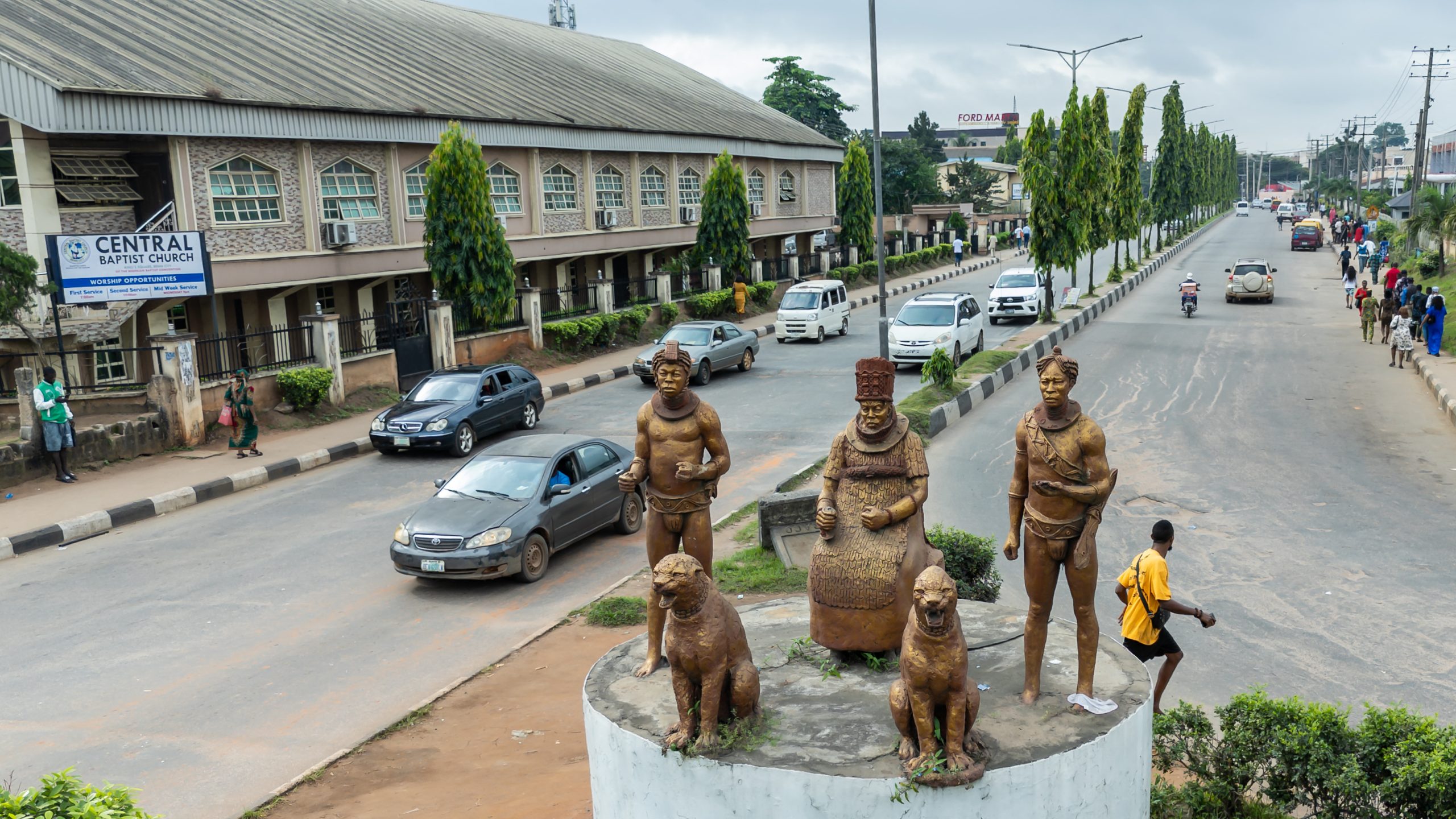
This aerial view shows commuters driving past a roundabout adorned with bronze statues depicting the Oba of Benin and his palace guards, in Benin City on November 10, 2025. Benin City has been known for centuries as the center of artisanal bronze and brass craftsmanship, the most famous emblems of which are the "Benin Bronzes," works of art that once adorned the royal palace and were looted in 1897 by the British army during a punitive expedition that resulted in the city's sacking.These works have been dispersed among various Western museums—notably the British Museum—and symbolize the struggle for the restitution to their countries of origin of art objects stolen during the colonial period. Several institutions, including German, Dutch, and Scottish ones, have already returned the "Benin Bronzes" from their collections to Nigeria. (Photo by TOYIN ADEDOKUN / AFP)
This aerial view shows commuters driving past a roundabout adorned with bronze statues depicting the Oba of Benin and his palace guards, in Benin City. Photo by TOYIN ADEDOKUN / AFP

In another part of the city, Kelly Omodamwen also casts bronze using age-old techniques. 

But this 32-year-old has carved out his own path: minimalist sculptures  inspired by local mythology and history to tell “the same story but in simpler forms.”

“Every time I tried to do different things, I came back to these stories,” said Omodamwen, whose works have sold in Europe and the United States.
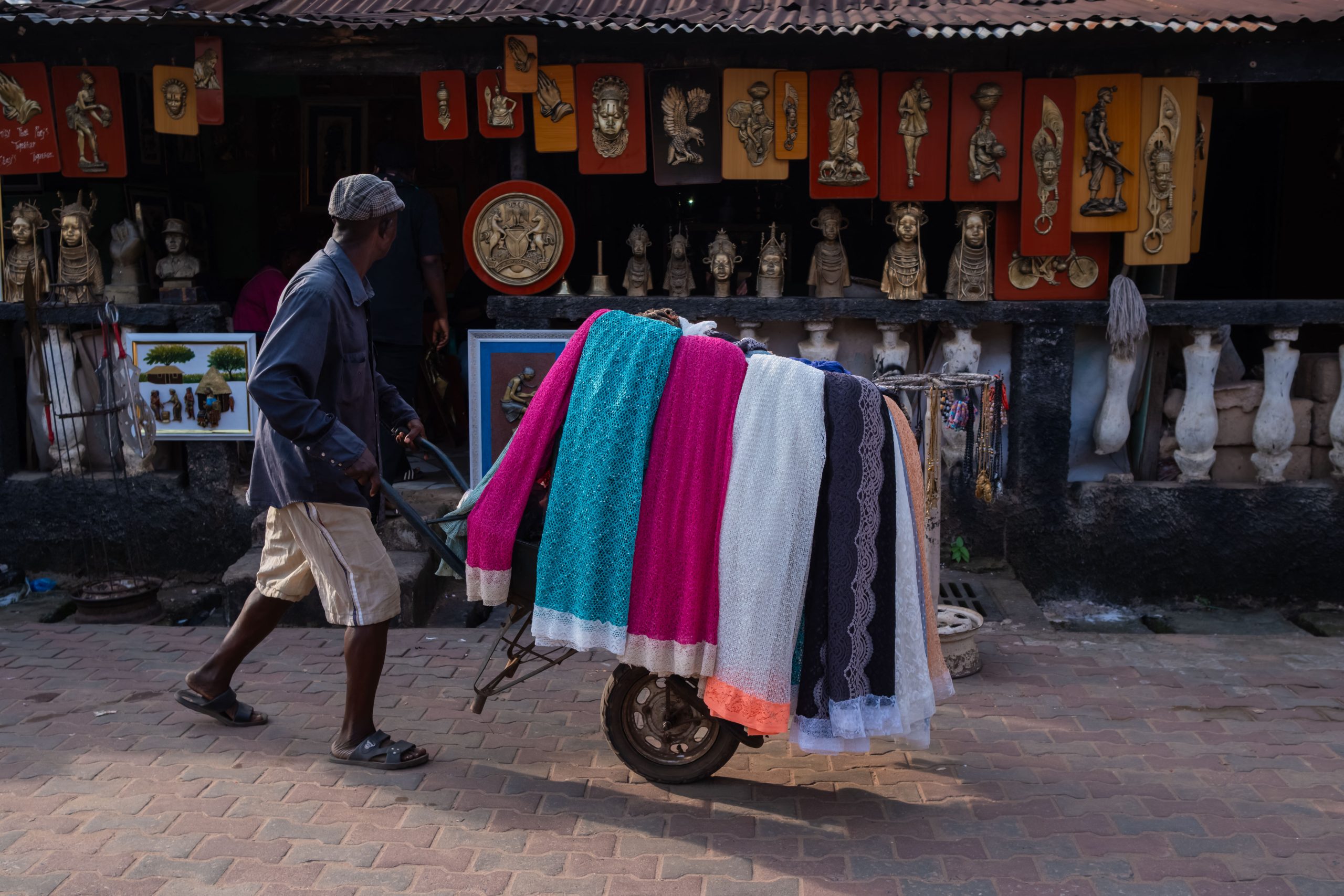

A street vendor pushes a wheelbarrow of clothes past a shop where finished bronze pieces are displayed for sale on Igun Street, in Benin City on November 10, 2025. Benin City has been known for centuries as the center of artisanal bronze and brass craftsmanship, the most famous emblems of which are the "Benin Bronzes," works of art that once adorned the royal palace and were looted in 1897 by the British army during a punitive expedition that resulted in the city's sacking.These works have been dispersed among various Western museums—notably the British Museum—and symbolize the struggle for the restitution to their countries of origin of art objects stolen during the colonial period. Several institutions, including German, Dutch, and Scottish ones, have already returned the "Benin Bronzes" from their collections to Nigeria. (Photo by TOYIN ADEDOKUN / AFP)
A street vendor pushes a wheelbarrow of clothes past a shop where finished bronze pieces are displayed for sale on Igun Street, in Benin City. Photo by TOYIN ADEDOKUN / AFP


Leslie Fauvel 

Guardian Life

Join Our Channels