 Follow Us on Google News
 Follow Us on Google Discover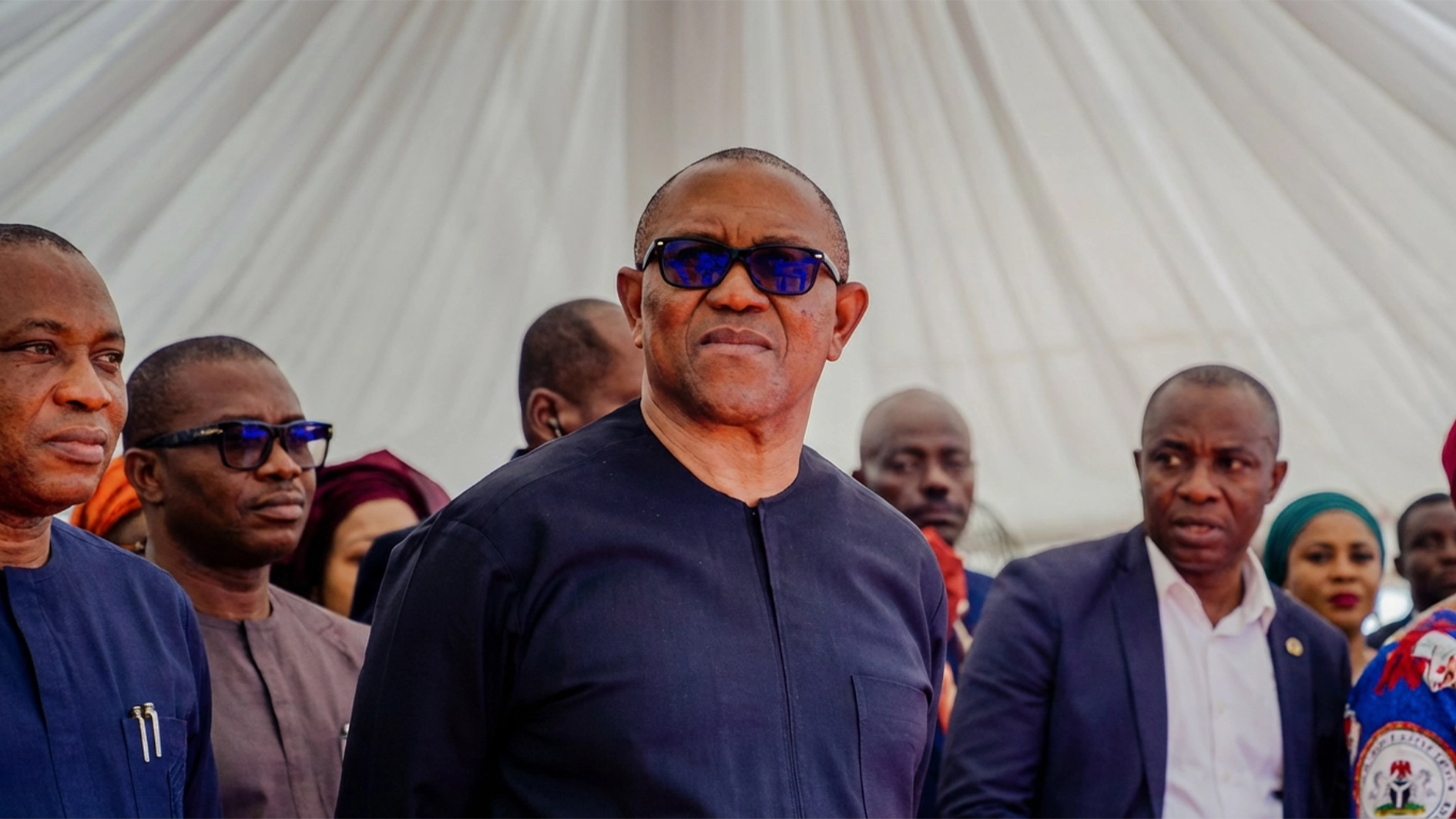
The presidential candidate of the Nigeria Democratic Congress (NDC), Peter Obi, is one of the leading contenders in the 2027 presidential race. But the lingering poser remains the possibility of winning a presidential election without the broad elite consensus of the political class, beginning with his South-East backyard, TUNDE BODUNRIN reports.
As Nigeria inches closer to the 2027 presidential election, the political landscape is gradually taking shape following the closure of the Independent National Electoral Commission’s (INEC) candidate nomination portal. Barring legal disputes or unforeseen developments, the contest is expected to revolve around three major candidates: incumbent President Bola Tinubu of the All Progressives Congress (APC), former Vice-President Atiku Abubakar of the African Democratic Congress (ADC), and former Anambra State Governor, Peter Obi, of the Nigeria Democratic Congress (NDC).
Each enters the race with distinct strengths and vulnerabilities. Tinubu enjoys the advantages of incumbency and a nationwide party structure. The ruling APC currently controls no fewer than 31 states, commands more than a two-thirds majority in the National Assembly, and maintains overwhelming control of most state Houses of Assembly, local government councils, and councillorship positions, giving it a formidable grassroots political structure.
Atiku remains one of Nigeria’s most experienced opposition politicians, with an established political network built over several decades across the country’s six geopolitical zones.
Obi, on the other hand, continues to draw considerable popularity and support from urban voters, young Nigerians, and sections of the middle class, who view him as a symbol of political change, accountability, and fiscal prudence.
Yet, popularity alone may not be sufficient in Nigeria’s complex electoral environment, where party structures, elite alliances, regional calculations, and organisational capacity often determine electoral outcomes.

Obi, who appears to be the underdog among the trio, will face three broad challenges: navigating resistance within sections of the political establishment, rebuilding institutional support in parts of his traditional base, and sustaining the momentum of the Obidient Movement that reshaped the country’s political conversation during the 2023 election.
Obi’s relationship with Nigeria’s political establishment has remained an important feature of his presidential ambitions since his dramatic exit from the Peoples Democratic Party (PDP) in 2022.
After leaving the PDP over disagreements surrounding its presidential primary, Obi joined the Labour Party and emerged as its presidential candidate. His decision fundamentally altered the dynamics of the 2023 election, transforming what had largely been expected to be another contest between the APC and PDP into a competitive three-way race.
Unlike many previous presidential aspirants who built their ambitions through extensive political negotiations within established parties, Obi relied heavily on public enthusiasm, particularly among young voters and professionals who rallied around the now-famous Obidient Movement.
This approach distinguished him from conventional politicians but also limited his acceptance among sections of the traditional political elite, where negotiations, alliances, and long-standing relationships continue to play significant roles in building presidential coalitions.
For many within Nigeria’s political class, presidential contests are won not only through public popularity but also through broad elite consensus capable of mobilising governors, legislators, party officials, and local political structures across the federation.
This partly explains why Obi has continued to encounter scepticism from influential political actors despite his impressive showing in the last presidential election.
When the Deputy Governor of Lagos, who is also the APC’s gubernatorial candidate in the state for 2027, spoke with the media a fortnight ago, he described Obi as no match for the incumbent, accusing him of being inconsistent and a serial defector from one party to another. He said such a character could not withstand the pressure of the presidency.
However, Goddy Uwazurike, one of Obi’s staunch supporters, cautioned against overstating elite influence. He argued that the 2023 election demonstrated that a candidate with limited establishment backing could still command millions of votes and reshape national political discourse.
He said Obi’s emergence reflected growing public dissatisfaction with traditional politics, although he noted that translating popular enthusiasm into electoral victory requires far more extensive institutional support than social media mobilisation alone.
One of the most closely watched aspects of Obi’s 2027 campaign is his relationship with political leaders in the South-East.
Despite being the region’s most prominent presidential aspirant in recent history, Obi has hardly enjoyed unanimous support from governors within the zone.
During the 2023 election, none of the five South-East governors openly aligned with his presidential campaign. Instead, several, especially the Governor of Imo State, Hope Uzodimma, maintained relationships with either the APC, reflecting the complex political calculations that often shape Nigeria’s electoral politics.
The most notable example remains Anambra State Governor, Charles Soludo.
Although Soludo acknowledged Obi’s achievements as governor of Anambra, he publicly questioned the viability of his presidential project before the 2023 election. Since President Tinubu assumed office, Soludo has also commended some of the Federal Government’s economic reforms while maintaining that states must work constructively with the centre, irrespective of party affiliation.
Soludo’s position has, however, been interpreted differently. Some argue it reflects ideological differences and pragmatic governance. Others see it as evidence of broader regional divisions that have complicated Obi’s efforts to consolidate elite support even within his home zone. For instance, Ifeanyi Christopher, one of the Obidient Movement adherents, said the situation in the South-East, which is Obi’s base, does not support his ambition, considering the enormous influence governors wield during elections.
According to him, “In a situation where three of the five states in the region are controlled by the APC, and the remaining two, Abia and Anambra, under the Labour Party and All Progressives Grand Alliance (APGA), respectively, are sympathetic to the incumbent president, what is left for Obi?”
The situation has become even more significant ahead of the 2027 election following the APC’s growing political presence in the South-East.
With more governors now aligned with the ruling party, Christopher believes Obi may find it increasingly difficult to rely on state-controlled institutional structures during the campaign.
But Uwazurike argued that electoral history also suggests governors do not always determine presidential voting patterns.
He pointed out that in 2023, Obi won several states despite lacking the support of their governors, indicating that voter preferences can sometimes diverge sharply from official party structures.
That experience has encouraged many of his supporters to argue that grassroots mobilisation remains capable of overcoming institutional disadvantages.
Recognising the need to broaden his electoral coalition, Obi’s decision to select former Kano State Governor Rabiu Musa Kwankwaso as his running mate for 2027 is widely viewed as an attempt to strengthen his appeal in Northern Nigeria, particularly the North-West, the country’s largest voting bloc.
Kwankwaso brings decades of political experience, an established grassroots following, and significant influence through the Kwankwasiyya political movement. The partnership could improve Obi’s competitiveness in parts of Northern Nigeria where he struggled to gain substantial votes in 2023.
A member of the ADC, who did not defect with Obi to the NDC and declined to be named, said: “While a running mate may enhance regional appeal, successful presidential campaigns still depend on effective party structures, sustained mobilisation, fundraising capacity, and extensive election-day logistics.
Obi ought to have exercised patience in the ADC instead of falling for the ruling party’s bait and leaving for the NDC.”
The source added: “Beyond regional calculations, Obi also faces competition for opposition votes. Unlike the 2023 election, when his emergence significantly disrupted the traditional two-party dominance, the 2027 race presents a more complicated opposition landscape, with Atiku Abubakar leading the ADC and seeking to consolidate anti-incumbency votes.
“Whether opposition supporters ultimately unite behind a single alternative or split their votes among multiple candidates may prove decisive.
“For Obi, therefore, the challenge extends beyond maintaining personal popularity. It includes building durable political alliances capable of matching the organisational reach of both the APC and ADC while persuading undecided voters that his platform offers the most credible alternative.”
The Obidient Movement emerged in 2022 as an unconventional political force driven largely by young Nigerians, professionals, civil society groups, and first-time voters. Unlike traditional political structures built around governors, party financiers, and established political networks, the movement relied heavily on volunteers, digital mobilisation, and grassroots fundraising.
Its influence was unmistakable during the 2023 election. Despite contesting on the platform of the relatively unknown Labour Party, Obi secured 6,101,533 votes, won 11 states and the Federal Capital Territory (FCT), and finished third behind President Tinubu and former Vice-President Atiku.
The performance altered long-held assumptions about Nigerian electoral politics by demonstrating that a candidate outside the two dominant parties could attract substantial nationwide support.
Unlike political parties with permanent structures stretching from the national headquarters to polling units, social movements often struggle to maintain cohesion once elections are over.
Volunteer enthusiasm can diminish, funding may become more difficult, and organisational discipline becomes harder to sustain outside an election cycle.
These concerns have generated debate over whether the Obidient Movement has retained the vibrancy that characterised its emergence.
While Obi continues to attract large crowds during public engagements and remains one of Nigeria’s most discussed political figures on digital platforms, Christopher said electoral victories depend on more than public visibility. He said they require effective ward-level organisation, polling agents, voter education, election-day logistics, and the capacity to protect votes across more than 176,000 polling units nationwide.
A former National Deputy Spokesman of the PDP, Diran Odeyemi, said many of the factors that worked for Atiku and Obi in 2019, when they contested together under the PDP but narrowly lost to the APC, are no longer present.
As for Obi, he said the EndSARS youth movement that supported him from 2022 to 2023 no longer has the same momentum.
He also noted that Tinubu was not president during the 2023 election but is now the incumbent and will maximise the advantages of office, which he believes the President has already demonstrated. He further argued that the desperation both Atiku and Obi have displayed over the years in their pursuit of the presidency may ultimately work against them.
Odeyemi also said the former Anambra State governor failed to take advantage of the Obidient Movement by either transforming it into a political party or using it to strengthen the Labour Party, rather than moving from one party to another.
On the possibility of Atiku and Obi stepping down for each other before 2027, Odeyemi said that it may be impossible because of Kwankwaso’s ambition. He asked: “If they do that, which is unlikely anyway, Kwankwaso may play the spoiler. Obi is in a difficult political situation at present. Even his zeal to contest the 2027 election has waned drastically.”
Obstacles beyond popularity
As the 2027 presidential election approaches, Obi continues to allege political intimidation, claiming his businesses and associates have been targeted because of his opposition role.
He has cited incidents, including a dispute over access to a restricted airport area, as evidence of undue pressure. However, government officials, including Aviation Minister Festus Keyamo and FCT Minister Nyesom Wike, have dismissed the allegations, insisting that government actions are based on regulations rather than politics. Similar controversy followed comments by Edo State Governor Monday Okpebholo, who urged Obi to notify security agencies before visiting the state.
Despite these controversies, Obi retains considerable appeal. Former Ekiti State Governor Ayo Fayose has described him as the opposition figure with the widest national reach, while the Oba of Benin, Oba Ewuare II, previously acknowledged his broad support across the country.
Yet Odeyemi argues that popularity alone is insufficient in Nigeria’s electoral system, where victory depends on party organisation, funding, regional alliances, and election-day structures.
Beyond the contest among President Tinubu, Atiku, and Obi, voters are expected to weigh economic conditions, security, and governance. Ultimately, Obi’s greatest challenge is converting widespread public goodwill into the nationwide political machinery needed to overcome Nigeria’s entrenched electoral realities.

