 Follow Us on Google News
 Follow Us on Google Discover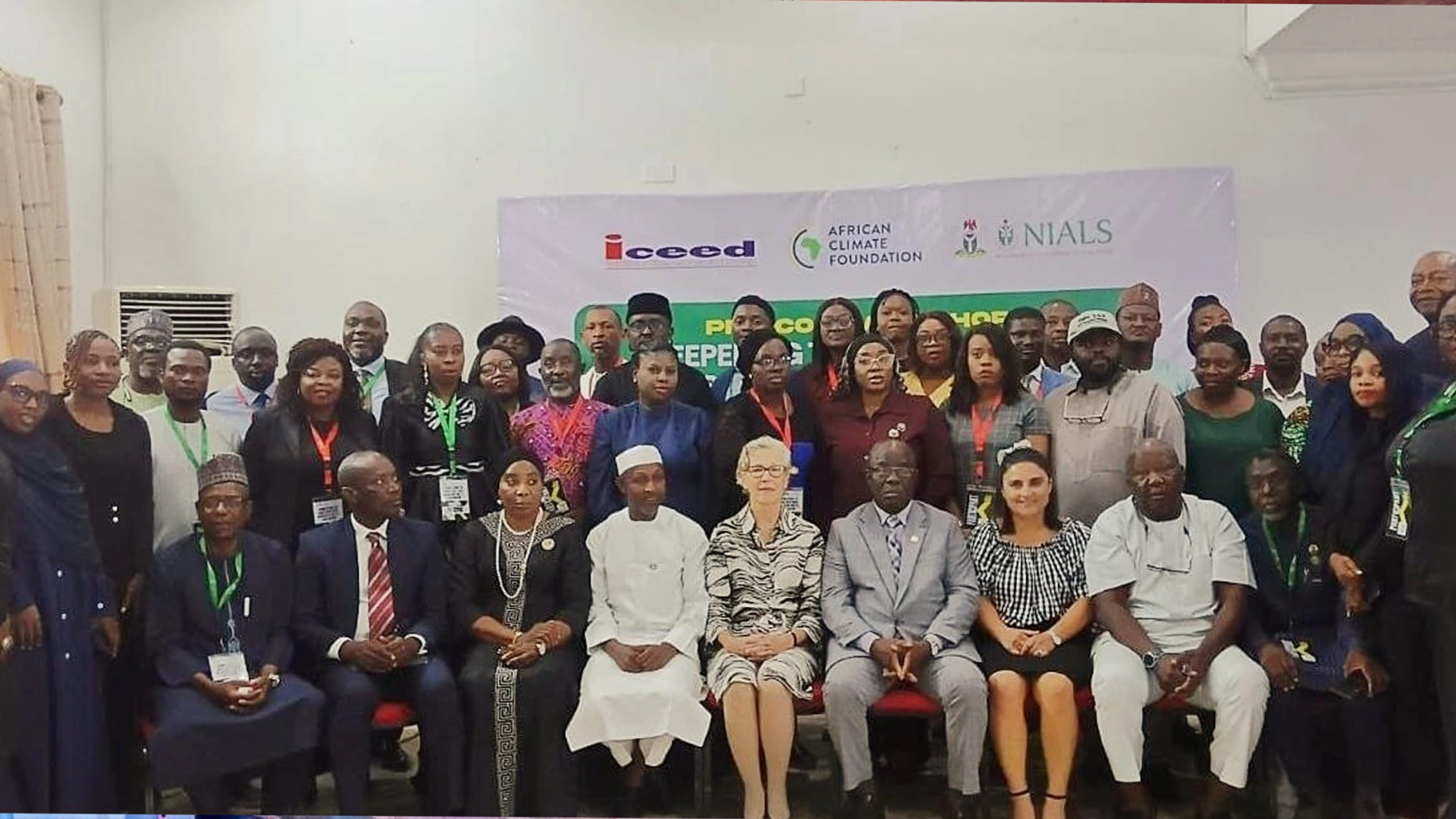
TO address gaps in Nigeria’s climate policies and international representation, the International Centre for Energy, Environment and Development (ICEED) has partnered with the National Institute of Advanced Legal Studies (NIALS) to build the capacity of legal practitioners.
The collaboration seeks to equip Nigerian lawyers with the requisite skills to review the existing Climate Change Act and support the country’s delegation at international negotiations, including the upcoming Conference of Parties (COP) in November.
Speaking during a capacity building workshop, in Abuja, the Executive Director of ICEED, Ewah Eleri, noted that international climate issues have become highly complex and technical since the Act was passed by the National Assembly.
He stressed the urgent need to integrate emerging global trends into the national legal framework.
“For us to negotiate on the best possible terms on issues of climate finance and several other issues that the Paris Agreement has set forth, we need to be able to build this kind of capacity,” Eleri said.
He recalled that an initial preparatory session held in May ahead of the June subsidiary bodies meeting in Germany, adding that the current training serves to further sharpen the skills of lawyers ahead of the global summit.
Eleri also disclosed that the initiative is establishing a permanent legal working group to consistently support Nigeria’s official delegations and serve as a resource for implementing the Climate Change Act.
Also speaking, the Director-General of NIALS, Prof. Abdulqadir Abikan, represented by the Director of Research Prof. Emmanuel Okon, observed that the current structure of the Climate Change Act might not adequately serve Nigeria’s interests when compared to global standards in other jurisdictions.
Abikan pointed that the Nigeria often experiences significant gaps during the negotiation of climate change instruments at the international level, a deficit the training actively aims to bridge.
He observed that “The major focus of the legal working group is to ensure that we do not just amend the Act or ask for a new one without a concrete purpose.
“This training will help us identify specific areas to integrate, whether through an amendment or new regulations.”

On his part, the Director of Climate Change at the Kano State Ministry of Environment, Umar Saleh Anka, emphasised the importance of the training for the state-level domestication of climate laws.
Anka stated that Kano State currently has a climate policy and an ongoing bill, adding that legal drafters must deeply comprehend the technicalities of the United Nations Framework Convention on Climate Change (UNFCCC).
Anka noted that “The texts are technical terms. If lawyers are not conversant with climate change technicalities, they may not be able to make a sound bill or policy. Without them understanding the nitty-gritty, we will not have sound laws.”
The Special Assistant to the Abia State Governor on Climate Change and Sustainability, Esther Ajah, described the training as timely amidst emerging global regulations.
She stressed that equipping lawyers with updated perspectives is vital for building investor confidence, noting that Abia State is already integrating climate alignment into its 25 year development plan to attract sustainable finance.

