 Follow Us on Google News
 Follow Us on Google Discover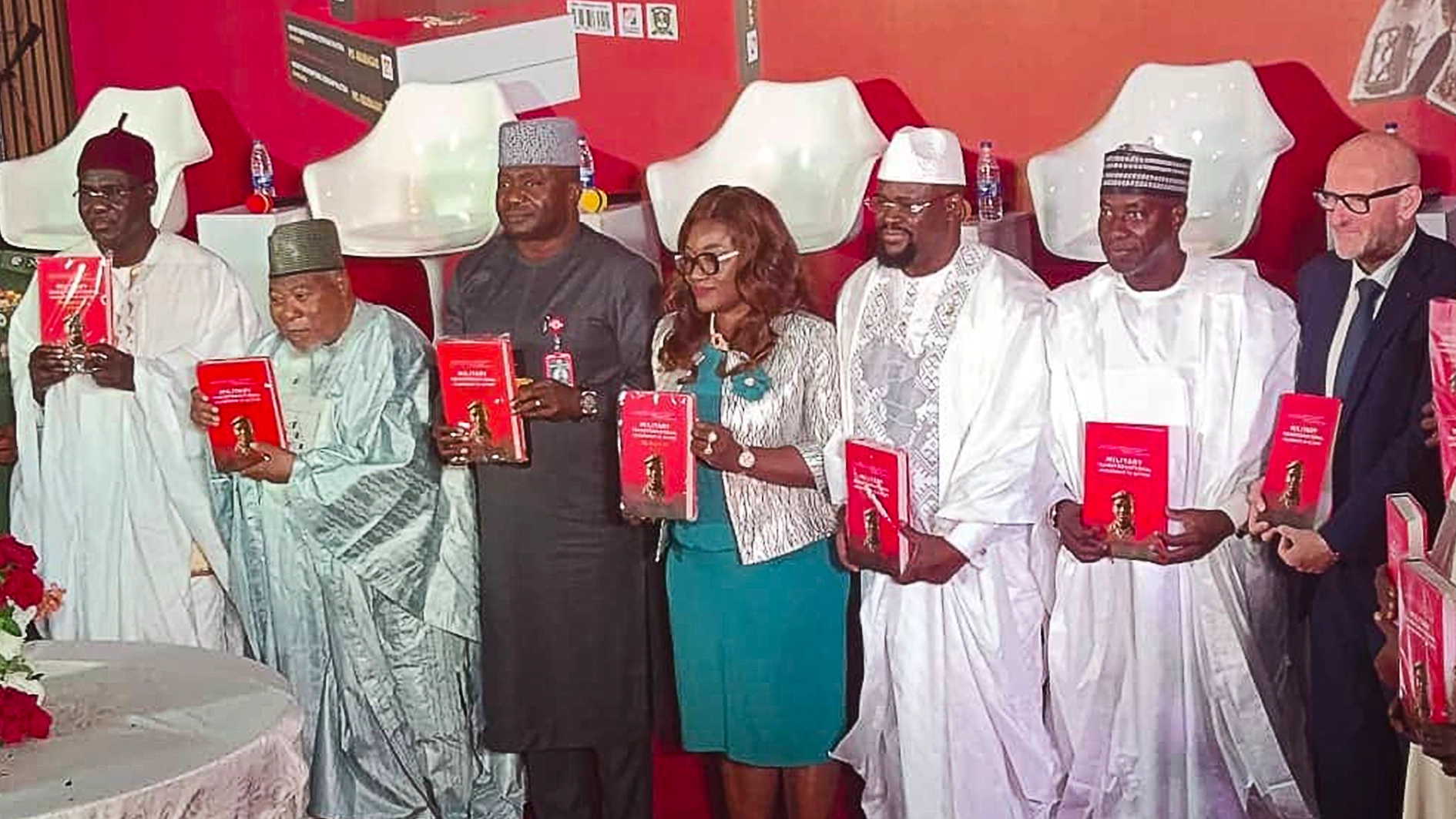
The Minister of Defence, Christopher Musa, and Senator representing Borno South, Ali Ndume, yesterday commended the former Chief of Army Staff (COAS), Lt. General Tukur Buratai (rtd.), for his leadership and contributions to the transformation of the Nigerian Army.
They spoke at the public presentation of Military Transformational Leadership in Action: The Buratai Era, written by Dr. M.S. Abubakar, at the Nigerian Army Conference Centre, Asokoro, Abuja.
The book, which examines the leadership decisions, institutional reforms and security challenges that characterised Buratai’s tenure as Army Chief, was presented by the Buratai Legacy Presentation Committee, with Sprezzatura Publishing Limited in collaboration with Clarivox Creative Limited.
Musa, who described himself as a direct beneficiary of Buratai’s legacy in the Armed Forces, said the former Army Chief demonstrated how institutional change could be achieved through policy, discipline and patient reform.
According to him, Buratai moved swiftly to address the challenges confronting the Army when he assumed office, adding that his interventions had continued to shape the service.
He said, “When he took over, he did not waste any time. He quickly dashed into providing solutions towards the challenges you were confronted with at that instance. And that was very, very significant.”

Musa highlighted Buratai’s ability to identify and develop future military leaders, saying officers who were given opportunities to serve under him subsequently rose to become senior commanders.
“One thing that distinguished him was his ability to identify future leaders,” the minister said.
He noted that several of the officers Buratai identified and empowered later became three-star and four-star generals, describing this as evidence of the former Army Chief’s leadership character.
Musa also recalled Buratai’s personal commitment to duty, saying he was constantly available to his officers and troops and worked extensively to monitor operations.
“I was wondering whether he ever slept. Because at every point in time you meet him, he was up and doing,” he said.
The minister urged military officers, students and policymakers to read the book and draw lessons from Buratai’s experience.
He said the publication should not merely remain on shelves but should serve as a reference for people seeking to understand leadership, sacrifice, institutional reform and national service.
Presenting the book, Musa said it was an opportunity for current and future leaders to reflect on the impact they were making in the country.
He urged officers to continually ask themselves what positive contribution they had made to Nigeria and strive to make a difference.
Ndume, who also reflected on Buratai’s tenure, said the former Army Chief provided leadership at a particularly difficult period in Nigeria’s security history.
He said the country’s security challenges should not be regarded as the responsibility of the military alone, stressing that traditional rulers, religious leaders, community leaders, security agencies, the judiciary and political leaders all had roles to play.
“Security is our duty, all of us. Traditional rulers, religious leaders, community leaders, the military, the police, the judiciary and, most important, the political leaders really have to be committed to peace,” Ndume said.
He urged Nigerians to abandon ethnic and religious interpretations of insecurity, insisting that the challenges confronting the country affected everyone.
“It’s not a Northern problem. It’s not a Muslim problem. It’s not a Christian problem. It is a Nigerian problem. We have lost our sense of being a nation. We have to go back to that,” he said.
Recalling the security situation before Buratai assumed office as Army Chief, Ndume said the level of insecurity had at one point affected freedom of movement even in Abuja.
He said Buratai’s tenure was significant not only because of military operations but also because of the leadership and institutional changes introduced during the period.
Ndume also commended the Federal Government for improvements in the welfare of military personnel, particularly the increase in soldiers’ remuneration.
The author, Abubakar, said the book was the result of about 10 years of research which began in 2016, when the war against Boko Haram was ongoing.
He said he documented events, interviewed stakeholders and observed the military campaign over the period in an effort to preserve the history of the Army’s transformation.
“This is not a praise song. It is a leadership document,” he said.
Abubakar said the book adopted an evidence-based and longitudinal approach to examining reforms introduced during Buratai’s tenure, including welfare schemes, the Nigerian Army University Biu, resource centres and manufacturing complexes.
He also examined Buratai’s approach to leadership in crisis, including his decision to relocate to the North-East and remain close to troops operating in the theatre.
The author said the book also documented the combination of kinetic and non-kinetic strategies, including human rights desks, medical outreaches and civil-military engagement.
He argued that military campaigns against insurgency could not succeed through the use of force alone, stressing the importance of institutions, development and civilian trust.
Also speaking, an expert in public administration and good security sector governance at the University of Abuja, Prof. Philip Dahida, said Buratai introduced several transformative and practical measures during his tenure.
He said the former Army Chief established institutions and military formations and strengthened the framework for counter-insurgency operations.
The Emir of Kano, Muhammadu Sanusi II, also called for stronger institutions and a reduction in the politicisation of ethnicity and religion.
Sanusi said Nigeria’s security crisis did not begin with the current manifestations of terrorism and banditry, arguing that years of divisive rhetoric had created conditions that could facilitate violence.
He urged political leaders to focus on providing education, healthcare, jobs and economic opportunities, while religious leaders should concentrate on their religious responsibilities.
Also speaking at the event, Lt. General (rtd.) Domenico Giani said the book offered an opportunity to examine how military institutions could be transformed while responding to complex security threats.
Giani said the Nigerian Army under Buratai had faced terrorism, insurgency, banditry and mass abductions, adding that the experience demonstrated the need for institutions to continuously adapt to changing threat

