 Follow Us on Google News
 Follow Us on Google Discover
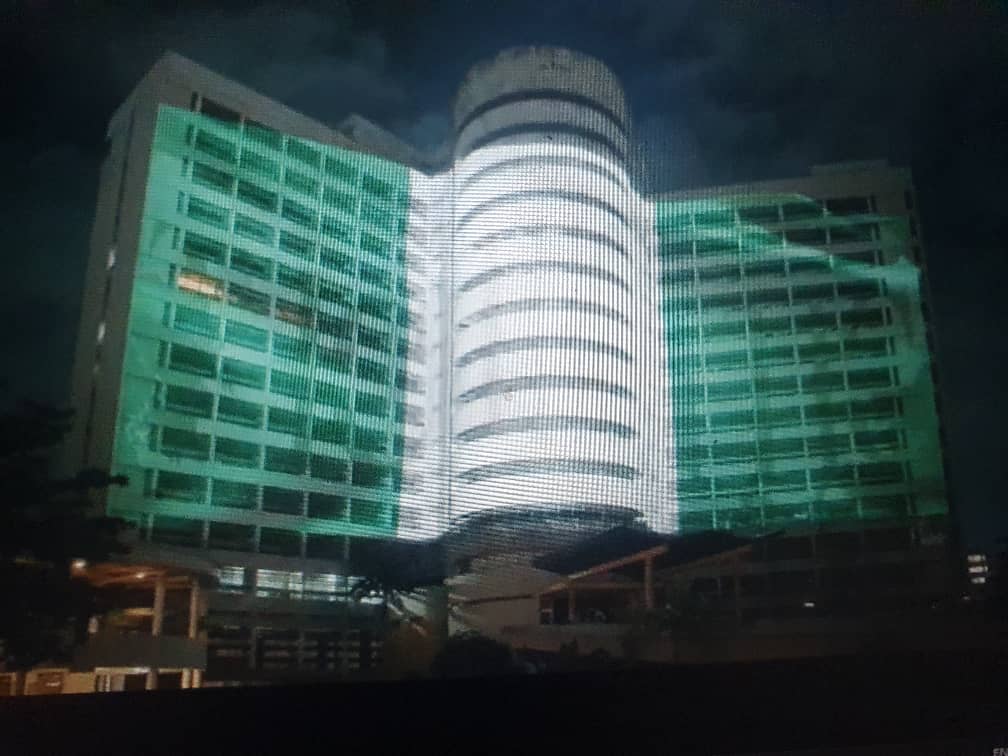
It was a moment to savour as Federal Palace Towers in Victoria Island were bathed in the piercing emerald ( Nigeria’s massive agricultural wealth) and stark ivory of the Nigerian flag, which symbolises peace and unity; the stunning display is far more than a fleeting architectural light show. Against the sprawling, relentless backdrop of Lagos’ night skyline, this illumination becomes a profound historical dialogue. Ask a historian, and they will tell you that monuments are never merely concrete and glass, but vessels of public memory. Lighting this particular edifice in the national colours of Green, White, and Green transforms a commercial landmark into a towering lighthouse of national remembrance and appreciation.
To understand the impact of this visual gesture, one must first recognise the hallowed ground upon which the Federal Palace stands in the chronology of the Nigerian nation and history.
The Crucible of First Republic
The Federal Palace Hotel is not an arbitrary canvas; it is the cradle of Nigeria’s post-colonial identity. Constructed by the A.G. Leventis group and opened just in time for October 1, 1960, it was explicitly built to host the world as Nigeria stepped onto the global stage as a sovereign nation. Within this very complex, the founding fathers gathered; dignitaries from across the globe toasted the birth of the most populous Black nation on earth; and the independence declaration’s ink dried.
To illuminate its towers today is to trace a direct line back to that midnight in 1960 when the British Union Jack was lowered, and the Green-White-Green was hoisted for the very first time.
Lighting the Federal Palace Towers is a temporal bridge. It forces the modern gaze to look upward and backwards simultaneously, anchoring the frantic pace of 21st-century Lagos to the profound optimism of the 1960 independence era.
By casting the national colours across the facade of the building where Nigeria’s independence was effectively inaugurated, we are engaging in a deliberate act of historical reclamation. It reminds the nation that the promises of the First Republic—sovereignty, unity, and progress—were birthed right here, on the edges of the Atlantic.

The Semiotics of Illumination: Green and White
When Michael Taiwo Akinkunmi designed the Nigerian flag in 1959, his mandate was radical simplicity. The green bands represent the nation’s immense natural wealth and agricultural heritage, while the white band stands as a perpetual mandate for peace and unity.
Fabric on a flagpole is subject to the wind; it can droop, fray, or fade. Light, however, is active and undeniable. Akinkunmi’s semiotics are amplified when these colours are projected onto the Federal Palace Towers at a monumental scale,
The Emerald Green: Projected into the night, the green light ceases to be just a symbol of agriculture; it becomes a glowing representation of survival and economic resilience. It honours the vastness of the Nigerian landscape, from the mangroves of the Niger Delta to the Sahelian savannas, acknowledging the natural endowments that have sustained the republic through decades of economic turbulence.
The Ivory White: The blinding white light cutting through the Lagos night is perhaps the most poignant. In a nation whose history has been fractured by a devastating civil war, regional fractures, and political upheavals, the white light stands as a continuous insistence on peace. It is a visual prayer for the unity that the architects of 1960 envisioned.
The Imperative of Remembrance
Identity is lost when a nation fails to institutionalise its memory. This is why lighting the Federal Palace is a vital act of public remembrance. It serves as a glowing cenotaph not just for the titans of the independence movement—Nnamdi Azikiwe, Obafemi Awolowo, Ahmadu Bello, and Tafawa Balewa—but for the ordinary Nigerians who endured the nation’s subsequent growing pains.
Remembrance, in a historical context, is not merely about nostalgia; it is about confronting the past with open eyes. The illuminated towers prompt a necessary reflection on the journey from the euphoria of 1960 to the complex realities of today. They silently demand that we remember the coups, the conflict, the protests, and the democratic transitions. The lights do not sanitise history; rather, they hold space for it, acknowledging that the Nigerian story remains a work in progress, hard-fought, and worthy of deep reflection.
A Gesture of Deep Appreciation
Beyond remembrance, this grand visual display is an act of profound appreciation for the endurance of the Nigerian spirit. Lagos, the economic nerve centre of West Africa, is a city defined by its kinetic energy, its hustle, and its relentless forward motion. In the midst of this daily grind, illuminating the city’s skyline in the national colours is a moment of collective pause.
It is a tribute to the resilience of a populace that continues to innovate, create, and thrive against staggering odds. When citizens look across the lagoon and see the towers glowing in Green and White, it validates their daily contributions to the Nigerian project. It says to the artist in Surulere, the tech entrepreneur in Yaba, and the trader in Balogun market: The nation you are building is visible; the heritage you carry is vibrant.
Monuments speak to those who are willing to listen. By dressing the Federal Palace Towers in the green and white colours of the republic, we are not just decorating a skyline. We are keeping a 66-year-old promise alive, projecting the enduring dream of Nigeria into the night sky, and ensuring that the light of the republic—no matter how stormy the surrounding waters—refuses to be extinguished

