
 Get Guardian on Google
The low public trust in the Independent National Electoral Commission (INEC), threatens to be the major obstacle to a free and fair 2027. For there to be integrity in elections, the process, from start to finish must be credible. It is incumbent on the electoral umpire to display credibility and courage. Stakeholders must testify that INEC is indeed independent and able to act without pandering to biases and plots of the political class.
Today’s INEC is struggling to earn the trust of the people. And public trust is crucial for the elections. There are concerns now that INEC urgently needs to boost its credibility rating among Nigerians if it is to be trusted to administer the 2027 elections.
The Concerned Citizens for Nigerian Democracy (CCND), a coalition of civil societies, alerted last week that they have no confidence in officials of INEC, as well as the police to deliver free and fair elections. Their fears are anchored on the perception that INEC is not neutral and could not be trusted to deliver free and fair elections.
In a survey reported in January by Yiaga Africa, more than half of Nigerians do not trust INEC due to their past experiences. In yet another of the organisation’s National Voting Intentions Survey 3.0, carried out in September 2026, INEC’s integrity rating fell from a previous 45 per cent to 34 per cent. That survey involved 2,470 Nigerians across the 36 states and the Federal Capital Territory, with 2,066 respondents interviewed by telephone and 404 others through face-to-face interviews.
Low voter confidence rating of INEC is not manufactured. The survey results are expressions of Nigerians who expect higher outcomes from an electoral body. Yet, by its disposition, INEC has continued to act as the electoral wing of the Federal Government. INEC is perceived not to distance itself from the antics of politicians, but is quick to give life to devious plots clothed in judicial pronouncement, all in the bid to suppress and weaken opposition.
Where INEC is expected to show discernment and restraint, it is seen more as a collaborator to partisan litigants whose objective is to neutralise and dismantle multi-party democracy. Each move by INEC, whether in fixing electoral timelines, approving list of candidates or sluggishness with the voter register, exposes its failure to stay neutral. There’s always the hand behind the scene, pulling the strings to ensure that INEC delivers a pattern of outcomes.

It is argued that because INEC lacks independence contrary to what its name advertises, the mentality among the staff is to be beholden to politicians in the ruling party, rather than owe their allegiance to the country. The appointment of the vital INEC bureaucracy by the President does a great harm to free and fair elections. Many INEC appointees are party loyalists, even when they’re not registered card-carrying members. They owe their patriotism to individuals, rather than to the country. Some are deliberately sabotaging the system from within.
Voter register crisis
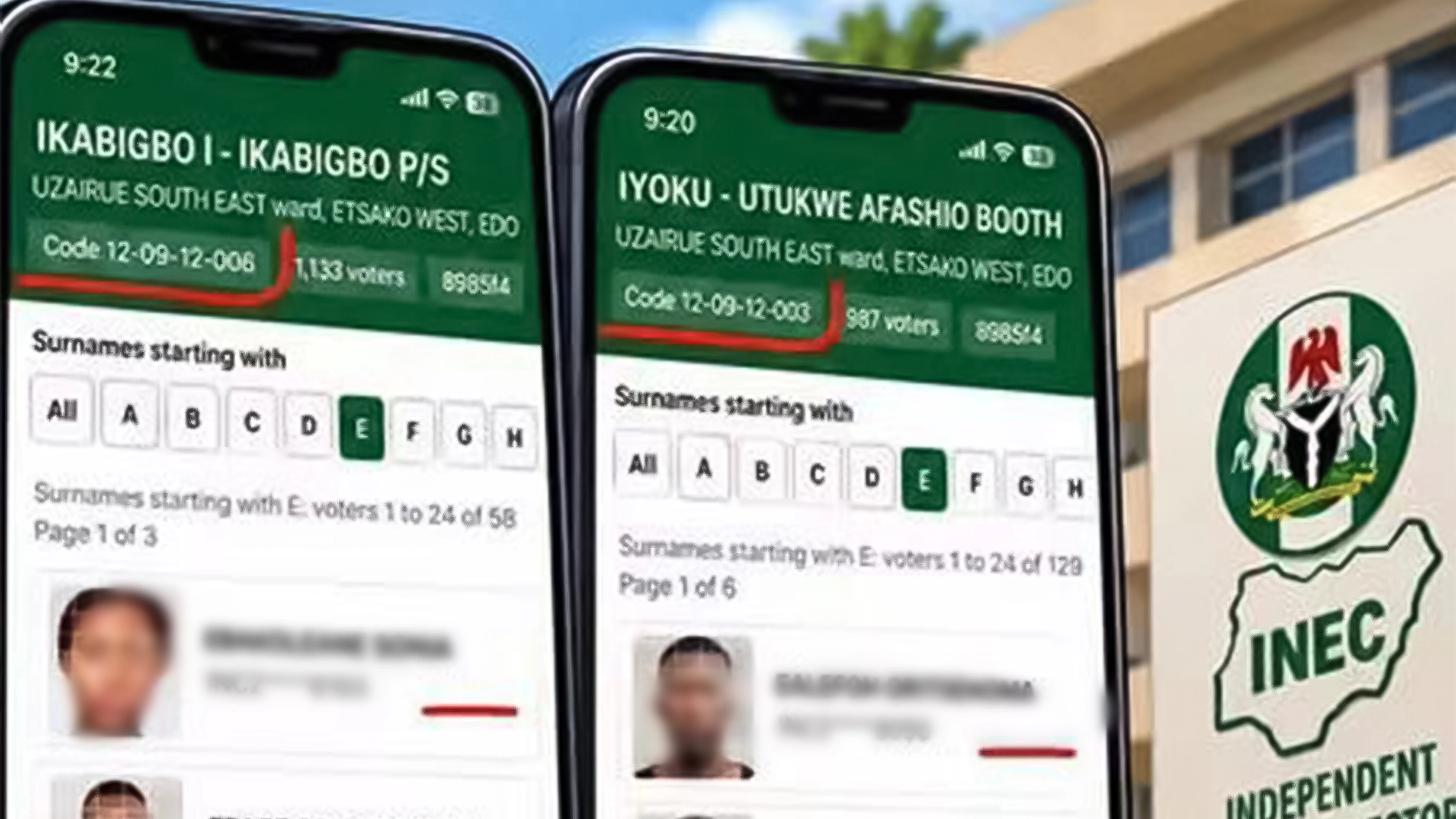
The revelations of fictitious and AI-generated entries in the preliminary register displayed online by INEC, is now the major threat to free and fair elections come 2027. There had been reports that INEC was reluctant to display the physical register at the Ward and Local Government level, as provided in the Electoral Act. Even though INEC claimed the register was on display from October 9 to 15, 2026, millions of registered voters lamented their lack of access to the document. The online display, last week, was meant to complement the poor physical display in the wards and councils, but it turned out to be a disaster.
The voter register is populated with AI-generated photographs and fake entries, including dead people. A particular corruption was flagged by MundX Analytics on X. It showed factitious entries in the register for Uwessan Ward in Esan Central, Edo State. In the 2023 elections, 397 voters were registered here. In the updated register for 2027 elections, the number had ballooned to 4,783, filled with computer-generated photographs.
In another Unit of the same Ward, where 4,900 were registered in 2023, the numbers of prospective voters are now 15,304. This is said to be the polling unit of Edo State Governor, Monday Okpebholo, who had promised to deliver 2.5 million votes to President Tinubu come 2027, by whatever means.
Horrified by this development, citizens are forced to conclude that INEC’s neutrality and capacity to deliver free and fair elections is now in great doubt. Nigerians are compelled to reason that INEC has knowingly packaged a dubious register to deliver an expected end.
In his response on X, activist and opposition leader, Prof. Pat Utomi, stressed: “INEC cannot afford to be careless with the credibility of Nigeria’s electoral process. The presence of AI-generated images in a register meant to support our democracy raises serious questions about verification, transparency and accountability. Our democracy is at stake here.”
In its initial response, INEC admitted there were irregular entries in the Preliminary Voter Register. The chairman of INEC’s Committee on Information and Education, Mallam Mohammed Kudu Haruna, claimed that during the physical display of the register for claims and objection, a number of questionable registration records were identified and flagged for further examination, which it had commenced reviewing for correction.
INEC further claimed that the display was intended for scrutiny by Nigerians, to correct the inaccuracies and irregularities. He said the Commission was examining the circumstances surrounding the suspicious photographs, including possible technical or procedural lapses.
The INEC Director of ICT, Dr Lawrence Bayode, clarified that some of the Commission’s registration officers in the field were responsible for inserting fake photographs and entries in the register. He said its field officers across the country have done different things to insert irregularities in the register, but it doesn’t know why. Bayode explained last Friday, on an Arise TV Morning Show, that preliminary investigations revealed that field officers abused their official login credentials to compromise the voter registration, and that the irregularities were not limited to one location, but involved its officers across different locations. He said the Commission’s Automated Biometric System (ABS) detected the fictitious entries.
Hear him: “When the ABS was run on the system, we saw these people, we know what did. We know how they did it, but honestly, I don’t know why.”
He doesn’t know why. Let’s help him out. Politicians had inflated the register in preparation for election day rigging. Many Nigerians will agree that INEC has not been proactive enough. Why would the Commission still go ahead to release a compromised register after its ABS was run on the system and it revealed the irregularities? If the content of what was displayed online is the same as what was displaced physically between October 9-15, and INEC knew it contained irregularities, why still go ahead to release it online? Why not take out the fake entries before going online? Why was the physical display not well done for proper scrutiny; and why was INEC sluggish to display the register online, until it was pressured?
Yiaga Africa, in its reaction didn’t appear surprised because this is not the first time a voter register is padded. It said: “As our Election Manipulation Risk Index (EMRI), shows, tampering with voter register has always been a tool for manipulation by politicians and compromised INEC officials. In the lead-up to the 2023 elections, there were confirmed cases of padding of the voter register. Some INEC officials implicated in these irregularities were reportedly investigated, yet, the public never received an account of the disciplinary measures taken against those implicated. In 2026, we seem to be witnessing a disturbing recurrence of the same problems. Will anyone be held accountable for manipulating or compromising the voter register?”
It is now clear that INEC’s gleeful announcement of registering 103 million voters was without substance. The numbers couldn’t have happened without padding and manipulation. Proceeding from here would be really difficult for INEC, because it has further lost more credibility. Yet, there’s not enough outrage in INEC because they’re used to it.
INEC and announcement of election result
Until the voter register blunder, INEC had wasted time arguing whether or not the media can declare election results. The media have never declared election results. It is INEC that has the authority to declare results. That is not in contention. What has become a headache to INEC and their sponsors in government, is the increased conversation among the opposition and the civil society on the need to ensure that results that are declared at the polling units, on their way to collation at the Ward, LGA up to the state level, are not tampered with.
Prof. Joash Amupitan, the INEC chair, has been all over the place making an issue of who should announce election results. It is a needless campaign that again betrays on whose side INEC is operating. Ordinarily, the Commission should be at home with the prospect of different groups helping to track results to ensure transparency in the system. It is to the advantage of INEC that citizens take advantage of the BVAS and INEC Result Viewing Portal (IREV), to monitor movement of results from the polling units.
Many groups have their Situations Rooms, including political parties, where they tabulate results sent in by their agents. They merely help to aggregate the scores, while INEC has the final say in announcing the results. That helps to give a second opinion and credibility to whatever INEC announces, because it is already in the public domain. So, what’s the Prof. afraid of?
In 2023, it was INEC that failed to deliver, when half-way it reported a glitch. In 2027 Prof. Amupitan should ensure there is no glitch. That’s why INEC presented a budget of over N200 billion to set up a robust ICT Desk. Nigerians are watching!
By Alabi Williams writes from Lagos, Nigeria