
 Get Guardian on Google
By Kabir Alabi Garba
In the Name of the Almighty, the Beneficent, the Merciful
“You are the best nation raised for mankind. You enjoin what is right, forbid what is wrong, and believe in Allah.” Qur’an 3 verse 110
For many Muslims in South-West Nigeria, the challenges of practising their faith and securing their socioeconomic future increasingly intersect. From the struggle of indigent Muslim families to educate their children in an increasingly competitive environment to the difficulties of accessing affordable healthcare, rising poverty, youth unemployment and the weakening economic capacity of many communities, the issues confronting the Ummah extend far beyond the four walls of the mosque.
The region has a rich Islamic heritage, a substantial Muslim population and a remarkable collection of religious institutions, scholars, philanthropists and successful professionals. Yet, the question of how these human, intellectual and financial resources can be harnessed to improve the living conditions of ordinary Muslims remains an important challenge.
There is also the need to strengthen Muslim institutions, deepen educational opportunities, encourage economic self-reliance, nurture responsible leadership and ensure that religious identity translates into tangible contributions to society.
This is why the 11th General Assembly of the Muslim Ummah of South West Nigeria (MUSWEN), scheduled for Sunday, November 15, 2026, in Ibadan, deserves more than routine religious attention.
Its proposed endowment fund, particularly the mobilisation of ₦2 billion for healthcare, scholarships and economic empowerment, present an opportunity for the organisation to redefine the meaning of collective responsibility within the Muslim community.
The assembly must therefore be seen as more than another gathering of Muslim leaders and stakeholders. It is an opportunity to confront an uncomfortable question: what practical difference does the collective strength of the Muslim Ummah make in the lives of its most vulnerable members?
The answer may well determine the enduring relevance of MUSWEN as the umbrella organisation seeking to coordinate the interests and aspirations of Muslims across the six South-West states.
The foundation for this thinking is found in Qur’an 3:110 referenced above. This verse is frequently invoked to celebrate the special position of the Muslim community. However, its deeper implication is that the distinction comes with responsibilities. Muslims are not described as the best community merely because of their numerical strength, religious visibility or historical achievements. Their distinction rests on their commitment to righteousness, their willingness to confront wrongdoing and their faithfulness to Allah.
Being the best community, therefore, must translate into measurable contributions to humanity.
A Muslim community that cannot adequately care for its disadvantaged members, provide educational opportunities for its children, support its unemployed youths or protect its vulnerable families must continually examine whether it is living up to the responsibilities imposed by this divine injunction.
The holy Prophet (peace be upon him) reinforced this obligation when he taught that whoever sees an evil should change it with his hand; if unable, with his tongue; and if unable, with his heart, which is the weakest level of faith. This teaching challenges Muslim institutions to move beyond preaching and become active instruments of social reform.
Perhaps the most compelling feature of the forthcoming MUSWEN assembly is the proposed mobilisation of ₦2 billion to finance programmes in healthcare, education and economic empowerment.
This initiative deserves particular attention because it addresses some of the most pressing needs of Muslim communities in the South-West.
The proposed establishment of a modern healthcare facility, scholarships for indigent students and empowerment programmes for disadvantaged members of the Ummah should be regarded as strategic investments in human dignity rather than ordinary charitable gestures.
Healthcare remains a major burden for many low-income Nigerian families. The rising cost of medical services, medicines, diagnostic procedures and hospital admissions often pushes vulnerable households into deeper poverty. For families without adequate financial protection, a medical emergency can become an economic disaster.
A MUSWEN-backed healthcare initiative could provide an important intervention, particularly when it is structured to offer affordable and accessible services to disadvantaged families, irrespective of their religious or ethnic backgrounds.
The proposed scholarship programme is equally significant. Across the South-West, many brilliant children from economically disadvantaged Muslim homes struggle to obtain quality education because their parents cannot meet the financial demands of schooling. Some are compelled to abandon their educational ambitions, while others remain trapped in institutions that cannot adequately prepare them for the demands of a changing world.
A well-administered scholarship scheme could help reverse this trend by identifying deserving students, supporting their education and developing a new generation of professionals, intellectuals and community leaders.
The third intervention, economic empowerment, is perhaps the most direct response to the poverty confronting many Muslim households. Rather than limiting assistance to occasional donations, the programme should support sustainable livelihoods through vocational training, entrepreneurship development, access to productive capital and business mentorship. Women, young people, artisans, small-scale traders and other economically vulnerable groups should receive particular attention.
It should be noted that the welfare of disadvantaged members of society is a central component of religious responsibility. In Qur’an 107:1-3, Allah (SWT) condemns those who neglect the orphan and fail to encourage the feeding of the poor.
Similarly, Qur’an 2:177 identifies righteousness with giving wealth, despite one’s love for it, to relatives, orphans, the needy, travellers and those who ask for assistance.
These injunctions establish that compassion and social responsibility are not peripheral to Islam. They are essential expressions of faith.
The proposed endowment fund is particularly important. Instead of depending perpetually on occasional appeals, MUSWEN is geared towards developing a sustainable financial mechanism capable of generating resources for its interventions over the long term.
The real achievement will not be the amount announced at the fundraising ceremony but the number of lives transformed through the effective application of the money.
The challenge of unity remains another important concern for the Muslim community in South-West Nigeria. MUSWEN was established to provide a common platform for Muslim organisations, scholars, traditional institutions, professionals and communities across the region. Its relevance lies in its ability to bring diverse interests together and mobilise their collective strength for the advancement of the Ummah.
The Qur’an provides a clear instruction in 3:103: “And hold firmly together to the rope of Allah and do not be divided.”
Unfortunately, religious organisations sometimes expend considerable energy on avoidable disagreements, personality clashes and institutional rivalries that weaken their collective influence.
The forthcoming assembly should encourage a renewed commitment to cooperation, mutual respect and shared development priorities. Muslim organisations must recognise that their individual strengths become more meaningful when coordinated towards common objectives.
Now, the anticipated leadership transition at the Ibadan assembly offers another opportunity for institutional reflection. After six years under Alhaji Rasaki Oladejo, the transfer of leadership to a new administration should represent continuity of purpose, institutional maturity and renewed commitment to the organisation’s objectives.
Islamic leadership is fundamentally a trust. In Qur’an 4:58, Allah commands believers to return trusts to those entitled to them and to judge with justice. Holy Prophet (peace be upon him) similarly taught that everyone is a shepherd and responsible for those under their care. These teachings should guide both the outgoing and incoming leadership.
MUSWEN needs leaders who can mobilise resources, strengthen institutions, promote accountability and engage constructively with government without compromising the legitimate interests of the Muslim community.
The organisation must also demonstrate that religious leadership can be inclusive, transparent, forward-looking and responsive to the everyday concerns of ordinary people.
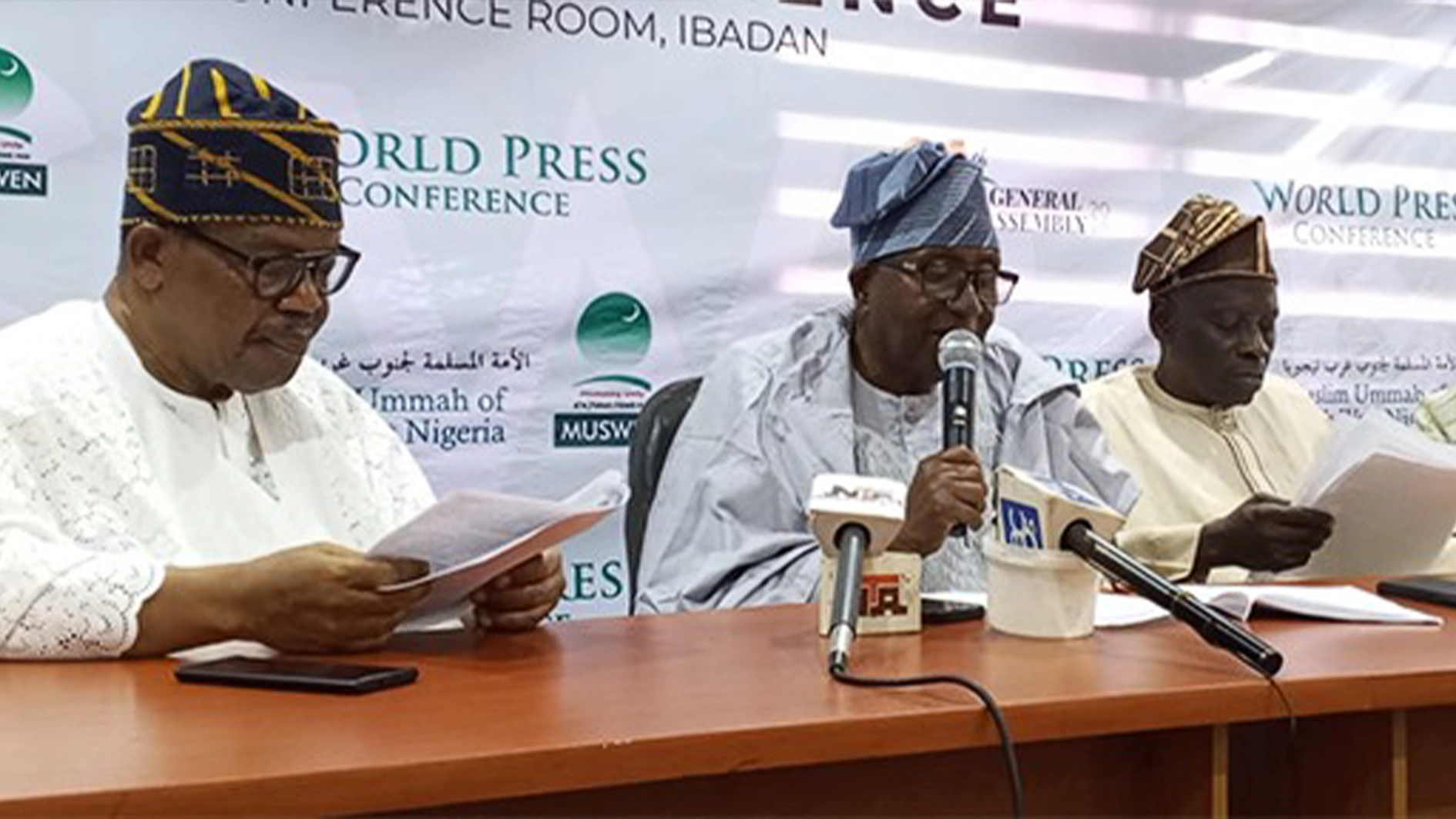
Gladly, preparations for the 11th General Assembly have involved consultations and mobilisation activities aimed at securing the participation and support of political leaders, traditional rulers, Muslim stakeholders and influential personalities across the South-West.
MUSWEN President, Alhaji Rasaki Oladejo, has led delegations on courtesy visits and consultations with prominent stakeholders.
Among those engaged are Lagos State Governor, Babajide Sanwo-Olu, and Chairman of the Lagos State Governor’s Advisory Council, Prince Tajudeen Olusi, who have pledged support for the assembly and the organisation’s development initiatives.
In Ogun State, the Deputy Governor, Noimot Salako-Oyedele, and the Olowu of Owu Kingdom, Oba Saka Adeola Matemilola, have also received MUSWEN delegations and encouraged Muslim unity and cooperation.
Engagements have also taken place with Ondo State Governor, Lucky Orimisan Aiyedatiwa, including discussions on religious harmony and the proposed state structure of the Nigeria Inter-Religious Council (NIREC).
The assembly is expected to attract President Bola Ahmed Tinubu, the Sultan of Sokoto, Alhaji Muhammad Sa’ad Abubakar III, governors of South-West states and other prominent personalities. Borno State Governor, Professor Babagana Zulum, is expected to deliver the annual lecture.
These mobilisation activities demonstrate the importance attached to the gathering. However, the presence of political leaders and eminent personalities should not become the principal measure of its success. Their participation should translate into meaningful partnerships, institutional support and commitments to the proposed social interventions.
MUSWEN’s responsibilities also extend beyond the immediate interests of Muslims.
In a religiously diverse country such as Nigeria, Muslim institutions have an important role in promoting peaceful coexistence, mutual respect and national cohesion.
The message in Qur’an 5:8 is instructive cautioning believers against allowing hatred of a people to make them depart from justice. Also, in Qur’an 60:8, Allah encourages kindness and fairness towards those who do not fight Muslims on account of their religion or drive them from their homes. These injunctions provide a sound foundation for interfaith engagement.
MUSWEN’s efforts to strengthen NIREC and encourage functional state-level structures deserve support. Regular engagement between Muslim and Christian leaders, particularly at the grassroots, can help prevent misunderstandings from degenerating into religious and communal conflicts.
The organisation must also encourage Muslims to participate responsibly in Nigeria’s democratic development, demand accountability from political officeholders and resist the temptation to sacrifice ethical principles for partisan interests as the country approaches the 2027 general elections.
Ultimately, the most important message of Qur’an 3:110 is that the distinction of being the best community must be continually earned through righteous conduct and service to humanity.
The 11th MUSWEN General Assembly should therefore be judged not only by the number of dignitaries in attendance, the grandeur of its ceremonies or the applause generated by its speeches, but also by the practical results it produces. The proposed healthcare facility must become operational. Scholarships must reach deserving students. Empowerment programmes must create sustainable livelihoods. The endowment fund must be professionally managed, and every contribution must be accounted for.
The incoming leadership must also develop a clear implementation framework, establish measurable targets and regularly communicate progress to the Muslim community.
As delegates converge on Ibadan on November 15, the fundamental challenge is unmistakable: can MUSWEN transform the collective spiritual, intellectual, human and financial resources of Muslims in South-West Nigeria into an effective instrument of social development?
The answer must be found in the lives saved, children educated, businesses established, families lifted out of poverty and institutions strengthened. That is what it means to translate faith into service.
And that is the real test of the Qur’anic declaration that Muslims are the best community raised for humanity.