
 Get Guardian on Google
By Tunde Adegbola
The editor, Olatoun Gabi-Williams’ introduction to ‘Our Digital Lives and Indigenous Pathways, Volume 2 of ‘Living Sustainably Here: African Perspectives on the SGDs’, establishes the direction of this anthology, exploring sustainable development through African lived experiences, knowledge systems and prospects in the Information Age. Drawing on contributions from different African countries, it examines how Africa can meet contemporary developmental needs while preserving ecological balance and cultural identity. Sustainable development must draw on indigenous knowledge, local practices and African creativity while engaging critically with digital technologies. It also raises fundamental questions about who owns and controls the data, platforms and technological infrastructure that shape Africa’s participation in the global knowledge economy.
The anthology seeks to make the Sustainable Development Goals (SDGs) accessible to Africans, particularly young readers. It identifies structural distortions of colonial systems in education, healthcare, infrastructure, finance and governance. Digital technologies, creative economies and financial technology are presented as possible instruments of African development and autonomy. Artificial intelligence and data ownership are new frontiers in the struggle for African self-determination.
Several contributions explore indigenous knowledge, environmental sustainability and intergenerational learning. One examines efforts by young Zambians to preserve culinary heritage through indigenous foods, that embody ecological and cultural knowledge, increasingly threatened by urbanisation and drought. A cooking session in Lusaka West, involving young people guided by elderly women, illustrates how community based learning and digital documentation can preserve traditional food knowledge.
However, the initiative’s limited scale points to the need for wider and more sustained interventions. Anna Leonard’s study of women-led economies in Windhoek, Namibia, examines how women entrepreneurs use social media for marketing, networking and knowledge-sharing. Although social media creates economic opportunities, entrepreneurs face barriers including restricted access to payment services, limitations on platform monetisation, online scams, shipping costs, VAT and high data charges. The study recommends digital-literacy training, improved access to funding, engagement with digital platforms and VAT relief.
It demonstrates how digital participation can support local enterprise while remaining constrained by structural and regulatory conditions.
Pelumi Olatunji advocates indigenous pathways to industrial and infrastructural development under SDG9, arguing that Africa’s pre-colonial technologies and production systems remain relevant to contemporary development. Examples include Yoruba court yard architecture, the Benin Moat, Nok iron working, Hausa mud architecture and Bid a glass beads.
Challenging the tendency to abandon indigenous technologies as out dated, he highlights their cost-effectiveness, durability, inclusiveness and relatively low carbon mission. Rammed-earth construction and cassava-based bio plastics demonstrate their continuing value. Artificial intelligence could help integrate traditional and modern technologies, provided its training data adequately
represents African cultural and technological contexts.
Abdulazeez Shomade approaches environmental sustainability through personal memory and field research.
Recalling his childhood in Ota, he describes a land scape once rich in butterflies and natural beauty that has since been transformed by urban expansion. His research with hunters in Ajura village introduces “shifting baseline syndrome”: successive generations gradually accept environmental degradation because they lack direct experience of earlier ecological conditions. He examines how Yoruba taboos, totems and oríkì once embedded conservation principles in cultural life but are increasingly treated as sentimental expressions rather than practical systems of environmental regulation. He advocates collaboration between scientific researchers and indigenous knowledge-holders, stronger policy recognition and intergenerational knowledge transmission, while communities retain ownership of their knowledge.
Taiwo Egunjobi examines the sustainable micro-economy of independent filmmaking in Nigeria through a film maker’s first-person account. His productions typically employ between 30 and 50 people, while the business model increasingly relies on streaming-platform revenues.
Challenges include high energy costs, low internet band width, inadequate film-training institutions and the absence of effective unions, insurance and pension arrangements. He envisages a three-tier industry comprising commercial, mid-budget streaming and independent production. Tax incentives, intellectual-property protection and patient capital are proposed to support the creative potential of independent cinema.
Joan Mwachi–Amolo presents World reader’s mobile-first response to the learning crisis in Sub-Saharan Africa. The contribution not es that 87% often- year-olds in the region cannot read a simple story, compared with a global average of 64%. World reader’s Book Smart application provides culturally relevant reading materials and is designed to work offline on basic phones.
The programme also engages caregivers through behaviour-change messaging, emphasis in parental participation and locally appropriate content. Mobile technology is a potentially scalable contribution to SDG4.
The anthology also examines AI, representation and the cultural consequences of digital technologies.
Malik Afegbua’s The Elder Series, discusses AI- generated stereo typical representation of the African elder. His artistic response imagines elders as regal, playful and fashionable members of a thriving society, challenging narrow representations of African ageing, reproduced by models trained on external data. The contribution highlights machine bias and the scarcity of representative African training data.
Despite Afegbua’s AACIS Academy’s training of over 5,000 people, and his appointment to Nigeria’s Council for Creative Technology Futures, data scarcity remains. Unreliable electricity and weak communication infrastructure promote talent migration, undermining development to representative AI systems. Will Africans continue as “rules-inherit or rules-maker” in generative AI? The pathway remains in sufficiently developed.
Gabi-Williams’ “The Risks of AI for Gen Z & Gen Alpha” takes the form of a dialogue with Chat GPT. It presents AI as a mirror and foil, rather than a guide or authority, an did entities decision fatigue, identity confusion and false authority as risks for young people. Proposed responses include interpretation, human presence, attentive listening and deliberate slowness, supported by activities such as silent observation, completing unfinished stories and gardening. An appendix connects these concerns to the Nigerian Child Rights Act 2003 and relevant SDGs, offering practical guidance for engaging children.
Another contribution reflects the 2019 International Publishers Association seminar in Nairobi, paying tribute to Chakava and Ngũgĩwa Thiong’o. It revisits Ngũgĩ’s argument for African languages to enjoy a place alongside ecolonial languages and highlights translations of The Upright Revolution. Initiatives such as Kwani?, BookBunk, eKitabu, Storymoja, Positively African, Kistrech and the Safal-Kiswahili Prize are presented as part of the effort to strengthen African-language publishing and literary culture. The contribution distinguishes language preservation from language sovereignty, arguing that genuine autonomy also requires African ownership of data and AI infrastructure, invoking UNESCO’s 2021 Ethics of AI and the African Union’s Continental AI Strategy.
In the afterword, Gabi-Williams explains the anthology’s inspiration in the Borders SDG Book Club and the UNSDG Book Club African Chapter. The series is an archive of contemporary African agency and a form of civic education. Emphasising systems thinking beyond conventional STEAM approaches, she encourages readers to ask who owns the data, models and infrastructure shaping technological development. She connects these concerns to Aspirations 1 and 6 of the African Union’s Agenda 2063 and to Keith Hart’s vision of African cities as centres of innovation.
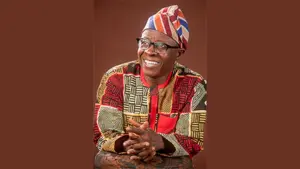
Dr. Adegbola, a Nigerian scientist, musician, engineer, linguist and culture activist, is best known for his work in setting up most of the pioneering private television and radio stations in Nigeria. He is the founder of TIWA Systems andthe executive director of Alt-i (African Languages Technology Initiative) and taught Artificial Intelligence as an adjunct for over 30 years in various Nigerian universities
Several themes recur across the contributions. Indigenous knowledge is a living resource with practical value, not sentimental cultural heritage. Technology is double-edged : it can empower communities and expand opportunities, but can also reproduce inequality and distort social structures.
Ownership and sovereignty are central, particularly concerning control over data, platforms, distribution systems and narratives. Youth participation and intergenerational transmission are essential to cultural continuity and adaptation. The contributions also expose the structural constraints facing local initiatives, including inadequate electricity, band width, capital and supportive policy.
In their approaches, the essays range from qualitative research and case studies to memoir, historical argument, personal reflection and editorial commentary. Attitudes towards AI range from cautious optimism, through acceptance of its possibilities subject to safeguards, to indirect engagement.
The essays’ geographical and analytical scales range from individual communities to continental policy questions. This diversity gives the anthology breadth, although some contributions offer more detailed analysis and evidence than others.
Overall, the anthology argues that viable pathways to African sustainability can be found in indigenous practices and communities’ creative adaptation of digital technologies. These possibilities, however, cannot be fully realised without addressing data and infrastructure ownership, public policy, funding and reliable utilities. The volume is persuasive in diagnosing these challenges, although it offers fewer detailed implementation strategies for some of the problems identified.
The anthology implicitly acknowledges Manuel Castells’ observation in Volume III of The Information Age that information technology and the capacity to use and adapt it are critical to generating and accessing wealth, power and knowledge. However, his warning about the lasting consequences of Africa’s disinformation and dependency at the dawn of the Information Age require more explicit acknowledgment, to ensure that Africa does not remain merely a consumer of technologies and systems developed elsewhere.
The volume could have addressed more explicitly the implications of the transition from commuting to communicating, anticipated by Arthur C. Clarke in 1964 and accelerated by the COVID-19 pandemic. This shift has profound implications for work, education, economic organisation and urban development. Its fuller treatment would have strengthened the anthology’s exploration of digital transformation and sustainable futures. It offers a useful direction for the third volume.
The anthology’s enduring contribution lies in its insistence that Africa’s engagement with the Information Age must be rooted in its own knowledge systems, cultural resources and developmental priorities. The challenge is not simply to preserve the pastor adopt new technologies, but to shape then systems through which knowledge, creativity and economic value are produced and shared.
Dr. Adegbola, a Nigerian scientist, musician, engineer, linguist and culture activist, is best known for his work in setting up most of the pioneering private television and radio stations in Nigeria. He is the founder of TIWA Systems and the executive director of Alt-i (African Languages Technology Initiative) and taught Artificial Intelligence as an adjunct for over 30 years in various Nigerian universities