 Get Guardian on Google
What happens when a book launch stops being a gathering of readers and becomes an experience in which the audience is invited to participate in the very world the book describes? For Toheeb Dele-Balogun, the answer was an unconventional theatrical production that challenged the boundaries between literature, performance art and social commentary.
On Sunday, November 1, 2026, at the J. Randle Centre, Lagos, Toheeb Dele-Balogun presented Algodrithm, The Sacred Book through a deliberately unconventional launch that replaced the familiar sequence of speeches, book reviews and formal presentations with live theatrical performances. It was a creative interpretation of the book’s central idea, transforming its satire into an immersive experience that invited attendees to confront their relationship with social media.
At the heart of Algodrithm, The Sacred Book is an unusual but compelling proposition: social media algorithms have become something resembling a god in contemporary society. They influence what people see, consume, discuss and, increasingly, how they present themselves to the world. Through recommendations, notifications, likes and digital validation, these platforms have acquired considerable influence over everyday human behaviour.
Toheeb Dele-Balogun explores this phenomenon through religious symbolism, presenting the algorithm as an object of worship. Rather than simply explaining this idea to readers, however, he decided to make them experience it.
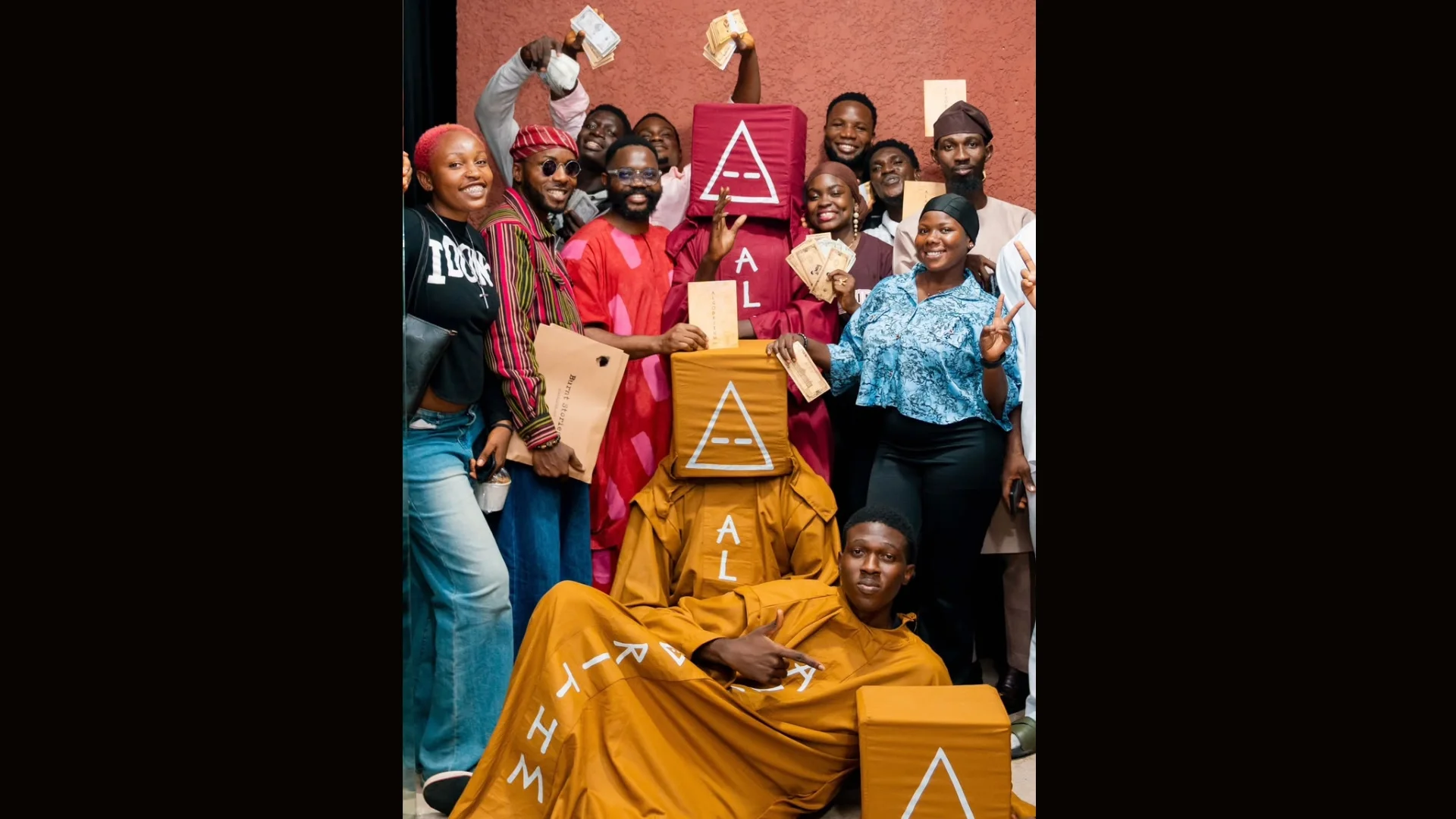
The theatrical dimension began immediately upon arrival. Guests were welcomed by messengers of Algodrithm, who repeatedly chanted, “Praise be to Algodrithm.” The deliberate use of religious language established an atmosphere in which the algorithm was treated as a supreme authority. Attendees were not merely spectators at a literary event; they were entering a fictional religious order created around digital dependence.
View this post on Instagram
The experience continued with the appearance of the Eye of Algodrithm, represented by creatively costumed and somewhat unsettling characters. These figures introduced the audience to the book through a dramatic reading of its introduction, establishing the mythology and atmosphere surrounding the project.
The creative direction was particularly significant because it allowed the audience to encounter the book’s ideas through performance rather than conventional literary explanation. Guests were invited to participate in instructions and theatrical rituals, including standing up, responding to the messengers and experiencing startling dramatic imagery associated with death. These moments reinforced the atmosphere of submission and unquestioning devotion that the project sought to satirise.
The central performances brought four major storylines from the book to life, each examining a different dimension of social media’s influence.
The first explored the experience of a woman who hosted a podcast discussing human anatomy. However, the algorithm redirected her towards producing content centred on twerking because such material generated more views, likes and shares. The performance questioned the pressure creators face to abandon expertise, personal interests and meaningful communication in pursuit of online visibility.
The second storyline presented an individual who had surrendered his life to the algorithm. His relationship with history and reality became increasingly dependent on digital platforms. Even eating became an experience that had to be documented, while his perception of the world was filtered through lenses. The story illustrated how the desire to constantly capture and share experiences can gradually replace the experience of living itself.
The third performance explored Zach’s new resolution, adding another dimension to the collection of narratives.
The fourth storyline was particularly striking. It examined the addictive nature of social media through the psychological rewards associated with dopamine, oxytocin and endorphins. A woman was portrayed on life support, requiring a continuous supply of digital stimulation to remain connected. Power banks functioned symbolically as medical drips, sustaining her dependence. Other dramatic scenes included someone eating from a tablet without actual food entering the mouth, another person counting a fake banknote and a woman lying on a bed. Through these unusual images, the production explored the growing disconnect between digital gratification and physical reality.
One of the most innovative aspects of the launch was the Certificate of Worship experience. Beyond the theatrical confession box, the project introduced a digital process through which individuals could examine their actual screen-time habits. Participants were encouraged to upload screenshots of their device screen-time reports to a digital platform created for the project. The platform scans the submitted screenshots and uses the screen-time information to determine the participant’s level of worship, subsequently issuing a corresponding Certificate of Worship.
This digital innovation extended the book’s satire beyond the launch venue. Rather than relying solely on participants’ personal estimates of how much time they spend online, the process introduced a practical way of confronting their digital consumption patterns. The resulting certificates provide a humorous but thought-provoking representation of the extent of their engagement with social media.
The experience also included a confession box where attendees reflected on how social media had affected important aspects of their lives, including personal goals, relationships and other commitments. Together, the confession exercise and digital certification transformed the audience from passive observers into active participants in the project’s central message.
The event attracted more than 200 attendees, requiring organisers to divide participants into different time slots and audience groups. The groups rotated through the performances, allowing everyone an opportunity to experience the production. The creative team performed for approximately six hours, presenting about ten performances with intermittent breaks.
The theatrical experience also connects with a broader social responsibility agenda through Awapikin, an educationally inclined platform owned by Toheeb Dele-Balogun. Through Awapikin, the conversation initiated by Algodrithm extends into Scroll Responsibly, an initiative established to encourage responsible digital engagement and address the harmful effects of excessive social media use, particularly among Nigerian young people.
The initiative recognises that digital dependence is not exclusively a young people’s problem. Parents and adults are equally exposed to platforms designed to sustain attention through continuous stimulation and instant gratification. It also raises concerns about parents increasingly delegating aspects of parenting to digital devices while struggling with their own screen-time habits. Through Scroll Responsibly, Awapikin seeks to encourage meaningful conversations among young people, adults and families about digital discipline, social media addiction and the importance of healthier relationships with technology.
The reactions shared by attendees on Instagram offered a glimpse into how the launch was received. Stephanie Ladipo wrote, “Congratulations once again Toheeb! Thank you for yet another amazing book launch.” Veekubia described it as “Quite an experience,” while astoldbyoma remarked, “It was such a beautiful experience. Well done.”
Daughterofelshaddai similarly commented, “Experience of the launch was beautiful to be part of! Welldone boss.” B. Hamzee described the production as “Brilliantly done,” while Ayomikun Ogunbola praised Toheeb Dele-Balogun, saying, “You’re so amazing at what you do!”
These reactions reflected the excitement surrounding an event that offered something considerably different from the traditional literary gathering.
Beyond its theatrical creativity, the launch raises an important question about the relationship between technology and human independence. Social media algorithms are designed to personalise digital experiences, but their influence can also encourage repetitive engagement and dependence on online validation. By presenting the algorithm as a god, Toheeb Dele-Balogun uses satire to expose how easily convenience, entertainment and digital approval can become objects of excessive devotion.
With Algodrithm, The Sacred Book, Toheeb Dele-Balogun has demonstrated how a literary project can be transformed into a cultural experience that entertains while provoking reflection. Through its theatrical performances, interactive rituals and digital Certificate of Worship, the launch extended the book’s message beyond the printed page.
Copies of Algodrithm, The Sacred Book remain available through algodrithm.org.
Ultimately, the theatrical launch at the J. Randle Centre demonstrated that a book can become more than something people read. It can become a performance, a conversation and an experience that challenges audiences to reconsider familiar habits.
Perhaps the most interesting question the event leaves behind is this: in a world where algorithms increasingly determine what captures our attention, who really controls whom?