
 Get Guardian on Google
A girl runs through a forest, pursued by five men who intend to sell her. She is a princess of a town in Oyo Empire, and her capture marks the beginning of a journey in which her identity will be stripped away and her life reduced to a commodity.
Taken to a place the novel calls ‘Parcel Land’, she desperately adopts a new name, Sisi, realising she faces certain death if her true identity leaks. She is now condemned to her new life as a ‘parcel’, a term the novel uses for captives.
In Like Butterflies, the debut novel by Nigerian author Abeeb Lekan Sodiq, this transformation raises a central question. What happens when a society’s hierarchies and classism determine who deserves to be treated as a human or not?
The U.S. Ambassador Pamela E. Bridgewater (ret.) in her review of the novel describes it as “a fast-paced journey through the brutal realities of the 19th-century Oyo Empire slave era.”
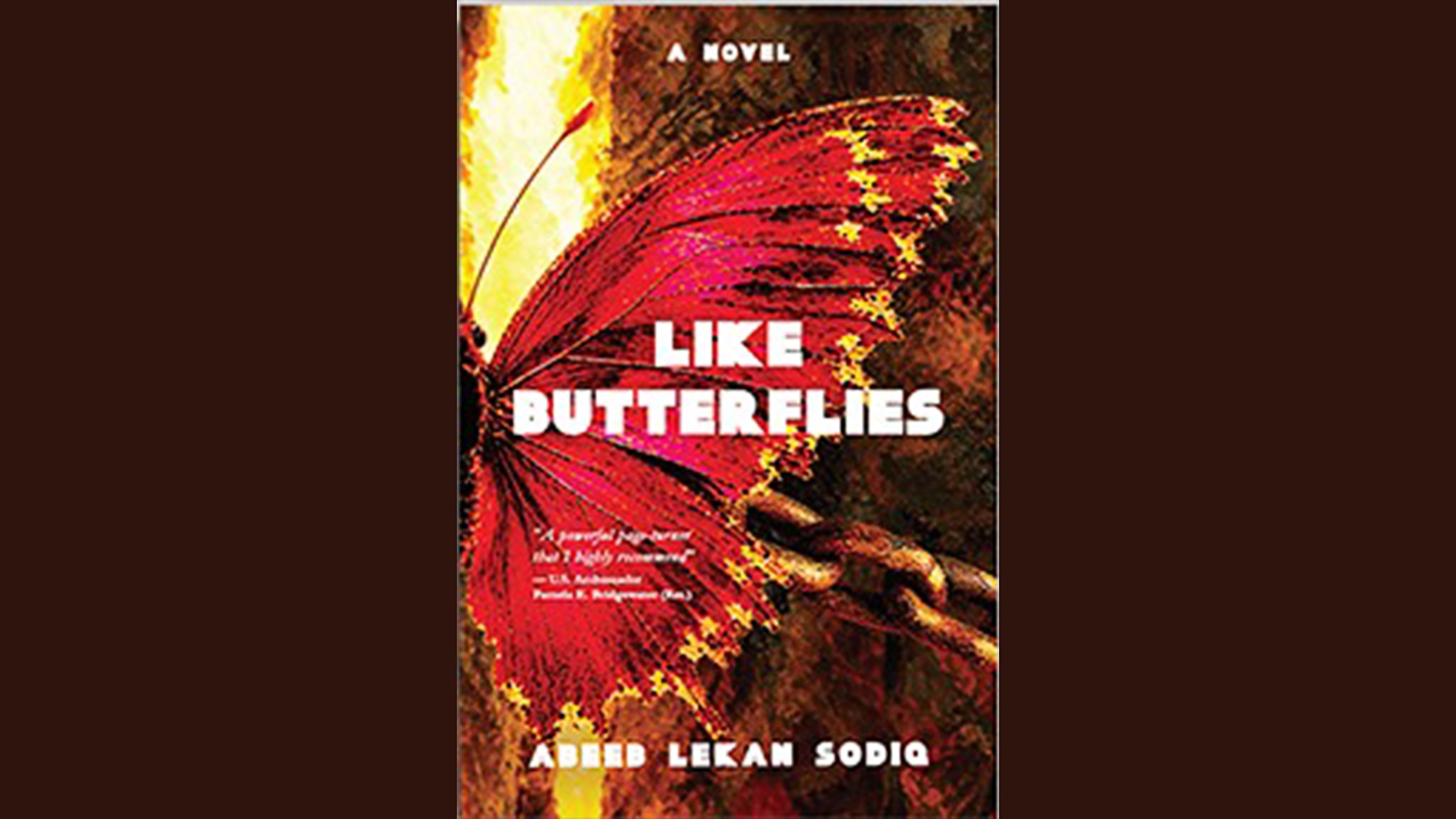
The ‘butterflies’ in the title and cover are a metaphor for the characters’ transformation from systemic oppression to the beauty of freedom; showing the enduring human determination to become free like butterflies.
Iya Temilola, one of the enslaved women in the novel, explains their new reality to abducted Sisi: “I cannot say much about it other than this is Parcel Land, and we are parcels, mere merchandise.”
These descriptions were used intentionally by their captors because once people are classified as property, their suffering becomes easier to disregard. The question is no longer what they are experiencing as human beings, but what can be done with them as goods.
Sisi’s resistance begins with her refusal to surrender to the circumstances of her capture. She observes, adapts and forms connections with those around her, including a chief maid who recently lost her sister to the local slave system.
Her relationship with Folayan, the son of her owner, introduces a challenge to the order of the estate she was sold to. Folayan comes to regards Sisi as a person despite the class difference that defines her.
This prompts a brief confrontation with his mother where he insists that “They’re humans too, mother”, but his mother replies angrily, “How dare you? They are animals. You are either a freeborn or an animal?”
Folayan’s ‘forbidden’ affection for Sisi creates a difficult class problem for the two lovers. He belongs to the family that owns her, while she lives under their absolute authority. Their relationship crosses a boundary that the estate’s social order maintains with brute force.
But affection alone cannot dismantle that order; as Sisi’s resolve develops, she convinces Folayan to back her rebellion against his own parents. Surprisingly, despite what was at stake as heir to his family wealth, he assured Sisi, telling her, “If my mother were to kill you, she would have to kill me too.”
This confidence drives Sisi, and without restraint, she makes her first public condemnation of their treatment, to the shock of every ‘parcel’. Her statement is both daring and revolutionary in every sense of the word, in a time when imagining that alone can take her head. Yet this young girl braver than most, says it aloud: “This is why the change must begin with us. We need to hold those over us accountable instead. Freedom!”
Ambassador Bridgewater calls this “the human spirit’s determination to be free,” in her review.
However, one of the novel’s most unsettling observations is that oppression can reproduce itself through the oppressed if the circumstance becomes beneficial to them or becomes a power play.
Literary reviewer and former Secretary of the Association of Nigerian Authors, Abuja Chapter, Ms Salamatu Sule, captures this in her review, ‘The Hierarchy of Men in Abeeb Lekan Sodiq’s Like Butterflies,’ arguing that: “When the oppressed finally take power, do they transform the system, or simply change who sits at the top of it? The answer is not necessarily comfortable. Collective liberation may dethrone an oppressor, but without a transformation of the values and structures that produce domination, another Adunni may simply take the throne.”
Adunni is the novel’s betrayer whose treachery got a ‘parcel’ brutally whipped, and took Sisi to the verge of death. Despite being a ‘parcel’ herself, she sacrificed their collective rebellion for her power-hungry ambition. In a secluded soliloquy, she said to herself:
“Come to think of it, being a parcel may be terrible, but being the parcel in charge is not. It means power over other parcels. Why should such a person want freedom?”
Her reasoning exposes a distinction between escaping oppression and rejecting the principles that sustain it. A person may resent being at the bottom of a hierarchy without questioning the hierarchy itself.
The desired transformation may be a change of position rather than a change in the conditions that make oppression possible. This means the difficulty lies not only in defeating those who hold power, but also in resisting the temptation to preserve the old order under new leadership.
The novel also addresses the historical and moral complexities of the role some local rulers, merchants and other intermediaries played in the enslavement and sale of other Africans. This was condemned through the words of characters who confront this reality, especially the chief maid. She stood with pain in her voice and said to a crowd of ‘parcels’:
“We sell ourselves to the white people… We sell ourselves to ourselves, and still whip ourselves like animals… this is wrong.”
Ms Sule also comments on this in her review. “Here, Sodiq moves beyond a simple condemnation of the colonial slave trade. He turns the gaze inward, asking the reader to confront the uncomfortable reality that oppression can also be reproduced by those who have themselves experienced it.”
However, this does not erase the responsibility of the European powers that organised and profited from the transatlantic slave trade. Rather, the novel raises a separate but related question about the classism within which exploitation could operate, and why paying attention to it will prevent it from recurring.
The demand for reparatory justice and the examination of local power structures need not cancel each other out. The question that remains is whether a society can truly become free while continuing to measure human worth through hierarchies, power or classism.
The novel has been endorsed by the Lagos State Council for Arts and Culture (LSCAC), and was selected as the official text for the 2026 HRM Alayeluwa Oba (King) Adewale M. Abdul’s Book Reading & Playlet Competition, involving 14 schools in Epe, Lagos.
The Lagos State government through the Ministry of Basic and Secondary Education, has included the novel in its 2026 – 2029 approved booklist for Senior Secondary Schools.
Sodiq is a Nigerian author and the Managing Editor of TheAfricanDream.net with extensive background in journalism. His debut novel, Like Butterflies, was published in 2026, with his second novel already in process.