
 Get Guardian on Google
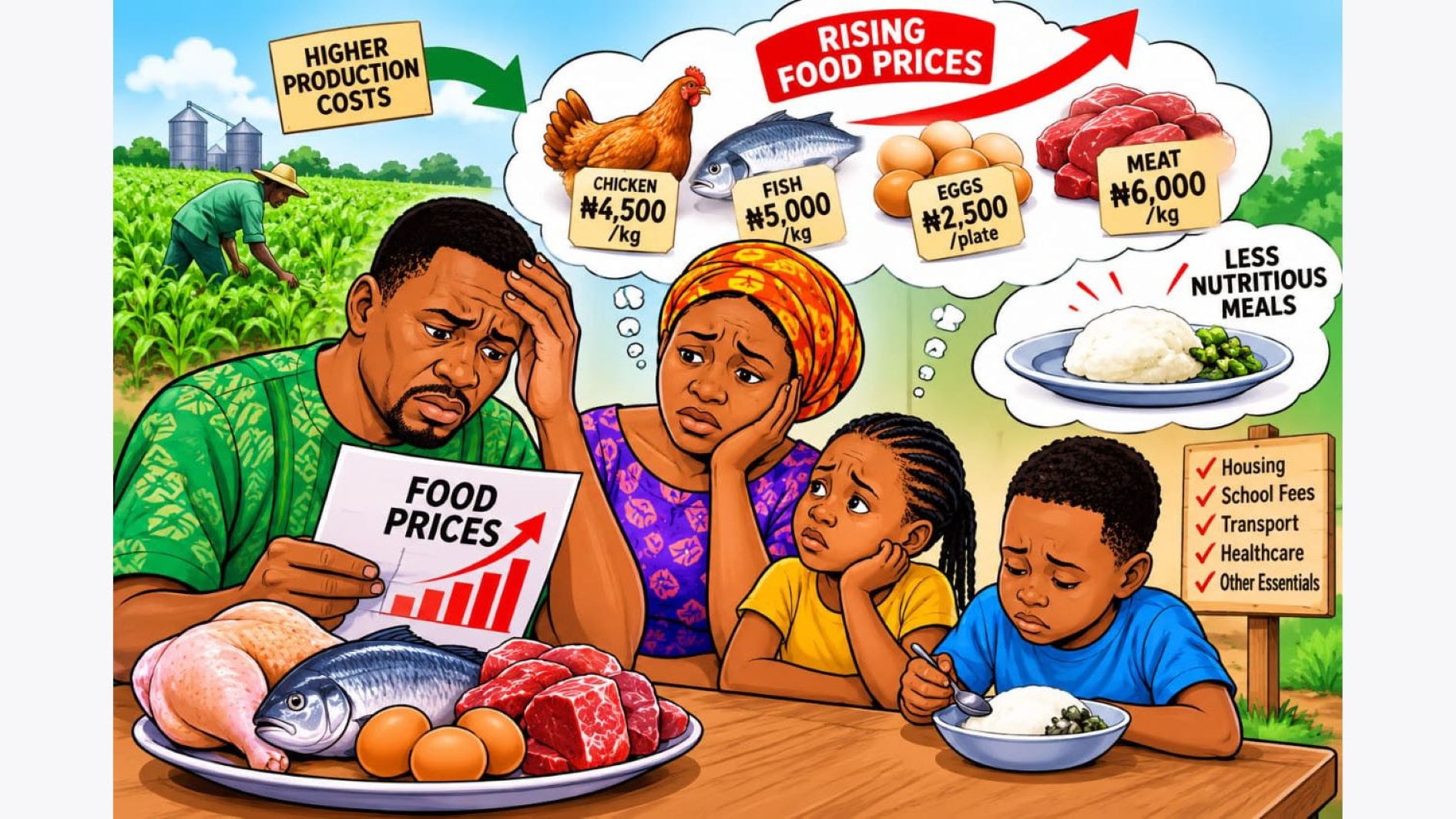
For some Nigerian households, the rising cost of food is not only changing what they eat but how often they can afford nutritious meals. Chicken, fish, eggs and meat, once regular features of family diets, are increasingly competing with other essential expenses, exposing the connection between agricultural production costs and the ability of consumers to eat well.
In Egbeda, Lagos State, the adjustment has become part of everyday life for Funke Iyamu, a 41- year-old trader and mother of three. She said a chicken that her family might previously have consumed in a week must now be divided into smaller portions to last longer.
“Before, we used to buy chicken every Sunday. Now, if I buy one chicken, we have to cut it into 12 pieces to last two weeks,” she said.
Her experience illustrates a wider economic question: as the cost of producing and distributing animal protein rises, how much of the pressure can households absorb before nutritious food becomes less accessible?
The National Bureau of Statistics (NBS) reported that the average cost of maintaining a healthy diet in Nigeria reached N1, 589 per adult per day in April 2026, up 4.74 per cent from N1, 518 in April 2025. Animal-source foods accounted for about 40 per cent of the total cost of the recommended diet basket while providing approximately 13 per cent of its calories, making them the most expensive food group to meet within the basket.
The measure represents the least expensive combination of foods required to meet specified dietary recommendations, rather than what every household actually spends. Nevertheless, it highlights the financial challenge of maintaining a balanced diet as food prices rise.
Behind the prices paid by consumers are the costs incurred by farmers, processors, transporters and traders. Poultry production requires feed, vaccines, medication, labour and suitable housing, while fish farming depends on feed, fingerlings, water management and disease control. Electricity and fuel add to the cost of maintaining production and moving products to market.
For poultry and fish farmers, these expenses, according to sector players, can determine whether production remains profitable. Stakeholders noted that when costs rise faster than the prices producers receive, they may reduce output, postpone expansion or close their farms.
Agricultural development expert, Olakunlehin John Oladapo, in an interview with The Guardian, stressed the rising production costs have left farmers with three difficult options: continue producing at a loss, abandon their farms or reduce production capacity.
“Farmers have only three options: to continue production at a loss, to abandon the farm or to reduce the capacity of what is producing,” he said.
Oladapo identified feed as a major cost driver in livestock production, estimating that it accounts for between 70 and 80 per cent of production costs. He attributed the pressure to the rising cost of maize and soybean meal, insufficient domestic production, foreign exchange constraints affecting imports and competition between human and livestock consumption of some agricultural commodities.
The cost of milling feed, particularly where operators depend on generators, further increases expenses. Other constraints include expensive financing, inadequate veterinary and extension services, poor-quality breeding stock and limited access to appropriate production technologies.
According to Oladapo, these pressures extend beyond individual farms, as reduced production can affect feed manufacturers, transporters and farm workers, while farm closures can disrupt the supply of animal-source foods to markets.
Transportation losses compound the problem. Oladapo recounted incidents involving livestock transported over long distances, including a journey during which he said more than 80 per cent of day-old chicks died after prolonged traffic delays. Such losses, where they occur, increase the financial burden on producers and traders, although the extent to which they affect retail prices depends on other market conditions.
Investigations showed that the problem also extends to the movement and preservation of food after production. Inadequate cold storage, unreliable electricity and inefficient distribution can increase losses, particularly for perishable products. These expenses may add to the cost of getting food from farms to consumers.
For households, the consequences are already visible in purchasing decisions. Iyamu said a crate of eggs that cost N3,200 last year is now being offered to her for N5,800, while a piece of Titus fish cost about N2,500. She said she had increasingly turned to beans and other less expensive foods as the family adjusted to higher prices.
“We used to eat meat four times a week, but now, maybe once. On other days, we eat stew with no meat,” she said, adding that her children sometimes asked why there was no meat in their meals.
Her account does not establish how widespread such changes are across Lagos or Nigeria. It nevertheless shows how food-price pressures can affect the frequency and variety of foods available to a household.
Eggs, fish, poultry and meat provide protein and varying amounts of essential nutrients, while milk and other animal-source foods contribute to diets in different ways. When these foods become less affordable, households may consume them less frequently or seek other alternatives. The nutritional implications depend on the foods replacing them and the overall quality of the diet.
According to nutritionists, beans and other legumes can provide valuable protein and should form part of the discussion about affordable nutrition. However, improving access to nutritious food requires adequate attention to both the cost of available alternatives and the ability of households to maintain a sufficiently varied diet.
Last April, the Federal Government acknowledged concerns about poultry prices during an engagement with the Poultry Association of Nigeria. The Ministry of Livestock Development said efforts to improve affordability would focus on key cost drivers, including feed, energy and other inputs.
Oladapo argued that lasting improvements would require reducing production costs and increasing productivity rather than relying on price controls. He called for a targeted livestock feed strategy, more reliable energy for feed mills, improved access to agricultural credit and stronger links between research institutions, extension officers and farmers.
He also advocated investment in cold-chain facilities, better transportation and technologies that extend the shelf life of animal-source foods. Expanding aquaculture and egg production, alongside agricultural insurance, targeted input support and equipment-leasing arrangements, could also help address constraints facing producers, he said.
The effectiveness of such interventions, stakeholders said, would depend on whether they reduce costs across the supply chain and improve access for consumers. Lower production costs do not automatically translate into lower retail prices, particularly where distribution expenses, market competition and profit margins remain significant.
The challenge is therefore not simply to increase the production of animal protein, but to make its production sustainable and its consumption more affordable. For farmers, that means an environment in which production costs can be managed and investment remains viable. For households, it means being able to buy nutritious foods without sacrificing other essential needs.