 Follow Us on Google News
 Follow Us on Google Discover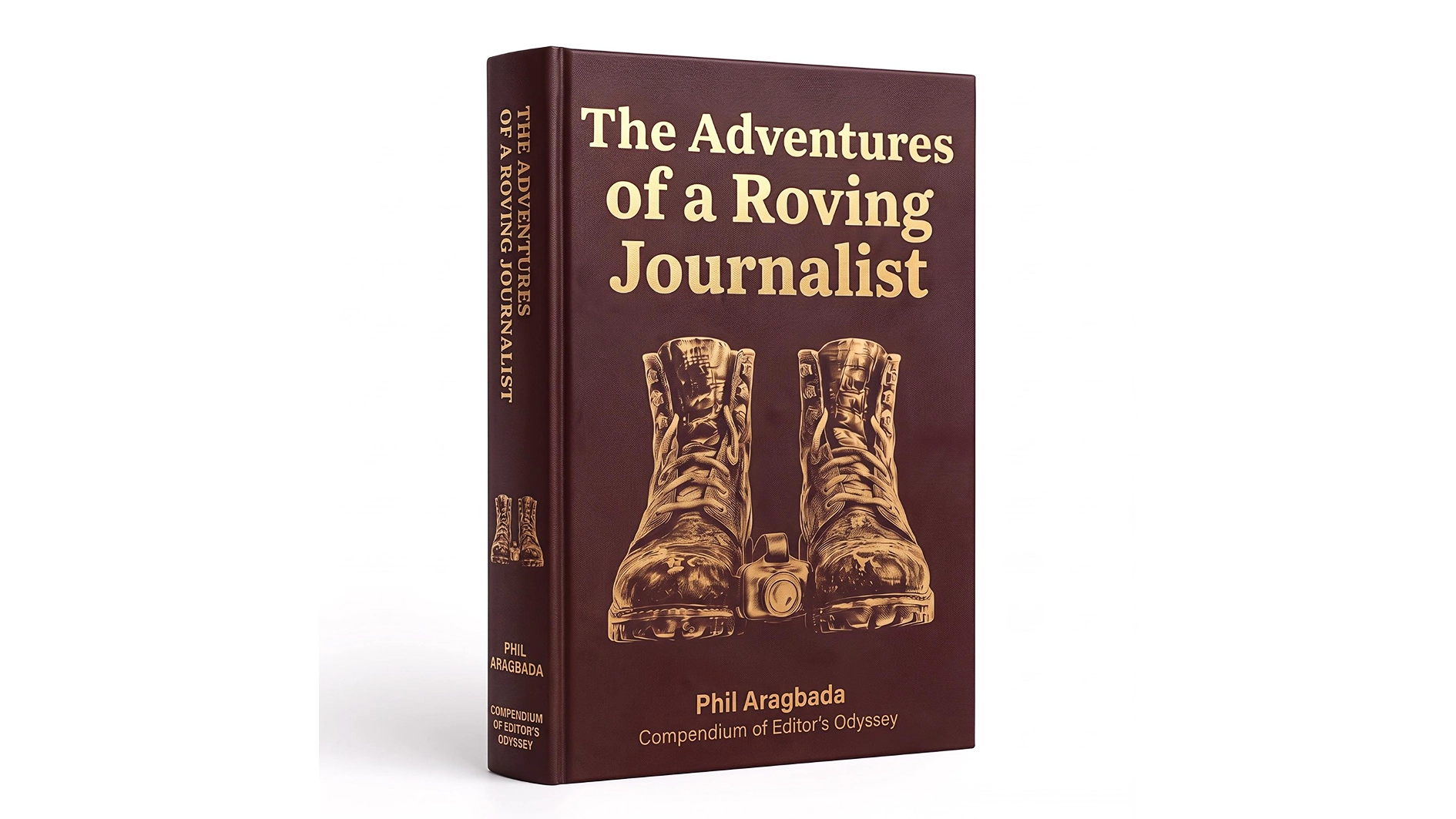
There is a quiet, heroic drama behind the physical existence of The Adventures of a Roving Journalist.
Phil Aragbada left the Sketch Newspaper in Ibadan in 1988, where he had risen to Group Insight Editor and earned a seat on the Editorial Board, for a long second career in banking.
By the time he retired and turned back to his old trade, he faced every writer’s worst nightmare: the private scrapbooks holding his cuttings from the 1970s onward had been destroyed by circumstances beyond human control.
In an era before digital back-ups and cloud servers, a decade of eyewitness reporting on post-independence Nigeria threatened to dissolve into the air. What followed was a remarkable act of historical rescue.
Urged on by his family, newsroom veterans, and friends in academia, Aragbada turned to the National Archives of Nigeria at the University of Ibadan. There, alongside senior archivist Niyi J. Adegoke and his staff, he sifted page by page through thousands of fragile, un-digitized newspapers in search of over four hundred original articles. While his introduction speaks of 94 recovered pieces, this first volume gathers 51 of them, with a second volume promised.
Strengthened by editorial input from his former Sketch colleague Pastor Bola Bolawole (later editor of The Punch) and featuring a cover designed by the author’s lawyer son, Tomiwa, the resulting collection is far more than a personal memoir. It stands as an indispensable primary record of Nigerian socio-political life.
Divided into four thematic parts, the collection captures the raw energy, structural paradoxes, and tragic turns of a nation in transition. The opening section, Travels and Discoveries, is field journalism at its most adventurous.
In March 1987, the Sunday Sketch published Aragbada’s account of the Mambilla Plateau in Gongola State (now Taraba and Adamawa states). By his own account the first daily newspaper journalist to make the journey, he documented a temperate domain perched more than 1,833 metres above sea level—home to over half a million cattle, a federally backed tea estate, and the Donga River with an estimated 534 megawatts of hydroelectric potential.
Yet Aragbada was never a mere tourist documenting picturesque landscapes. He focused on the plateau’s severe isolation: ‘Kona Gomina’ (Governor’s Corner), a sheer drop less than 10 feet from the road, and ‘9 Mile Hill’, where his driver ordered male passengers out to walk two kilometres on foot so the vehicle could climb.
He recorded the bitter economics of an abundant region cut off from national markets: kerosene that cost 50 kobo elsewhere sold for five to ten naira during the rains, while a single photocopy that cost 20 kobo in Ibadan commanded eight naira on the mountain. The exposé caused a national stir, forced government authorities to pay attention to the region’s infrastructure deficit, and contributed to his 1994 Nigerian Union of Journalists (Oyo State) Award of Excellence.
That eye for structural paradox runs throughout his travelogues. In Badagry, he confronts the dark memory of the transatlantic slave trade: a 50-metre iron neck chain long enough to hold 100 captives on the march toward the “Point of No Return” on Gberefu Island.
A short walk away stands the historic two-storey mission house of 1845 where, by local tradition, Bishop Samuel Ajayi Crowther worked on translating the Bible into Yoruba. In Lagos, his study of Victoria Island and Maroko contrasts the manicured lawns of the financial elite with a settlement of half a million working-class residents less than a hundred metres away, living without piped water or electricity, who took to wooden canoes whenever seasonal rains submerged their homes.
Aragbada’s investigative work is most potent when confronting state violence and institutional abuse. In October 1982, he travelled nearly 1,000 kilometres from Ibadan to Benue State to investigate the death of Gwaza Ahura, a 20-year-old student at Government College, Makurdi.
Ahura had been sentenced to nine months in prison without the option of a fine for “stealing” a goat—though his family said he was observing Igba, a Tiv custom that allows a son to take a hen or goat from his mother’s people during festive periods. Six weeks into his sentence, Ahura was dead in Gboko Prison.
Medical reports cited head injuries; relatives who saw his body described deep whip wounds and a ruptured kidney, and blamed prison warders, two of whom were questioned by police. Aragbada’s interview with Ahura’s mother— who was turned away at the prison gate two days before her son died and told to
“write an application” just to see him—is among the most moving passages in the book, demonstrating the vital role of investigative press oversight during periods of institutional fragility.
In Part Two, “Society and Politics,” the register shifts to political economy. The section opens with “Nigerian Elites and the Tragedy of Leadership,” an essay dated 2014 that reads as the veteran’s retrospective verdict on the decades he covered day by day.
He argues that military rule from 1966 onward dismantled self-sustaining regional economies built on cocoa, groundnuts, and palm oil, replacing them with dependent states that must go cap-in-hand every month for federal oil allocations. Around it sit his original 1980s dispatches covering state creation, public utility privatization, electoral management under FEDECO, and the 1985 expulsion of undocumented regional migrants.
The third and fourth sections offer a rich mosaic of public affairs, culture, and portraiture. Aragbada reports on the earth tremors that shook South-Western Nigeria on July 28, 1984, the Johnson Wax factory fire, aggressive infant-formula marketing, and the untapped bitumen reserves of Ondo State. His profiles span spiritual, military, and academic figures—from Celestial Church founder Samuel Bilewu Oshoffa and Pentecostal pioneer Benson Idahosa to neurologist Professor Oluwakayode Osuntokun.
The volume closes with ‘Erin Wo’ (‘The Mighty Falls’), the Sketch’s tribute to Chief Obafemi Awolowo. Co-authored with colleague Muyiwa Apara in under eight hours to beat rival newspapers to the story, it captures the competitive newsroom culture the book celebrates.
The volume is not without limitations. As an archival collection, it is episodic rather than a continuous narrative, and a few pieces carry no original publication dates. The 2014 essay sits among 1980s dispatches without a clear editorial signal to mark the decades-long jump in time. Furthermore, modern readers will miss retrospective footnotes connecting historical dispatches to modern developments, such as Maroko’s eventual demolition in 1990 or modern updates on the Mambilla hydroelectric project.
Yet what endures is the reporting itself. Aragbada writes lucid, energetic prose anchored in figures, names, and places. Filed by a journalist willing to trek up mountain roads or sit with a grieving mother in a rural village, this volume is an indispensable record for scholars of West African history, media analysts, and general readers alike.
Pix: Roving Journalist

