 Get Guardian on Google
The choice of materials by an artist holds significance and can determine the meaning ascribed to a work of art. A skillful use of beads, scraps of cloth and other mundane objects of everyday use can facilitate memory and metaphor. This skill was demonstrated at the 2026 Life in My City Art Festival (LIMCAF) grand finale.
In the exhibition, held at the International Conference Centre of the Institute of Management and Technology (IMT), Enugu, 100 finalists from 17 regional centres, used different methods of expression to illustrate the chosen theme, Open Letter.
The concern could be social, political, emotional, cultural or environmental. Each artist was at liberty to choose whom to address, be it society, history, the environment or an individual, institution or idea. Several entries were pleas, memorials, protests or confessions.
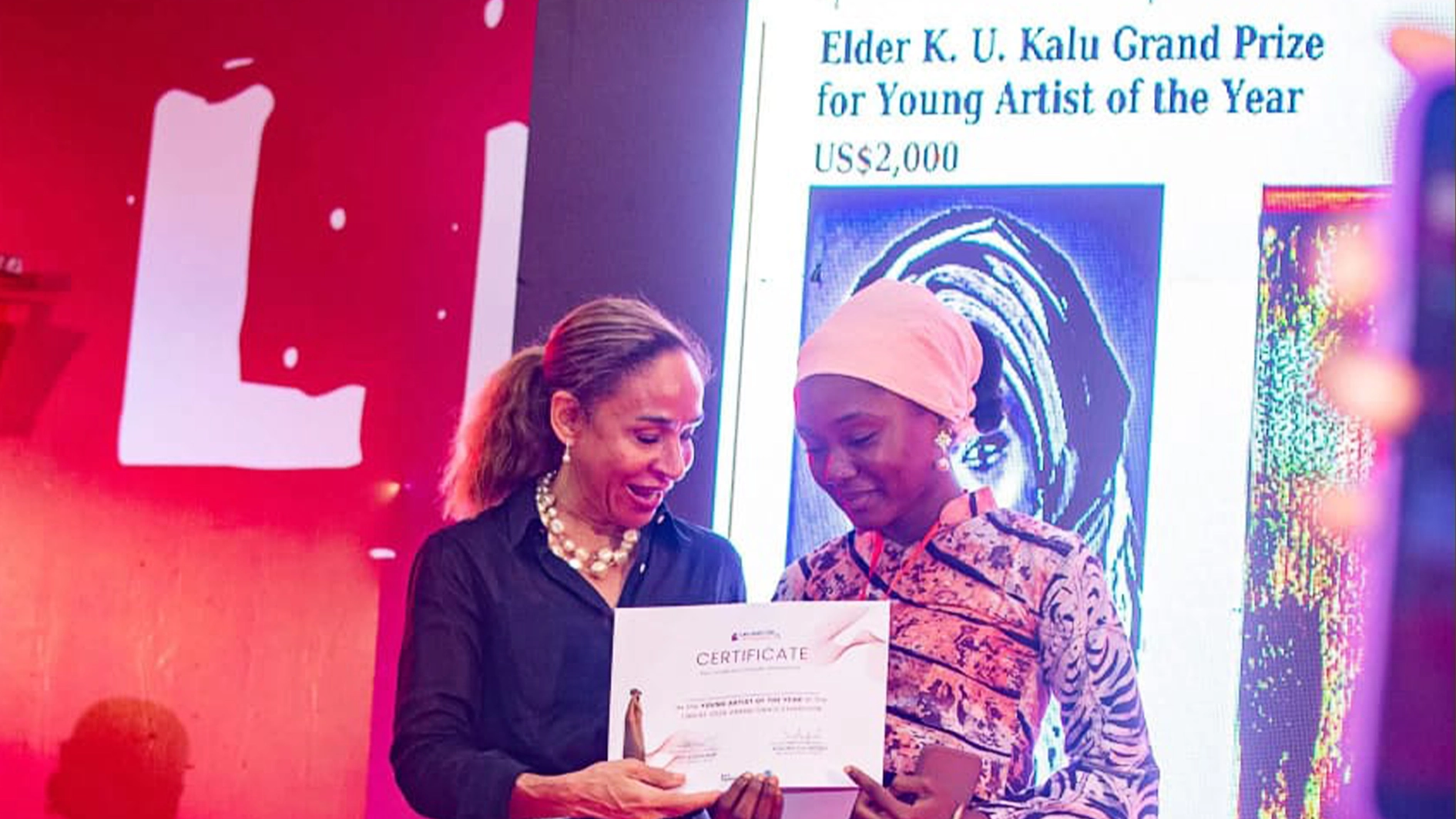
One work that garnered a great deal of response was Bilikisu Oyiza Shuaibu’s Mai Kisto: A Million Tales.
Its announcement as the winner of the $2,000 festival’s grand prize, Elder K.U. Kalu Prize for Young Artist of the Year, on October 31, also confirmed the impression it made on spectators to the exhibition.
With 100 other finalist works on display across the two-level lobby of the conference centre’s auditorium, Shuaibu’s was simple yet arresting. Using beads and strings to construct an image of women having their hair done at a beauty salon, the artist subverted the familiar and mundane social environment with her manipulation of her medium: There was skill in the transformation, as well as interest in the artist’s appreciation of the social environment as a worthy subject for her craft.
Along with Shuaibu’s victory, other prizes were also presented that evening. Kayode Oluwapelumi from Calabar/Uyo won the Capt. Everest Nnaji Prize for Best Painting for his work, titled, Open World: Where Everything Grows. Success Emeka from Zaria won the Chinelo Chime Prize for Best Photography for her work, The Tomorrow We Might Never See, while Obeka Simon Edoh from Jalingo won the Tayo Adenaike Prize for Best Watercolour for his work, Breaking Chains, Not Spirits.
Other category awards included Extraction, by Chimmuanya Onuzulike of Enugu, winning Best Ceramics; How I Play My Part, by Gushi Clinton Data of Zaria, winning Best Sculpture/Installation Art; and To The Wounds That Refuse to Heal by Victoria Oluwadamilola Adewole of Abuja, winning Best Textile Art/Fashion Art.
Praise Edward of Lagos, won the Most Creative Female Artist award for Between The Lines of Inertia, and Taiwo Iyamu Shileola of Ondo, won the Artists Living with Disability prize, for Open Letter to the Mind.
The endowed prizes also recognised various artistic achievements. The People’s Manifesto, by Godwin Ejike Ugwuagbo, won the Justice Aniagolu Prize for Originality; Prime, an entry from Auchi, won the Pius Okigbo Prize for Technical Proficiency. Ruth Ben of Calabar/Uyo won the Mfom Usoro Prize for Best Entry from Uyo Centre for The Rat Race. Louis Ifeanyi Igwegbe of Enugu won the Vin Martin Ilo Prize with Every Feeling Leaves a Mark, and Hosea Timothy Dakas of Jos, won the Chike Obeagu Prize for Best Collage with A Letter Unread.
Green-White-Green Like Babel, by Augustine Marrin Ebuka of Abuja, won the Stephen Bezalel Prize; and Que Sera Sera by Victor Ishaya, the Agoreyo Armstrong Prize for Best Entry with Wastepaper. Enugu’s Daniel Ogbodo, won the Kanyeyachukwu Tagbo-Okeke Prize for Best Entry by Special Needs Artist with Residue of
Time. Six consolation prizes were also awarded to participants.
However, the most engaging aspect of the festival can be seen in the observations of the six-member Grand Finale jury. The comments shed more light on the works, and therefore, on the hopes, fears and aspirations of the young artists.
Dr Chike Chinazom Obeagu, chaired the panel, which included Dr Talatu Adiwu Onkala, Prof. Frank Ugiomoh, Ugochukwu-Smooth Nzewi, Ph.D., Bella Anne C. Ndubuisi and Dotun Popoola. The members of the jury made their appraisal based on four main criteria: how well an artist engaged with the theme, how creatively an artist used available materials, how well an artist finished his/her work and the level of originality in expression.
The jury lauded the use of found and waste materials in constructions as evidence of a growth in experimentation. Fabrics of all types, metal and aluminum scraps, mesh, paper and other found objects were used in constructions to positively respond to texture and yield conceptual works. The report sees this as a growth in consciousness of local resources.
A more critical review of some artists’ work indicated an unfortunate reliance on popular prevailing trends in the art gallery. Some also reproduced the visual approaches of previous LIMCAF prize winners.
This, of course, raised one of the most critical challenges facing emerging artists: how does an artist develop his or her individual artistic voice in an environment that is already dominated by a few recognisable styles and visual formulas?
While existing bodies of work recognised by the jury represent an artistic benchmark against which other artists can compare, Imitation, however fine, will not bring the artistic distinction that a competition like LIMCAF seeks to achieve.
The jury was very clear about this. Regional coordinators, it said, should pay more attention to originality when selecting entries. Works that closely resemble existing entries or works presented at previous editions should be disqualified. The jury asked that guidelines concerning presentation be given and enforced. More importantly, it asked that the entries be inspired by bold and original interpretations of the artists’ personal and local realities. It cautioned against the use of derivative visual formulas.
It added that the participants should be motivated to break new grounds artistically. Participants should be inspired to create works that help restore faith in the commitment of the humanist struggle to bring
about positive social change in the world.
It emphasised that an artist’s vision is made evident through the artist’s unique way of presenting his/her ideas and combining materials to make a statement; and this is what sets artists’ work apart and gives it significance. In the end, an artist’s body of work is best remembered by the artist’s way of seeing things. This is the only thing that truly sets one artist’s work apart from another. Because of the small size and vastness of the world, space is already created for artists to share ideas with the rest of the world.
This inspired the jury’s selection process. Members identified their favorite entries. After the votes were counted, the works were ranked. The final listing was arrived at through further deliberation and assessments. The jury recognised the responsibility entrusted upon it and sought Divine guidance and grace for the work at hand, through prayer.
The jury applauded the organising committee for its efficient planning and the administration of the festival. The jury also commended the Board of Trustees and other sponsors for their support and belief in the younger artists of Nigeria.
The challenge before LIMCAF is to maintain the artistic energies inspired by its regional meetings and raise the bar for participation.
It operates in locations such as Lagos, Abuja, Jalingo, Zaria, Enugu, Jos, Ondo, Auchi, Ibadan and Calabar/Uyo and this shows that artistic expression goes beyond Nigeria’s cultural centres and capitals.
Next year’s festival, themed Emerging Frontiers, carries added warning for entrants. The next frontier may lie in the more challenging task of developing a personal and unique artistic voice.
In the end, the 100 entries at this year’s edition were 100 opportunities for artists to say something about their world. Some entries were successful, while others left a lot to be desired. However, the most important lesson of Open Letter is that the artist must first decipher what is worth saying, and then find an idiom that is uniquely theirs.