 Follow Us on Google News


 Follow Us on Google Discover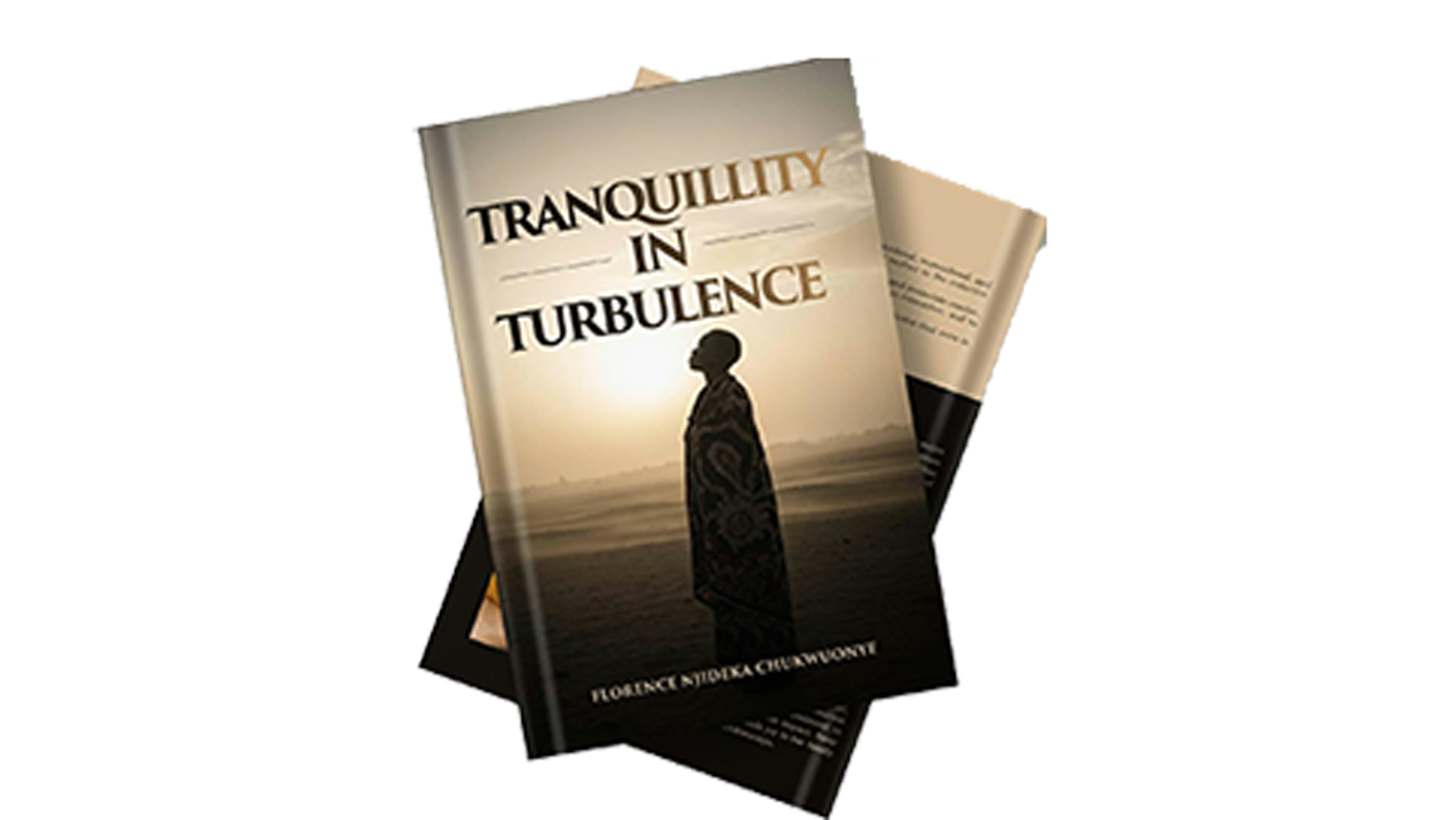
By Anote Ajeluorou
That life isn’t a bed of roses is a truism long been established. However, individuals experience the precarious nature of life in different ways, either due to their environments or how they respond to conditions around them. While some quietly endure the vagaries of life without a whimper, others choose other routes and shout their grief or pain to the world to share and be partakers of their journeys. This is usually with the hope that those who listen are able to learn a thing or two that might help them in their own journeys and avoid where others slipped.
Florence Njideka Chukwunonye takes the latter route and decides to share for others to learn and be wise.
Her recent collection Tranquility in Turbulence epitomises that personal journey that also morphs into the national realm, as persons and nations also embark on journeys that ultimately define and differentiate them. Chukwunonye starts with her personal journey of grief. The woman who meant the world to her suddenly falls ill and the world takes on a dark hue. Death eventually claims her, and she’s devastated. How does a daughter mourn a beloved mother? The intensity of her grief is unbearable but she finds anchor in the memory of her goodness as a mother.
This searing poem starts Part I, ‘Mother/Memory/Loss’ of the collection, where she proclaims: ‘Let me eulogise her/ With a voice loud as thunder/ A woman whose life beamed with kindness/ And oozed goodness.’ In spite of great grief, she consoles herself with the memory of her undying love, when she says, ‘But I wrap my heart/ In the soothing balm of your love/ You were my gem./ You remain my jewel.’
Grief is capable of yoking a painful past to the present, and many are constantly plagued, particularly women who remain mired to a past they seem incapable of finding escape, as the next poem ‘Chained to the Past’ suggests. But Chukwunonye does not believe that one should remain forever shackled to past chains.

This hopeful thread runs throughout the collection. Despair is human, but resilience is superior, she seems to say. She concludes this poem with the hopeful lines, ‘But even iron weakens./ Even wounds scar over./ And beneath the ash/ Something still breathes.’ But the piece ‘A Dream Dashed’ doesn’t seem to offer any hopeful end, as the aspiration remains just that: aspiration without fulfillment. From ‘She climbed her ladder slowly’ in what appears a promising beginning to when ‘A ring snapped’ to ‘Some dreams do not break loudly/ They fall/ And leave you staring/ At the sky/ You almost reached’ is the naked disappointed of a once promising adventure that ends badly. But that is life, too.
But it’s not all gloom and doom in the first part. It ends with the poem, ‘The Best Day of My Life’, of the hopeful journey of a lady who bumps on the one man, who is to be her life’s partner, and how the heavens align for their hopeful union. ‘Scanning the crowd,/ I saw the music of my soul./ He saw me./ He felt me./ He heard me./ Ladden with joy,/ I thanked heaven/ For the rhythm/ And the music in my soul’.
Chukwunonye shifts the poetic muse from the personal to the national and universal in Part II, ‘Nation/Turbulence/Society’. She starts with Nigeria’s perennial ‘Power Failure’ problem and ends it with ‘Night invaded noon./ Hope flickered./ The city held its breath.’ The piece on ‘War’ is equally telling and digs at global geopolitics and the nastiness of war and how ‘War is a foe to peace/ A fiend to man’, and in spite of how detestable war is, because of man’s folly, ‘And yet, it returns/ Again and again.’
‘Poverty’, ‘Corona Virus’ and ‘Let Peace Reign’ also make up this part.
In Part III, ‘Woman/Empowerment’, Chukwunonye turns to her own gender in searching soul-to-soul, intimate conversation. This section is specially for her gender. Just two poems, ‘Girld Child’ and ‘Mighty Woman’s make up this section. It tells how much she invests in her gender. To the girl child, Chukwunonye is unsparing of her heart-to-heart moment to plant in the girl child’s heart the very seeds of greatness that will equip her for the turbulence life’s journey will throw at her, and how resolute she must be, so she could arrive safely at her destination.
So, Chukwuonye sings to the girl child: ‘My dear child,/ Blessed at birth,/ Born to rock the world with guts and grit./ Dream and aspire,/… Rise like the eagle above the storm,/ Roar like the lion (lioness?) shaking the night./… You are not mere/ You are enough’.
It is in ‘Mighy Woman’ that Chukwunonye invests her supreme poetic powers, as she finds reason enough to tell women who they truly are, and why they must not be afraid to own their feminity and humanity and never allow themselves to be denied agency. And she says to women, ‘You are liberty./ You are freedom/ With your feet on the ground/ And your wings in the wind…/ You fan and poke/ The smouldering embers of silenced dreams/ Into a roaring flame.’ And Chukwunonye ends the longest piece in the collection thus, ‘Mighty woman…/ Go forth in your might/ And do mighty things.’
‘Time/Nature/Existence’ makes up Part IV, where Chukwunonye sings about things in her natural environment like ‘Harmattan’, ‘Beauty’, ‘The Hawk’s, ‘Sunrise’, ‘The Sun’ and ultimately asks the universal question in a poem, ‘What Is Life?’ And she responds, ‘Life is music,/ Chords strung with care or chaos./ Dissonance grates,/ Harmony soothes…/ What we hold in the pulse of our heart.’
In Part V, ‘Mind/Faith/Inner Strength’, Chukwunonye turns to faith and the inner power that equips one to navigate life’s turbulent journey. In ‘The Wonderful Exchange’, she finds anchor in her faith, singing: ‘At Calvary,/ Christ took my unrighteousness/ And gave me righteousness.’ Also in ‘What Shall I Ask For?’, she makes a list of earthly possessions that eventually count for nothing: ‘Beauty, fleeting as the dawn?/ Money, fading like evening shadows?’ but affirms that which is constant and life-giving: ‘I ask for Jesus,/The Author of life,/ Who fades not, wanes not, fails not.’ And as Christ becomes ‘My Delight’, Chukwunonye finds pleasure and courage to declare, ‘Hold your rituals, your rites,/ I delight in knowing him…/ This knowing nourishes me,/ Enlightens my eyes,/ And reveals the fullness of life.’
Chukwunonye’s poetry makes for delightful reading. In the ‘Preface’, Chukwuonye admits that ‘I did not write these poems from a place of ease’, as testament to the Williams Wordsworth’s age-old definition of poetry ‘as the spontaneous overflow of powerful feelings’. In this case, powerful feeling of unease “shaped in moments when grief felt close, when the air carried both harmattan dust and uneasy headlines, and when the future of a nation seemed suspended between hope and disappointment. They emerged from private sorrow and public observation – from watching, waiting, enduring.” It’s perhaps why she “…dedicated (the book) to the quiet moments that saved me. To the days when the noise was loud, the storms were relentless,and yet a small still voice whispered, ‘Be still’.
Chukwuonye’s Tranquil Turbulence is poetry of survival, of resilience and the will power to say no to those forces that threaten to drown the human spirit. And having emerged victories, she raises her voice to sing and encourage others, particularly her fellow women, to never despair of whatever life throws at them, but to stand tall. Turbulence is a normal human experience that comes at some point in a man’s life. But how do you respond to it? That’s Chukwuonye’s question to anyone hurting or going through some of life’s soured moments. Be tranquil. Be still. That’s what she offers. It’s what serves. This is poetry more than motivational speech. It grounds the human spirit and elevates it to heights that seem possible.

