 Follow Us on Google News



 Follow Us on Google Discover

Three years into President Bola Ahmed Tinubu’s administration, Nigeria’s aviation industry is recording significant progress in safety oversight, aircraft financing, international connectivity and infrastructure development.
At the centre of these reforms is Aviation and Aerospace Development Minister Festus Keyamo, whose efforts to resolve longstanding challenges are strengthening Nigeria’s position in global aviation.
When a Boeing 737-700 aircraft landed in Lagos in November 2025, it represented far more than another addition to Air Peace’s fleet. Delivered by AerCap, one of the world’s largest aircraft leasing companies, it marked Nigeria’s first major commercial dry-lease transaction in nearly a decade.
For years, international lessors had been reluctant to supply aircraft to Nigerian airlines because of concerns over contract enforcement and aircraft repossession. The transaction signalled renewed confidence in the Nigerian market.
For Festus Keyamo, Minister of Aviation and Aerospace Development, it was a significant validation of the reforms he had championed since assuming office in August 2023.
Three years into President Bola Tinubu’s administration, Nigeria’s aviation sector is showing evidence of a broader transformation, driven by regulatory improvements, international partnerships, infrastructure investment and renewed attention to indigenous airlines.
Keyamo’s five-point agenda, anchored on safety, local airline development, infrastructure, human capacity and revenue optimisation, has provided the framework for these reforms.

Breaking the aircraft leasing barrier
Perhaps Keyamo’s most consequential achievement has been restoring Nigeria’s credibility in the international aircraft leasing market.
Working with judicial and aviation authorities, the ministry strengthened implementation of the Cape Town Convention through a new Practice Direction and administrative procedures governing aircraft de-registration and repossession.
Nigeria’s compliance score on the Aviation Working Group’s index subsequently rose from approximately 49 per cent to 70.5 per cent and then to 75.5 per cent, securing its removal from the group’s watchlist of non-compliant jurisdictions.
The subsequent AerCap–Air Peace dry-lease transaction demonstrated that these regulatory changes could produce commercial results.
For Nigerian airlines, improved access to leasing offers opportunities to expand fleets, reduce financing constraints and compete more effectively internationally.
It is a breakthrough with implications for the industry’s long-term competitiveness.
A new benchmark in aviation safety
In April 2026, Nigeria recorded a 91.45 per cent Effective Implementation score during the International Civil Aviation Organisation’s Coordinated Validation Mission, its highest reported aviation safety oversight assessment.
The preliminary result placed Nigeria above the global average of 70.4 per cent and the West African regional average of 61.1 per cent cited at the time.
The achievement reflected improvements across aviation regulatory institutions, particularly the Nigerian Civil Aviation Authority
Aviation Minister Festus Keyamo and industry stakeholders during the arrival of Air Peace’s dry-leased Boeing 737-700 aircraft in November 2025, marking a significant milestone in Nigeria’s return to international aircraft leasing., and reinforced the country’s commitment to internationally recognised safety standards.
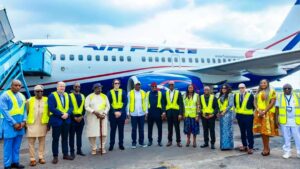
For Keyamo, who placed safety at the forefront of his agenda, the assessment represented an important milestone in strengthening Nigeria’s aviation credibility.
Restoring international confidence and connectivity
When the Tinubu administration assumed office, foreign airlines faced difficulties repatriating approximately $850 million in accumulated revenues, damaging Nigeria’s reputation and disrupting international operations.
Through coordinated action involving the Federal Government, Central Bank of Nigeria and aviation authorities, the backlog was substantially resolved. By April 2024, the International Air Transport Association reported that 98 per cent of the blocked funds had been cleared.
The return of Emirates to Lagos on October 1, 2024, after nearly two years away, became a visible symbol of renewed confidence.
Keyamo also pursued greater reciprocity for Nigerian carriers on international routes.
Air Peace commenced Lagos–London Gatwick services in March 2024 and subsequently expanded its London operations to include Heathrow through Abuja services in October 2025.
These developments strengthened indigenous participation in a lucrative international market historically dominated by foreign operators.
Nigeria has also advanced aviation arrangements involving Brazil, Algeria, Cameroon, Canada and other countries, creating opportunities for expanded connectivity, trade and tourism.
Strategic partnerships with global aviation leaders
Keyamo’s international engagements have brought Nigerian airlines closer to major manufacturers, financiers and technical institutions.
Visits to Boeing in Seattle and Airbus in France produced cooperation agreements covering aircraft acquisition, technical training, infrastructure and aerospace development.
Subsequent programmes involving Boeing and Cranfield University have supported safety leadership and operational management training for Nigerian aviation professionals.
Through participation in international aircraft leasing conferences in Dublin, the minister has also facilitated engagement between Nigerian carriers and global financiers.
These efforts complement the proposed Nigerian Aircraft Leasing Company, approved in principle by the Federal Executive Council to improve aircraft access for domestic and regional operators.
Together, the initiatives seek to strengthen the financial and technical foundations of Nigeria’s airline industry.
Modernising aviation infrastructure
Airport infrastructure remains central to the administration’s reform programme.
In July 2025, the Federal Executive Council approved ₦712.26 billion for the comprehensive rehabilitation and modernisation of Murtala Muhammed International Airport in Lagos, including the reconstruction of its ageing international Terminal One.
The investment is intended to improve operational efficiency, passenger experience and Lagos’s competitiveness as an international gateway.
Other initiatives include the ₦21.68 billion first-phase construction of a new Nigerian Airspace Management Agency headquarters and centralised Air Traffic Management Centre in Abuja.
Keyamo has also encouraged private-sector participation through the concession of Akanu Ibiam International Airport in Enugu, while advancing efforts to strengthen international aviation capabilities at airports in Uyo and Maiduguri.
These projects are expected to improve infrastructure and regional connectivity as implementation progresses.
Resolving an 18-year concession dispute
Another major achievement is the settlement of the longstanding dispute between the Federal Government and Bi-Courtney Aviation Services Limited over the Murtala Muhammed Airport Terminal Two concession.
The disagreement, which persisted for nearly two decades, involved competing contractual claims and a judgment debt reportedly valued at approximately ₦132 billion.
Following negotiations under Keyamo’s leadership, a settlement agreement was signed on October 20, 2026, resolving major concession issues and securing Bi-Courtney’s waiver of its substantial judgment debt claim.
The agreement removed a longstanding source of legal and financial uncertainty, strengthening the environment for private investment in airport development.
Nigeria’s rising continental aviation profile
In May 2026, the African Development Bank appointed Keyamo African Champion for its proposed $7 billion Integrated Aviation Transformation Programme for Africa.
The initiative seeks to improve aviation financing, infrastructure and connectivity across the continent.
Nigeria subsequently signed a Letter of Intent with the bank in Brazzaville on May 28, 2026, to advance its implementation.
The appointment reflects recognition of Nigeria’s reform progress and positions Keyamo to contribute to efforts to strengthen Africa’s aviation economy.
Investing in people and settling inherited obligations
The ministry has also pursued human capacity development through the African Aviation and Aerospace University and international training partnerships.
The institution is intended to develop expertise in aviation management, engineering and aerospace disciplines, while Nigeria’s Civil Aviation Master Plan provides a longer-term framework for industry development.
Another significant milestone came in September 2026 when the Federal Government commenced the settlement of ₦18 billion in outstanding severance benefits for approximately 2,700 former Nigeria Airways employees.
Many had waited more than two decades following the airline’s liquidation in 2003.
Keyamo’s sustained advocacy contributed to the intergovernmental efforts that made the payments possible, bringing relief to former employees and their families.
Tinubu’s reform agenda and the importance of continuity
The developments recorded in aviation reflect the broader priorities of President Tinubu’s Renewed Hope Agenda, particularly infrastructure development, institutional reform and private-sector investment.
Keyamo has consistently argued that the administration’s economic reforms require continuity to deliver their full benefits.
Aviation illustrates that argument.
Airport reconstruction, aircraft financing arrangements, regulatory improvements and professional capacity development require sustained implementation beyond their initial approvals.
The foundations established since 2023 have created opportunities for stronger airlines, improved infrastructure and greater international competitiveness.
Consolidating these gains will be essential to translating policy reforms into lasting economic benefits.
A legacy taking shape
For decades, Nigeria’s aviation ambitions have been constrained by the gap between its considerable market potential and the institutional weaknesses of the industry.
Under Keyamo, important progress has been made in narrowing that gap.
From improved aircraft leasing compliance and stronger safety oversight to international partnerships, airport modernisation and the resolution of longstanding disputes, his tenure has produced a substantial record of reform.
Perhaps his most important contribution has been recognising that a competitive aviation industry requires more than modern airports. It depends equally on credible regulation, affordable financing, skilled professionals and international commercial confidence.
Three years into President Tinubu’s administration, these foundations are becoming stronger.
If the reforms are sustained and the investments translated into measurable improvements, this period could be remembered as a defining chapter in Nigerian aviation, with Festus Keyamo among its most consequential figures.

