 Follow Us on Google News


 Follow Us on Google Discover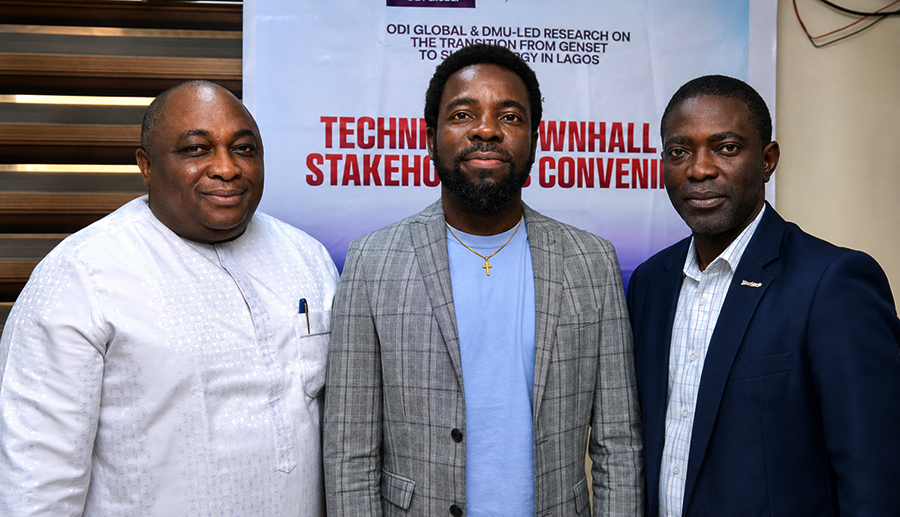
Dr Adeola Balogun of the Electrical & Electronics, Engineering Department, University of Lagos (left); Dr Eghosa Igudia of De Montfort University and Acting Director, National Centre for Energy Efficiency and Conservation, UNILAG, Dr. Manasseh Shitta during the Solar Technicians Town Hall held in Lagos.
Generator and solar energy technicians in Lagos said a coordinated framework is required to drive the transition from traditional energy to renewable.
The call was made at a Solar Technicians Town Hall held in Lagos as part of a four-month action research project examining the transition from genset-based livelihoods to solar employment in the state.
The initiative is being undertaken by researchers from ODI Global/African Cities Research Consortium (ACRC) and De Montfort University (DMU), with support from the University of Lagos (UNILAG) and the Federation of Informal Workers Organisations of Nigeria (FIWON).
The town hall brought together informal energy workers, solar technicians, and researchers to discuss the opportunities and challenges facing workers in Nigeria’s energy landscape, as it increasingly shifts towards renewable energy.
Discussions at the forum highlighted the critical role already being played by informal technicians in
the energy sector and the need to ensure that they are not excluded from the emerging solar economy.
The researchers noted that many technicians who have built their careers repairing and maintaining generators already possess practical electrical, mechanical and customer-service experience that could provide a foundation for acquiring solar installation and maintenance skills.
However, participants identified fragmented training pathways, inadequate access to recognised certification, financing constraints, limited opportunities for structured retraining and regulatory challenges as some of the barriers that could slow the transition.
The town hall is part of a wider research process designed to generate evidence on how technicians acquire solar skills and the extent to which existing training systems are meeting the needs of the rapidly changing energy market.
As part of the study, the research team has undertaken a rapid labour-market assessment involving technicians operating in major informal technical clusters across Lagos. Over 300 technicians were surveyed, including generator repairers, solar installers and workers operating across both sectors. The rapid survey examined the occupational backgrounds, routes into solar work, apprenticeship and informal learning experiences, access to formal training and certification, and work experiences of genset and solar energy technicians.
Speaking on the significance of the initiative, Dr Eghosa Igudia of De Montfort University said the project seeks to evaluate the level of skills, training provisions and gaps, funding for the training programmes and the role of other stakeholders in Lagos’ solar energy space, which is currently dominated by informal workers.
The project is being framed around the African Cities Research Consortium’s Theory of Change, which emphasises the mobilisation of citizens and the development of coalitions capable of influencing reform and strengthening state capacity. Dr Tim Kelsall of ODI Global and the African Cities Research Consortium is providing the political-economy and research framework for the initiative.
Experts from the University of Lagos and the National Centre for Energy Efficiency and Conservation are also contributing technical and renewable-energy expertise to the research. Federation of Informal Workers Organisation of Nigeria (FIWON), through its network of informal workers’ associations, is facilitating access to technicians and other workers operating within Lagos’ informal and semi-formal energy economy.
Participants stressed the importance of developing training programmes that recognise the existing knowledge of experienced technicians whilst providing them with the additional competencies required for safe and effective solar installations and maintenance in the rapidly changing sector.
The research team will use findings from the town hall, technician survey, interviews and training-programme mapping to develop recommendations for policymakers, industry and development partners.
The next phase will include a multi-stakeholder engagement workshop involving representatives of the informal workforce, government agencies, solar companies, training providers and development organisations.
The workshop is expected to examine practical measures for addressing identified skills gaps, improving training pathways, strengthening certification systems, expanding access to financing and improving coordination among institutions involved in solar skills development.

