 Follow Us on Google News



 Follow Us on Google Discover
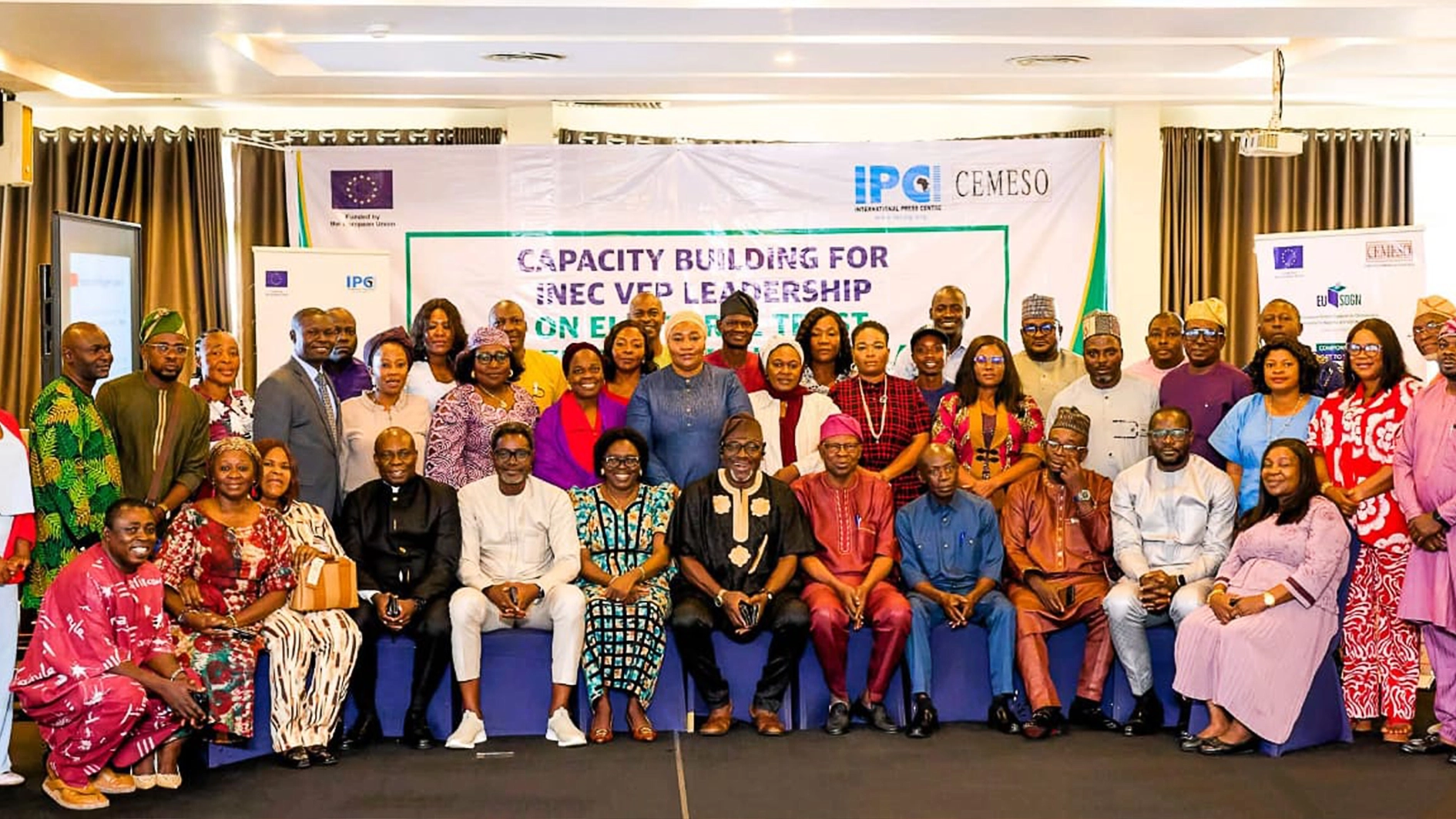
With the 2027 general elections fast approaching, members of the International Press Centre (IPC) and the Center for Media and Society (CEMESO) have stressed need to strengthen electoral confidence.
Members of the organisation stated this at the opening of a two-day capacity-building engagement for Independent National Electoral Commission (INEC)’s Voter Education and Publicity (VEP) leadership in Ibadan, Oyo State.
In his welcome remarks, IPC Executive Director, Lanre Arogundade, noted, “electoral trust is built long before election day. It depends on what citizens know, when they hear it and who they hear it from.”
He urged participants to move beyond disseminating information to communication that allows citizens access, understand and verify electoral information.
With misinformation travelling faster than corrections, and Artificial Intelligence (AI) making fabricated audio, images and video more convincing, he said electoral communication systems must withstand uncertainty, controversy and competing narratives without compromising accuracy, impartiality or public confidence.
Speaking further, Arogundade said fact-checking, though essential, must be complemented by proactive, coordinated and trusted communication. He also cautioned that solutions that work in one region may fail in another, given the nation’s diverse information environments.

On his part, Executive Director of CEMESO, Akin Akingbulu said, “all eyes are on INEC, and all ears are on VEP,’ identifying clarity, promptness and efficiency as what citizens will expect of the commission’s voter education and public communication.”
Akingbulu highlighted information challenges, including Permanent Voter Card collection, claims and objections on the register, questions about candidate lists and changes introduced under the Electoral Act 2026. Unanswered questions, he said, can quickly become rumours, while unclear or inconsistent explanations can undermine public confidence.
He added that participation depends on more than registration and PVC collection, but also requires confidence that the process is credible and that every citizen can understand and engage with it.
He called for communication that reaches diverse audiences through digital platforms, indigenous-language radio and accessible voter education for Persons With Disabilities.
Both leaders urged participants to turn the engagement into practical results.
Arogundade asked them to question what they hear, share what works in their zones and leave with concrete commitments rather than notes alone. Akingbulu charged them to become ‘Knowledge Multipliers’, carrying the lessons from Ibadan to state colleagues, Electoral Officers and local government teams.
The first day focused on communication, law and information integrity. Participants interrogated regional electoral trust and information needs, crisis and rapid-response communication, the Electoral Act 2026 in plain language, and media relations that protect INEC’s neutrality and credibility.
The second day explored misinformation risk mapping and information integrity, including verification of false claims, manipulated content, deepfakes and AI-generated media.
Other sessions covered include, conflict-sensitive communication and inclusive, audience-segmented voter engagement.
Applied scenario exercises test participants’ ability to coordinate responses to legal enquiries, misinformation incidents and voter-inclusion gaps. The programme also covered knowledge cascading, operational readiness and 90-day implementation commitments.
The engagement is the South-West edition of a zonal series. It was jointly implemented by IPC and CEMESO under Component 4 (Support to Media) of the European Union Support to Democratic Governance in Nigeria (EU-SDGN II) Programme, with funding from the European Union. The would be extended to the Northcentral (Jos), Southeast (Enugu) and Northwest (Kano) zones.

