 Follow Us on Google News
 Follow Us on Google Discover
The loss of lives and property in the Alakija building collapse in Lagos has renewed concerns about weaknesses in building regulation, professional supervision and emergency response, with built-environment experts calling for tougher enforcement, regular inspections and earlier action to prevent further tragedies.
The four-storey building collapsed on Old Ojo Road, near the Alakija Bus Stop, off the Lagos-Badagry Expressway in Satellite Town, Lagos State, Nigeria.
Eight died and 26 persons were rescued in the incident which occurred June 25, 2026.
The experts said the collapse highlighted the consequences of poor construction practices and weak oversight, stressing the need for competent professionals, quality materials and proper monitoring of buildings from construction through occupancy and maintenance.
They spoke at a conference organised by the Building Collapse Prevention Guild (BCPG), Amuwo-Odofin Cell, in Satellite Town, Lagos, with the theme, “Building a Resilient Lagos Through Synergy.”
The conference brought together regulators, construction professionals, developers, academics and community leaders to discuss ways of improving building safety and urban resilience in Lagos.
Coordinator of the BCPG Amuwo-Odofin Cell, Chubike Okafor, said the Alakija collapse was among the incidents that prompted the conference.
According to him, the incident exposed weaknesses in emergency coordination and highlighted the need for better early-warning systems.
Okafor urged residents, property owners and community leaders to report structural cracks, flooding, settlement, tilting, spalling concrete, persistent water damage and other signs of building distress to qualified professionals or relevant authorities before they develop into emergencies.
The Chairman of the conference, Dr Austin Otuoke, said building safety could not be guaranteed by one profession or institution alone, particularly in a rapidly growing city facing increasing demand for housing and infrastructure.
He said professionals and regulatory agencies must ensure that buildings were properly planned, approved, constructed and maintained, with clear responsibility at every stage.
The General Manager of the Lagos State Building Control Agency (LASBCA), Florence Gbaye, warned against the use of substandard materials and unqualified workers for critical construction activities.
Gbaye also criticised professionals who take on several projects but leave important responsibilities to unqualified persons.
She urged developers and practitioners to involve regulatory authorities throughout the construction process.
She said LASBCA’s Certified Accreditors Programme, involving more than 150 private practitioners, was designed to improve regulatory efficiency and professional participation.
The Vice President, Africa, International Society for Soil Mechanics and Geotechnical Engineering, Dr Sebastian Ozoamalu, said proper checks on soil and ground conditions before construction could help prevent structural failures.
He warned that neighbouring properties could have different ground conditions, making it unsafe to copy a foundation design simply because it had worked on another property.
Ozoamalu urged practitioners to work within their areas of competence and seek specialist advice where necessary.
Speaking on flooding and drainage, Agwu Ogonna Roberts said accurate information about land levels and proper drainage planning were important to building safety, particularly in low-lying parts of Lagos.
He warned that errors in land surveys and poor connections between private and public drainage systems could increase the risk of flooding and damage to buildings.
He advocated better mapping and drainage planning, as well as measures to manage stormwater and erosion.
A retired Permanent Secretary in the Lagos State Ministry of Waterfront Infrastructure Development, Olayinka Patunola-Ajayi, said building safety should be viewed as part of the wider resilience of Lagos.
She said the city’s rapid population growth, low-lying terrain, coastal exposure and interconnected infrastructure meant that problems with housing, drainage, transportation and utilities could have wider consequences.
Patunola-Ajayi called for major projects to undergo broader risk assessments and for buildings and infrastructure to be managed throughout their useful lives.
She also highlighted the potential of mapping and other digital technologies to improve planning and monitoring, while stressing that technology should support, not replace, professional responsibility.
Participants also raised concerns about poor-quality construction materials, inadequate site investigations, poor workmanship and weak supervision.
They warned against hiring professionals only to obtain building approval and then excluding them from the actual construction work.
They said supervision was particularly important during foundation work, reinforcement, concrete work and other critical stages.
A quantity surveyor, Oluwatomi Ogundare called for a shift from investigating building collapses after they occur to identifying and managing risks before failure.
According to BCPG records cited in his presentation, Nigeria recorded 817 building-collapse incidents between October 1971 and July 27, 2026, including 477 in Lagos.
Of the Lagos incidents, 325, representing 68.1 per cent, occurred while buildings were occupied, while 121, or 25.4 per cent, occurred during construction and 31, or 6.5 per cent, at the end-of-life stage.
Ogundare identified gaps in building records, investigations and early intervention as areas requiring urgent attention.
He recommended risk-based inspections, stronger controls on building alterations and changes of use, improved building records, updated fitness certification and a system for tracking distressed buildings until identified problems were resolved.
The Dean of the School of Environmental Studies, Yaba College of Technology, and Third Vice President of the Nigerian Institute of Building, Dr Aladeloba Adesina Emmanuel, called for the training and recertification of artisans and craftsmen.
He identified poor planning, inadequate financing, abandoned projects and weak project management as other challenges affecting the construction industry.
The General Manager of the Lagos State Physical Planning Permit Authority, Kehinde Osinaike, represented by Busola Olatunji, and other participants urged residents to adopt a “See Something, Say Something” approach by reporting unsafe buildings and unauthorised construction.
The stakeholders said building safety required more than regulations and approvals.
They called for tougher enforcement, ethical professional practice, quality materials, competent supervision, regular inspections, effective maintenance and timely intervention.
They said the Alakija collapse should reinforce the need to move from investigating failures after they occur to preventing them before they happen.
Experts demand tougher enforcement to tackle building collapse in Lagos
Date: 5 October 2026 4:21am WAT
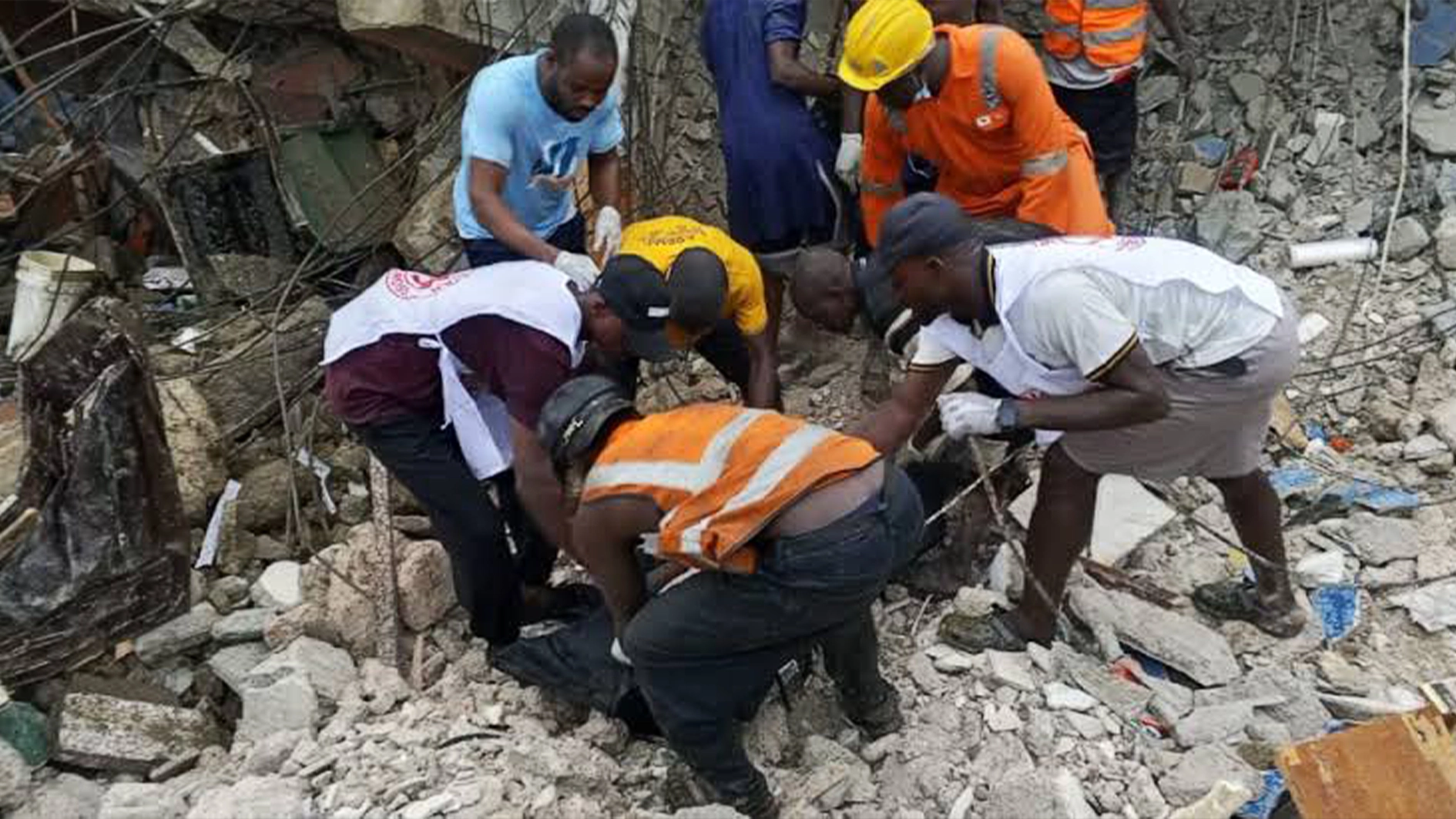
Rescuers during Alakija building collapse in Lagos
Rescuers during Alakija building collapse in Lagos

