 Follow Us on Google News


 Follow Us on Google Discover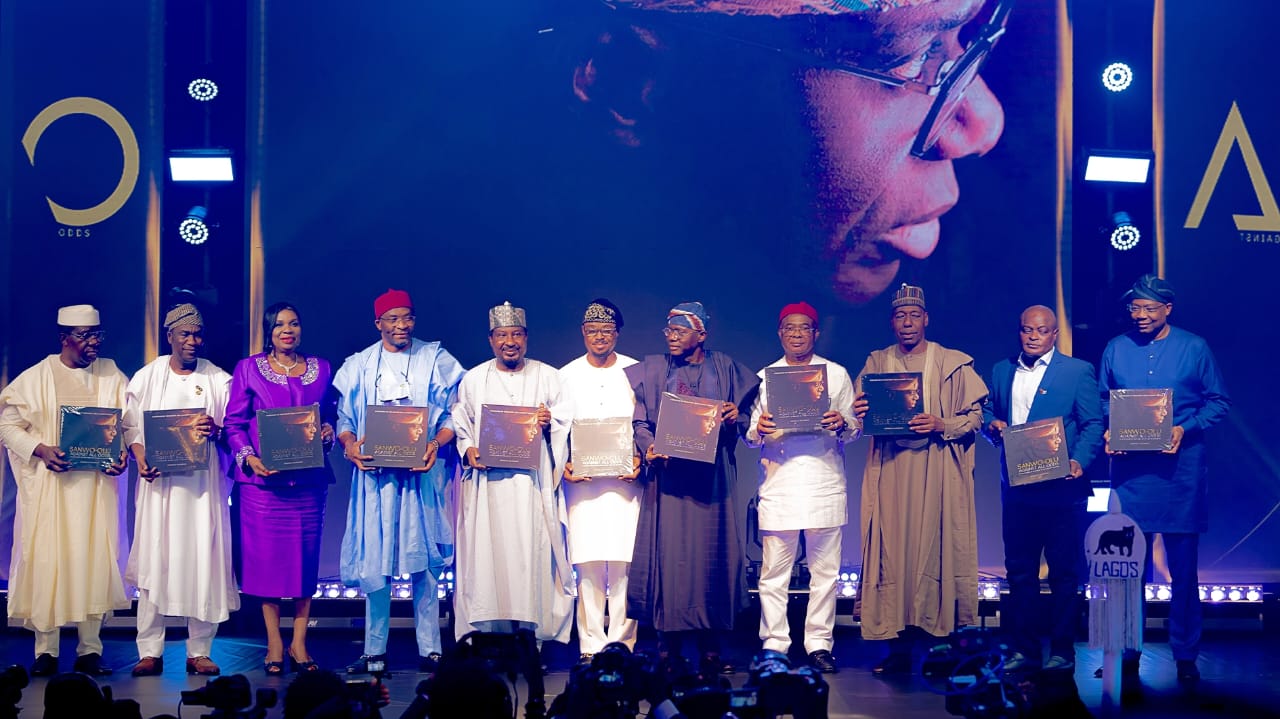
By Babatunde Amakaye Olowu
…How against all odds change the way I see Lagos
There are evenings that entertain. There are evenings that educate. Then there are evenings that quietly change the way you see a city forever.
I believe I witnessed one of those evenings.
By the time I arrived at the official unveiling of Against All Odds, I had already travelled through its pages. I had followed its stories, reflected on its arguments and walked beside its portraits of leadership under pressure. I came expecting a book launch. I left carrying a deeper question.
Not a question about politics or even governance, but about ourselves. About what it truly takes to build a city that never sleeps. About whether those of us who enjoy the fruits of Lagos have paused long enough to consider the price that was paid for them.

That evening was not simply the unveiling of Against All Odds. It was the unveiling of Lagos itself.
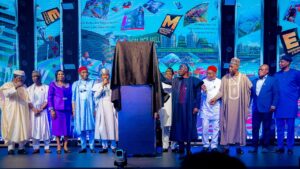
Not the Lagos of traffic, headlines and endless social-media debates, but the Lagos beneath them all, a city built by men and women who accepted impossible responsibilities because someone had to.
Yet there was something about the evening that made it different from an ordinary book presentation. The book was only one part of the experience. Alongside it stood a solo photographic exhibition by its author, Ademola Olaniran, presenting the same story in another language – the language of images.
That distinction mattered.
The book allowed the story to be read. The exhibition allowed it to be encountered.
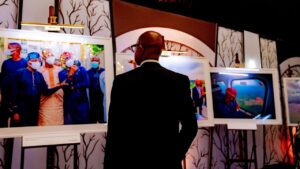
One could move from the printed page to the gallery wall and suddenly understand that these were not merely photographs illustrating a publication. They were fragments of lived time. Moments in which decisions were being made, crises were unfolding, people were working, grieving, building, responding and carrying responsibilities that would eventually become the history of Lagos.
As I settled into my seat, I realised I was not about to discover the story for the first time. I had already encountered it in the book. What the evening offered was something different. It gave voices to the pages I had read. It placed faces beside testimonies and allowed those who had lived the story to affirm what had been so carefully documented.
And then the photographs surrounding the exhibition space seemed to say: look again.
Long before I attended the unveiling, one question had lingered with me as I turned the pages of Against All Odds: who was the patient mind behind a work like this?
The answer revealed itself quietly.
The author was not merely documenting an administration; he was practising a vocation. Trained as a documentary photographer, refined through years of international learning and shaped by a career devoted to observing rather than interrupting history, he approached leadership with the discipline of a witness rather than the enthusiasm of a promoter.
That understanding helped me appreciate the book differently.
Behind its pages was the patient eye of a documentary photographer who understands that preserving history is itself a form of public service.
Ademola Olaniran had not written from a distance. He had spent years behind the lens, following Governor Babajide Sanwo-Olu through moments of celebration and seasons of strain, through public ceremonies and private burdens, through construction and crisis.
That explains why the photographs never felt merely official.
They felt historical.
Documentary photography carries a quiet patience that cannot be manufactured. It is cultivated through years of observing, waiting and allowing moments to reveal themselves. Reading the book, I never felt the photographs were asking to be admired.
They were asking to be remembered.
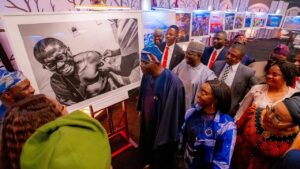
Seeing them enlarged and presented independently in the exhibition made that quality even more apparent. A photograph on a page is part of a sequence; a photograph on a gallery wall becomes an encounter. It asks you to stop. To look again. To notice the face in the background, the gesture that might otherwise have escaped attention, the expression behind the ceremony.
The exhibition slowed the evening down, it gave the audience permission to look. And looking, I discovered, is sometimes the beginning of understanding.
That understanding deepened as the speeches began.
What emerged from the evening was more than a sequence of speeches; it was almost a collective testimony to a chapter in Lagos’s recent history. From the remarks of the Chairman of the Progressive Governors Forum,Senator Hope Uzodimma, to those of the Deputy Speaker of the House of Representatives, Rt. Hon. Benjamin Okezie Kalu, and the Deputy President of the Senate, Senator Barau I. Jibrin, speaking on behalf of the Senate President, there was a striking convergence of thought.
Leadership is ultimately measured not by the ease of the circumstances in which it is exercised, but by what a leader does when the circumstances become difficult.
Uzodimma captured this through the language of his own professional experience, likening Governor Sanwo-Olu to a good driller who drills to the target. The image was simple, but it carried a powerful idea: persistence is not always dramatic. Sometimes it is simply the refusal to stop before the work is done.
Kalu invoked Theodore Roosevelt’s celebrated image of the leader “in the arena”—the person willing to accept the dust, the criticism, the uncertainty and even the possibility of failure that come with actually doing the work.
The Senate’s representative placed the Lagos experience within the wider continuum of democratic leadership and institutional continuity.
Different voices. Different experiences. Yet a common recognition, the circumstances matter.
But the response to those circumstances matters even more. The speeches gave political language to what the photographs had already been showing.
Then Governor Sanwo-Olu took the podium, and the character of the evening changed. He did not speak merely as the subject of the bok, he spoke as a witness to the years it records.
His speech was reflective, grateful and deeply personal.
He acknowledged those who had built the Lagos story before him- President Bola Ahmed Tinubu, Governors Babatunde Fashola and Akinwunmi Ambode and he recognised his own deputy, Dr. Kadri Obafemi Hamzat.
It was an important reminder that no administration begins with a blank page.
Cities inherit.
Governments inherit.
Leaders inherit.
And responsible leadership understands that inheritance is not something to destroy in order to prove that one has arrived.
Sanwo-Olu spoke about COVID-19, the EndSARS protests, explosions, building collapses and the succession of painful episodes that tested Lagos.
He did not describe them as footnotes to his administration, he described them as defining tests of leadership.
Yet beneath the recollections was another message that seemed particularly important: continuity.
Lagos, he suggested, does not have to tear down what others have built in order to build something of its own.
It can add. It can improve. It can extend.
Perhaps most revealing was the Governor’s own understanding of his place in the photographs. He described himself, in essence, as the man the camera repeatedly found at the centre of the frame. But he insisted that the real subject was Lagos.
The trader.
The nurse.
The engineer.
The student.
The worker.
The millions of ordinary people whose lives give the city its meaning.
That observation brought the book and the exhibition together, because what was on those pages- and what hung on those walls- was not simply a portrait of a governor, It was an attempt to photograph a city through the moments in which its leadership was being tested.
For me, however, one of the most moving dimensions of the evening was the way the speeches continually returned Against All Odds to its real purpose.
It was not being presented simply as a collection of impressive photographs, It was an attempt to preserve memory while the memory was still alive.
The Governor’s acknowledgement of Ademola and the wider eleven-member team therefore carried unusual weight. He called Ademola the “chief witness”- a phrase that seemed, in many ways, to define the entire project.
A witness does not manufacture the event.
A witness does not decide what history should become.
A witness stands close enough to see.
And then remembers.
The author’s own earlier assertion that a photograph cannot invent character or manufacture legacy, but can only bear witness, seemed to find its fullest expression that evening.
The political leaders supplied testimony.
The Governor supplied lived experience.
The book supplied the visual record.
The exhibition allowed the audience to encounter those years almost photograph by photograph. Together, they formed something greater than any one of them could have achieved alone.
They turned public service into lived experience.
They turned memory into evidence.
And they turned a book launch into an encounter with history.
That was perhaps why Against All Odds reads differently from many official publications. It does not feel assembled for publicity, it feels observed.
There is a difference.
Publicity tells us what happened. Documentary storytelling allows us to discover why it mattered.
Rather than presenting a catalogue of projects, the book follows the journey of a city. It moves from emergence to responsibility, from crisis to resilience, and from survival to vision. Its chapters are less about celebrating accomplishments than revealing the demands that produced them.
One feature of the book deserves special mention. At one point, the narrative quite literally unfolds. A beautifully executed gatefold reveals the scale of Lagos’ rail vision, inviting the reader to pause before turning the page.
It is far more than an elegant design decision; it is a literary statement in itself. Some visions cannot be contained within the boundaries of a single page. They must be unfolded to be fully appreciated.
For me, that moment became a metaphor for the larger story the book was telling. The Lagos Rail Mass Transit project is more than an infrastructure milestone. It represents a profound reimagining of how a modern African megacity should move, grow and connect.
Railways do more than transport passengers. They restore time to families, expand economic opportunity, reshape urban development and quietly redefine the rhythm of everyday life.
As the gatefold opened before me, I realised it was revealing more than rail lines. It was unfolding a vision of Lagos that stretches well beyond the present generation.
And that same idea seemed to exist in the exhibition.
The page showed the project.
The photographs showed the people inside the project.
The speeches gave context to both.
One speaker described Against All Odds not as a boast but as a description.
Those words stayed with me.
Against all odds.
A city growing faster than almost any government can plan. A population expanding relentlessly. Infrastructure under constant pressure. Expectations rising every day. Yet Lagos continues to reinvent itself.
Whether one agrees with every policy or not, few can deny that the city has refused to surrender to impossibility.
That refusal deserves study.
Long before the applause began that evening, the book had already persuaded me that leadership is not measured by the absence of storms.
It is measured by what still gets built while the storm is raging.
That is why the title feels so honest.
Not beyond the odds.
Not without the odds.
Against them.
By the time I entered the hall, the chapters on Abule Ado, COVID-19, EndSARS and the succession of emergencies had already convinced me why the book bears its title. I had encountered those moments first through the author’s documentation of them, and the evening gave me an opportunity to reflect on the human weight behind the accounts I had already read.
The pages had shown the burden.
The evening revealed the people who carried it.
One account in particular had stayed with me. In the book, Ademola recounts a moment shared by Prof. Akin Abayomi during those long and difficult nights at Government House, when the Governor was wrestling with decisions whose consequences could affect an entire city. On one such night, exhausted and with bloodshot eyes, Governor Sanwo-Olu quietly turned to him and said:
“Prof, be careful what you pray for in life.”
I could almost hear the gentle laughter that must have followed, but beneath the humour was a sobering truth: leadership often appears glamorous from a distance. Up close, it is sacrifice without applause.
That, to me, became one of the defining lessons of the evening.
The speakers did not dwell merely on projects. They spoke about choices—the choice to continue when retreat would have been easier; the choice to absorb criticism without abandoning responsibility; the choice to keep building while the city demanded answers faster than any administration could possibly provide them.
That is where leadership truly lives.
A bridge is concrete. A road is asphalt. A school is brick and mortar. Yet before any of them exists, someone must first carry an invisible burden that few people ever see.
That burden is leadership.
As I listened, I found myself thinking about the author’s reference to Rudyard Kipling’s timeless poem, If. No one quoted it that evening, yet its spirit lingered in the room. The journey captured in Against All Odds echoed its enduring message: keeping one’s head when others lose theirs, enduring doubt without surrendering to bitterness, meeting triumph and disaster with equal composure, and finding the strength to begin again when years of labour are threatened by forces beyond one’s control.
Whether one admires Governor Babajide Sanwo-Olu or questions some of his decisions, both the book and the conversations surrounding it return to one enduring truth:
Leadership is not tested on ordinary days, It is tested when every reason to give up appears reasonable.
As the evening unfolded, I found myself looking beyond the stage to the audience.
Young people sat beside elders. Traditional rulers shared the hall with professionals, students, public servants and business leaders. There were indigenes and residents, people of different faiths, generations and political persuasions.
Yet, for those few hours, they were united by a single story.
That, too, is leadership.
Real leadership gathers people who would ordinarily disagree and invites them to consider something greater than their differences.
I noticed something else. Whenever the conversation moved away from statistics and entered the realm of human experience, the hall grew quieter. The applause became less frequent, but the attention became deeper.
Stories were accomplishing what arguments rarely can.
Having already read the account of the governorship campaign, it was fascinating to hear those events revisited by people who had witnessed them firsthand. The book described a campaign marked by suspicion, controversy and public scepticism. The speakers confirmed that those early days demanded not only political skill but unusual restraint.
Again and again, they returned to a leader who answered difficult questions without bitterness and kept bringing the conversation back to one subject:
Lagos.
It struck me that the first victory recorded in the book was not electoral, it was the victory of restraint over provocation. Then another thought took hold, Lagos is one of the few places where identity itself becomes an act of leadership.
Who truly owns Lagos?
Those born here?
Certainly.
Those whose ancestors built Isale Eko and preserved its customs and traditions?
Without question.
Yet both the book and the evening suggested another answer.
Lagos also belongs to those willing to carry her burdens, not merely those who inherit her history. That has always been the miracle of Eko.
For generations she has welcomed traders before they became merchants, dreamers before they became captains of industry, strangers before they became neighbours and migrants before they became patriots.
She has opened her arms to those prepared to build with her.
But every embrace carries a responsibility.
The city does not simply ask what it can give you.
It quietly asks what you intend to leave behind.
Perhaps that is why the vision stated near the opening pages of Against All Odds remained with me: to make Lagos Africa’s model megacity and a global economic and financial hub.
It is an inspiring vision. Yet visions are never fulfilled by slogans.
They are realised through disciplined decisions, many of which the public never sees.
One of the strengths of the book is that it refuses to present completed projects as isolated achievements. Instead, it reminds the reader that behind every commissioning are countless meetings, difficult conversations, revisions, consultations and compromises that rarely attract cameras.
Leadership, I realised, is usually invisible before it becomes visible.
One of the evening’s greatest lessons was that we were not being asked merely to admire achievement. We were being challenged to inherit responsibility.
There is a profound difference.
Roads can be copied. Policies can be copied. Buildings, technology and master plans can all be reproduced.
But can courage be copied?
Can institutional memory be cbopied?
Can resilience, trust and the discipline to withstand crisis after crisis be transferred from one place to another?
Those are far more difficult to replicate.
Perhaps cities become great not because they possess greater resources, but because they produce more people willing to accept greater responsibility.
The evening also refined my understanding of criticism.
Every healthy democracy depends upon it. Without criticism, leaders become complacent. Without accountability, institutions weaken.
Yet criticism without study becomes noise, just as praise without evidence becomes propaganda. That, perhaps, is one of the book’s greatest achievements. It never demands agreement. Instead, it invites engagement.
It asks the reader to examine before concluding, to understand before simplifying and to study before judging. In an age when opinions are formed in seconds and forgotten just as quickly, that invitation felt both refreshing and necessary.
By then, I realised that the evening had become far more than the celebration of a publication.
It had become an invitation to think more deeply about leadership, memory and our collective responsibility to understand the stories that shape our society.
And the exhibition had quietly altered the way I was looking at the photographs.
At first, I had seen images.
Then I began seeing moments.
Finally, I began seeing evidence.
A photograph of a construction site became evidence of a decision.
A photograph of a hospital became evidence of preparation.
A photograph of a meeting became evidence of responsibility.
A photograph of a grieving family became evidence of the human cost that statistics can never adequately convey.
This is what documentary photography does at its best.
It does not merely show us what happened.
It preserves the possibility of remembering how it felt.
That is why Ademola Olaniran’s role in this project deserves to be understood beyond the conventional description of photographer.
He is a visual historian.
He possesses the uncommon discipline to stand quietly where history is unfolding, allowing moments to reveal themselves before committing them to memory.
His craft is rooted in patience, his eye trained by years of documentary practice, and his purpose shaped by the conviction that societies remember only what someone deliberately preserves.
In his hands, the camera becomes more than a creative tool.
It becomes an archive, a witness and, ultimately, a guardian of history.
Even the physical presence of the book reinforced that sense of permanence.
Before one is persuaded by its arguments or moved by its photographs, one is struck by the care with which it has been produced.
Its generous format, thoughtful sequencing, refined typography, exceptional image reproduction and meticulous finishing communicate the same conviction: this was never intended to be a publication for the moment.
It was designed to endure.
In an age of disposable content, Against All Odds reminds us that when a society chooses to preserve its history, it should do so with excellence worthy of the story it seeks to tell.
Books outlive microphones.
They outlive elections, governments and headlines.
The more I reflected on the evening, the more I appreciated the quiet discipline behind this remarkable work. It suddenly made sense that someone drawn to poetry, fine art, music and the preservation of treasured objects would eventually produce a book like Against All Odds.
Such people are naturally drawn to memory.
They understand that yesterday is not something to escape but something to preserve for tomorrow.
Perhaps that is why this publication feels less like an official record and more like a civic archive—a conversation between generations, preserving not only events but the values that shaped them.
Perhaps that is also why I left the hall with a deeper respect not only for those who lead, but for those who preserve leadership.
Long after speeches have faded and headlines have disappeared, it is the patient work of writers, historians, photographers and storytellers that enables a people to remember who they were, what they endured and how they became who they are.
Civilisations are sustained not merely by memory, but by preserved memory.
As I stepped outside, I looked once more at the cover of Against All Odds. It suddenly occurred to me that the title did not belong only to Governor Babajide Sanwo-Olu.
It belonged to Lagos itself.
What other city grows at the speed of Lagos? What other city welcomes millions of dreams from every corner of Nigeria and still somehow finds room for more? What other city survives explosions, pandemics, protests, economic uncertainty and relentless population growth, yet rises each morning determined to continue?
Perhaps the book’s most enduring protagonist is not only the Governor, but Eko itself.
The roads were still crowded.
The traffic had not disappeared.
Traders still bargained with customers.
Commercial buses still competed for passengers.
Nothing outside had changed.
Everything inside me had.
I was no longer seeing traffic.
I was seeing movement made possible by decisions taken years earlier.
I was no longer seeing flyovers, hospitals and schools simply as structures.
I was seeing planning, sacrifice and foresight.
I remembered Prof. Akin Abayomi’s account of preparations that began before COVID-19 reached Nigeria.
Familiar landmarks had become evidence of unseen labour.
That is what great storytelling does.
It teaches us to see what has always been there.
Before reading Against All Odds, I knew Lagos as a city.
By the time I attended its unveiling and walked through its exhibition, I had begun to understand it as an argument.
An argument that impossible things remain possible.
An argument that vision can survive criticism.
An argument that preparation can save lives before crisis arrives.
An argument that compassion is not weakness but one of leadership’s greatest strengths.
An argument that resilience can become public policy. Perhaps that is the enduring spirit of Eko.
For some of us, Lagos is inheritance. For others, it is opportunity. For all of us, it is responsibility.
No city becomes great because of governors alone. Neither does it become great because of investors alone. It becomes great because ordinary people decide that the place they call home deserves their honesty, their labour and their best ideas.
The fisherman at Ebute Ero.
The trader at Balogun.
The banker on Victoria Island.
The artisan in Mushin.
The teacher in Agege.
The engineer in Lekki.
The market woman in Mile 12.
The young innovator in Yaba.
The custodian of tradition in Isale Eko.
The newcomer pursuing a better future.
Each is a co-author of the next chapter of Lagos. That, perhaps, was the greatest lesson of the evening.
The unveiling of Against All Odds was never asking us to become spectators of history. It was inviting us to become participants in it.
So, was it merely a book launch? No.
It was a book being presented, an exhibition opening, a body of testimony being offered, a chapter of governance being examined, and a photographer placing his archive before the public.
It was political leaders speaking from experience.
It was a Governor looking back upon years in which responsibility was tested by crisis.
It was an author reminding us that a camera can preserve what memory alone cannot.
It was a city seeing fragments of itself assembled in words and images.
It was history refusing to disappear.
It was evidence challenging opinion.
It was photography becoming literature.
It was public service becoming a case study.
Above all, it was responsibility reaching forward to shake hands with the future.
As I drove home, one thought refused to leave me.
Every generation inherits a city.
Only courageous generations leave behind a civilisation.
That, I believe, is the deeper purpose of Against All Odds.
Beyond documenting the achievements of one administration, it reminds us that leadership should be studied before it is judged, documented before it is forgotten, and understood before it is simplified.
Behind every policy stands a person.
Behind every decision lies a burden.
Behind every success is a sacrifice.
And behind every enduring record stands someone who understood that the moment would one day become history.
As I reflected on the evening one last time, my thoughts returned to the quiet chronicler behind the work.
Ademola Olaniran is more than a photographer; he is a visual historian. He possesses the uncommon discipline to stand quietly where history is unfolding, allowing moments to reveal themselves before committing them to memory. His craft is rooted in patience, his eye trained by years of documentary practice, and his purpose shaped by the conviction that societies remember only what someone deliberately preserves.
Perhaps the most fitting description came from the Governor himself:
The chief witness.
In that phrase lies the significance of everything I had encountered that evening.
The book.
The exhibition.
The photographs.
The speeches.
The memories.
The testimony.
They were all saying, in different ways, that a society must decide what it is willing to remember.
When history writes the next chapter of Lagos…
When another generation gathers to reflect on the city we inherited…
When another author opens a fresh page to tell the story of our own time…
Will our names appear merely as people who lived here?
Or as citizens who helped build her?
That is the question I carried home.
That is the question Against All Odds left with me.
And perhaps it is the question every Lagosian, whether indigenous or resident, must now answer.
Because Eko has given much to all of us.
The time has come to ask what all of us will give back to Eko.
-Babatunde Amakaye Olowu

