
 Get Guardian on Google
By Abdlrazaq Ayodeji Shittu
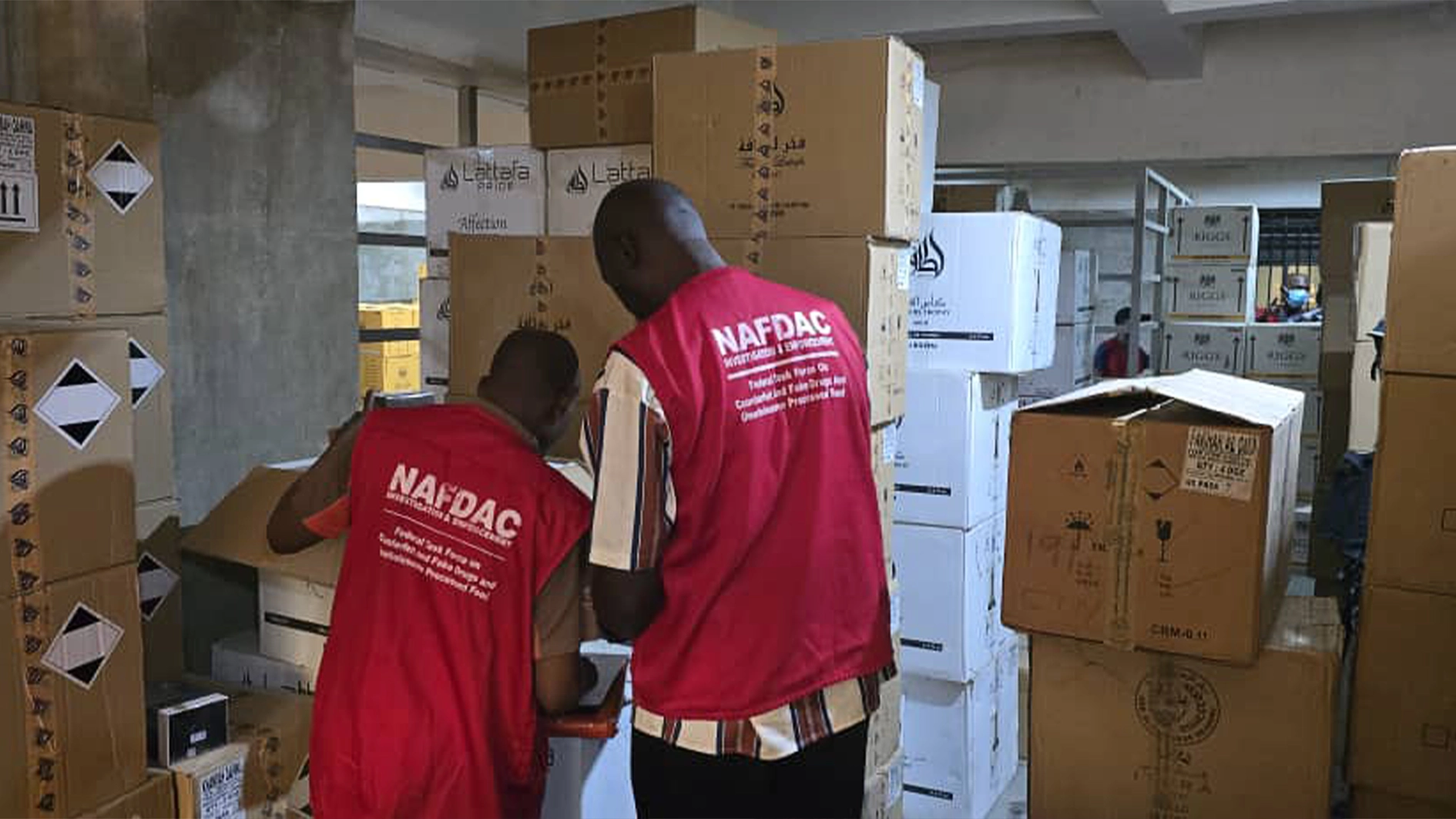
In February, National Agency for Food and Drug Administration and Control (NAFDAC) officers entered a three-story building at the Lagos International Trade Fair Complex, registered as a spare-parts warehouse. Inside, they found more than 10 million doses of counterfeit medicines, including injections for cerebral malaria, antibiotics, and the banned painkiller Analgin. NAFDAC valued the stock at over N3 billion and said it could have killed three million Nigerians.
“What we discovered should make every Nigerian cry,” said Dr. Martins Iluyomade, NAFDAC’s Director of Investigation and Enforcement. “When fake injections are used in emergencies, such as for cerebral malaria, they become a death sentence.”
Days later, in the same complex, officers found another N3 billion in banned and counterfeit cosmetics hidden in an unfinished building. This month, they returned and seized counterfeit and “revalidated” alcoholic drinks worth over N2 billion, stored in more than 20 illegal shops behind makeshift parking lots.
Same addresses. Same products. Same ending: a raid, a press release, a bonfire. Then the warehouses fill again.
An industry, not a crime wave
Let us stop calling these isolated scandals. This is an organised industry with its own warehouses, logistics, packaging suppliers, financiers, and protection.

When NAFDAC raided the Trade Fair market in October 2025, armed thugs attacked its officers and vandalised their vehicles. Market security reportedly locked the gates. NAFDAC’s Director-General called the attack premeditated. Criminals who fight like that are not protecting a few cartons. They are protecting a billion-naira business.
Some have tried to pin this crime on a single ethnic group. They are wrong, and they help the real culprits hide. Poison has no tribe. Those caught come from every part of Nigeria. Greed is the common thread.
This industry is in our food as much as in our medicine. Federal officials have warned that palm oil is being mixed with dye, lard, and even transformer oil to make it look richer. Fruit is ripened with calcium carbide, which NAFDAC says contains arsenic and phosphorus. Expired milk, yogurt, ketchup, and soft drinks are given new dates. In December 2025, NAFDAC destroyed N55.4 billion worth of fake and substandard products in Ibadan. That was one zone, in one exercise.
No household is safe, no matter how careful. In August, former Vice President, Professor Yemi Osinbajo, told a gardeners’ seminar in Lagos about what happened when his wife, Dolapo, switched from fizzy drinks to freshly squeezed orange juice. “After a while she started having some strange headaches,” he said. She sent the juice to a laboratory, and the result came back: “not fit for human consumption.”
His warning belongs in every kitchen: “The fact that fruit looks fresh doesn’t mean that it is safe.” He cited surveys in which half of the fruit sellers questioned in Ado-Ekiti and a quarter of those in Uyo admitted using calcium carbide. In Lagos, 22 of 50 retailers surveyed admitted treating produce with chemicals. If a former Vice President’s household can be exposed, so can every one of us.
Some of this is cheating. Much of it is poisoning, and we must call it that. A mother who gives her child a counterfeit antimalarial is not just cheated; her child is left untreated. The UN Office on Drugs and Crime estimates that counterfeit antimalarials cause about 267,000 deaths yearly in sub-Saharan Africa. Counterfeit antibiotics also contribute to drug resistance, which the WHO links to about 60,000 deaths in Nigeria each year.
The true death toll is invisible. When a fake drug fails, the death certificate reads “complications”. Nobody counts the fake drug.
Why raids are not working
NAFDAC’s officers deserve our respect. They work under fire, underfunded and understaffed, with too few laboratories across 36 states. But courage cannot fix a broken system, and that system has three fatal flaws. First, the punishment is a joke. Under the Counterfeit and Fake Drugs Act, the maximum fine is a measly N500,000.00.
For a syndicate holding N3 billion in stock, that is not a deterrent. It is a licence fee, or at best a light slap on the wrist. As NAFDAC’s Christy Obiazikwor put it: “They can simply pay a small fine and go free.” Some cases filed in 2010 are still in court, and suspects on bail return to business.
Second, enforcement is reactive. NAFDAC must locate the warehouse before it can act. By then, many consignments have already reached homes. Seizures do not measure success. They measure how much got through.
Third, the Constitution ties the states’ hands. Drugs and poisons fall under the Exclusive Legislative List, so only the federal government can regulate them. Yet counterfeiting occurs in markets, warehouses and shops that states and local governments control. The tier of government closest to the crime has the least power to fight it.
What must happen now!
We must shift from catching criminals to stopping them. There are five steps: Declare a national emergency for food and drug safety, with emergency funding for NAFDAC and the Standards Organisation of Nigeria (SON). Every zone needs accredited laboratories, field test kits, and proper security for officers.
Fix the law. Pass the long-delayed amendments to the NAFDAC Act and the Counterfeit Drugs Act. Set fines based on the value of seized goods, not on a fixed naira amount that inflation has eroded. Toxic adulteration should carry life imprisonment, and the proceeds should be forfeited automatically.
Devolve power. Move drugs and poisons to the Concurrent List. Federal standards should remain the minimum, but states must retain the authority to inspect and enforce. We moved electricity to the Concurrent List in 2023, and the sky did not fall. India shows what happens without coordination, so the amendment must require shared data and federal minimum standards.
Let states act now. Any building used to store counterfeit goods should be forfeited. Large warehouses should be licensed. Landlords, transporters, and security officers who knowingly assist should be prosecuted. The South-West, where the largest operations are based, should lead with a joint law and a shared intelligence centre.
Make every product traceable and every citizen a watchman. Put a scannable code on every medicine and on high-risk foods. Pay whistleblowers a share of what is seized. We need to build a national movement around three actions: See it. Report it. Stop it.
The cost of doing nothing
SON estimates that Nigeria loses about N15 trillion yearly to substandard goods. Honest manufacturers cannot compete with fakes that pay no taxes and cut corners. Counterfeiting was one reason GSK and Sanofi stopped manufacturing in Nigeria in 2023. Every fake sold costs jobs in factories that employ Nigerians.
What you can do:
Check the NAFDAC number and scratch code before buying medicine. Buy from sellers you know and can return to. If the price is too good to be true, it may be poison. Report suspected products to NAFDAC’s toll-free line at 0800-162-3322. Talk about it in your religious and community gatherings, your market union, social clubs, your estate meeting, and your family’s WhatsApp group.
Those who poison our food are counting on two things: that we will not notice, and that if we do notice, we will do nothing. Nigerians have beaten impossible enemies before. This one is easier to find. It operates in buildings we can name, in markets we all know.
The question is whether we will act before the next child, the next mother, the next breadwinner becomes another death nobody counted.
Enough is enough. It is time to rise!
Dr Shittu, a Telecoms and IT expert of almost five decades, a scholar-practitioner, is chairman of Medsure Medical Ventures Limited.