 Follow Us on Google News


 Follow Us on Google Discover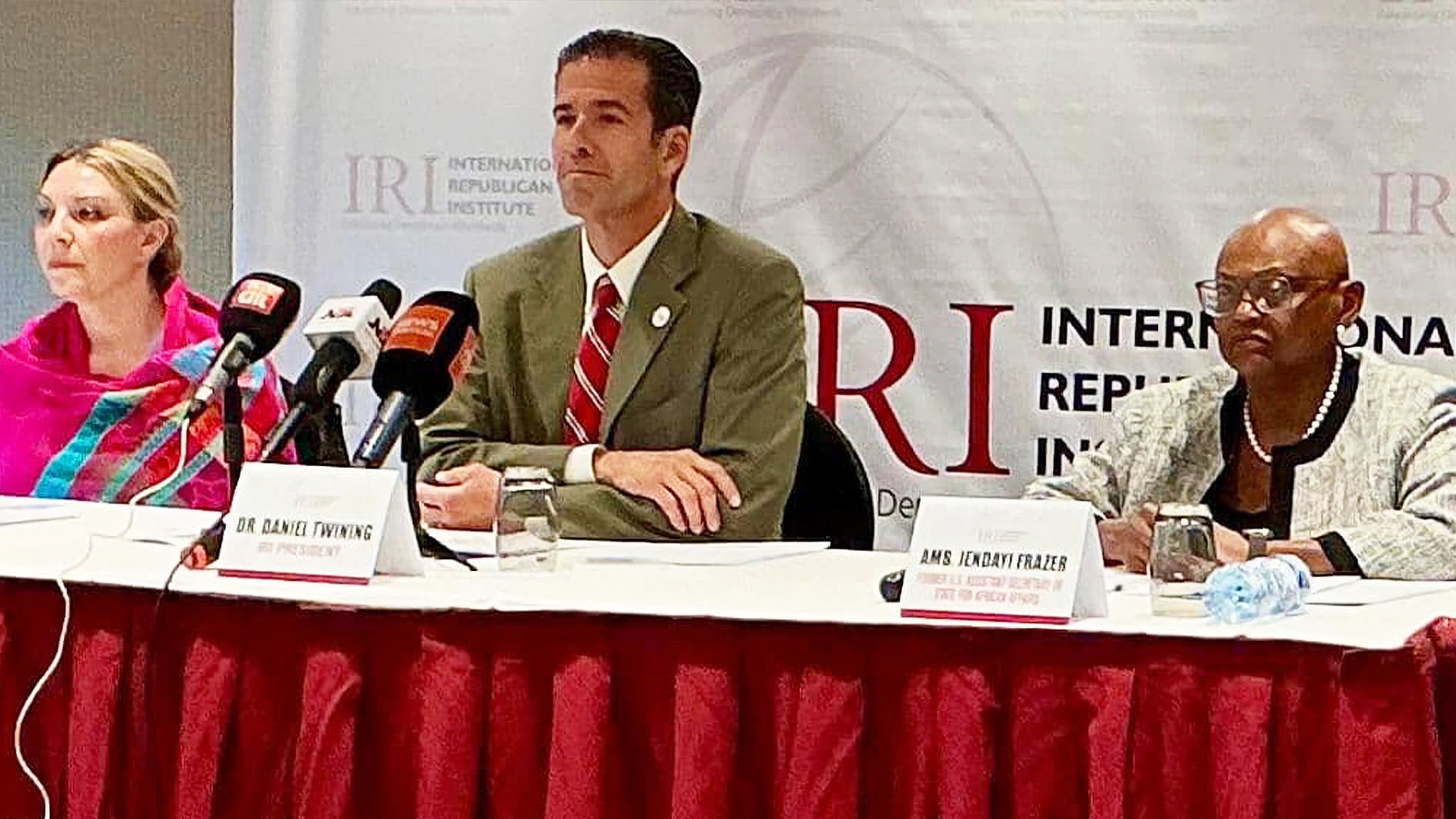
…Task political leaders to shun hate speeches
A US-based election observation group – International Republican Institute (IRI), has said that insecurity and political violence have been observed as major threats to the forthcoming 2027 general elections.
Speaking Friday in Abuja on what it tagged, ‘Media Advisory’, the group led by its President, Dr Daniel Twining alongside Former US Ambassador to South Africa, Jendayi Frazer and the Regional Director for Africa, IRI, Janai Cox, called on political leaders and parties to shun rhetoric that threatens opponents, incites violence or portrays electoral defeat as inherently illegitimate.
Worried that persistent insecurity and political violence, erode confidence in the electoral process and depresses voters’ participation, the group held that where voters, candidates and observers cannot participate without fear of violence or intimidation, technical improvements and legal safeguards have only limited effect.
“This challenge is unfolding within a political landscape that has transformed considerably since 2023”, the group said.
Acknowledging existence of electoral reforms, IRI is skeptical about the practicability of the new legal framework as public confidence remains one of the most consequential challenges facing the process.
Stressing that its mission in Nigeria is to provide an independent and impartial assessment of the country’s electoral processes, offering key findings and recommendations that will help stakeholders strengthen electoral process ahead of the 2027 general elections, it said the country’s experience of 2023 has continued to shape perceptions of Independent National Electoral Commission (INEC), particularly with respect to results, transmission and collation.
It held that in the 2027 outing, electoral credibility will depend not only on administrative capacity but also on the transparency of institutional authority.
Twining in his remarks, said that IRI’s interest is to support Nigerians in their ambition of peacefully exercising their democratic rights and their democratic voice in an election that is peaceful, inclusive, credible and seen as legitimate in the eyes of the public.”
He described the 2027 elections as critical, not only for the country but also for Africa considering that its political trajectory carries significance beyond its borders.
“The resilience of Nigeria’s institutions and the quality of electoral competition carry not only national but also regional and global implications.
“Our delegation approached this assessment with a straightforward objective to identify practical steps that can strengthen confidence in Nigeria’s electoral process well before voters go to the polls in 2027.
“Over the course of the mission, we met with more than 65 stakeholders, whom we thank for their cooperation and insights. Our findings also draw on IRI’s observation of the Ekiti and Osun off cycle gubernatorial elections, and the work of long-term analysts deployed in the advance of this delegation.”
Adding: “These findings are therefore not abstract prescriptions. They reflect concerns raised across the electoral landscape and lessons drawn from previous elections. At the heart of these recommendations is public confidence. Credibility is not produced by law, technology or institutions alone. It is built when Nigerians believe they can vote without fear, that their choice will be respected and that power cannot be used to override the will of the voter”, the institute said.
Ahead of the 2027 election, the group therefore urged INEC to run a robust stress test of its systems and mock elections to troubleshoot potential challenges with the BVAS and IREv; communicate operational decisions, procedural changes and contingency measures through consistent and authoritative channels and collaborate with security personnel to protect ballot secrecy on election day.
“INEC and security agencies should prioritize the security of election facilities, protect participants, materials, party agents and observer groups without restricting lawful access. Attention should be given to preventing intimidation and securing the movement of results at collation centers.”
The group also recommended that political parties should hold their party officials, agents and supporters accountable for vote buying and voter inducement while national and state leadership should communicate clear expectations throughout party structures and ensure they are enforced down to local and polling unit levels, including sanctions, fines and prosecution of civil and criminal offenses.
“Significant enforcement actions would help demonstrate that electoral offenses, especially violence are unacceptable at all levels. Political parties should train and supervise their party agents on lawful conduct, ballot secrecy and results verification. Political parties should take responsibility for the conduct of their agents and promptly address violations committed on election day.
“INEC should improve the accessibility of polling units for persons with disabilities and build on lessons learnt from the 2023 elections by updating the Internally Displaced Persons voting framework.
“Political parties and candidates should also refrain from producing or amplifying false information, manipulated electoral materials or Artificial Intelligence (AI) generated impersonations that could undermine confidence or inflame tensions”, it said.

