 Follow Us on Google News


 Follow Us on Google Discover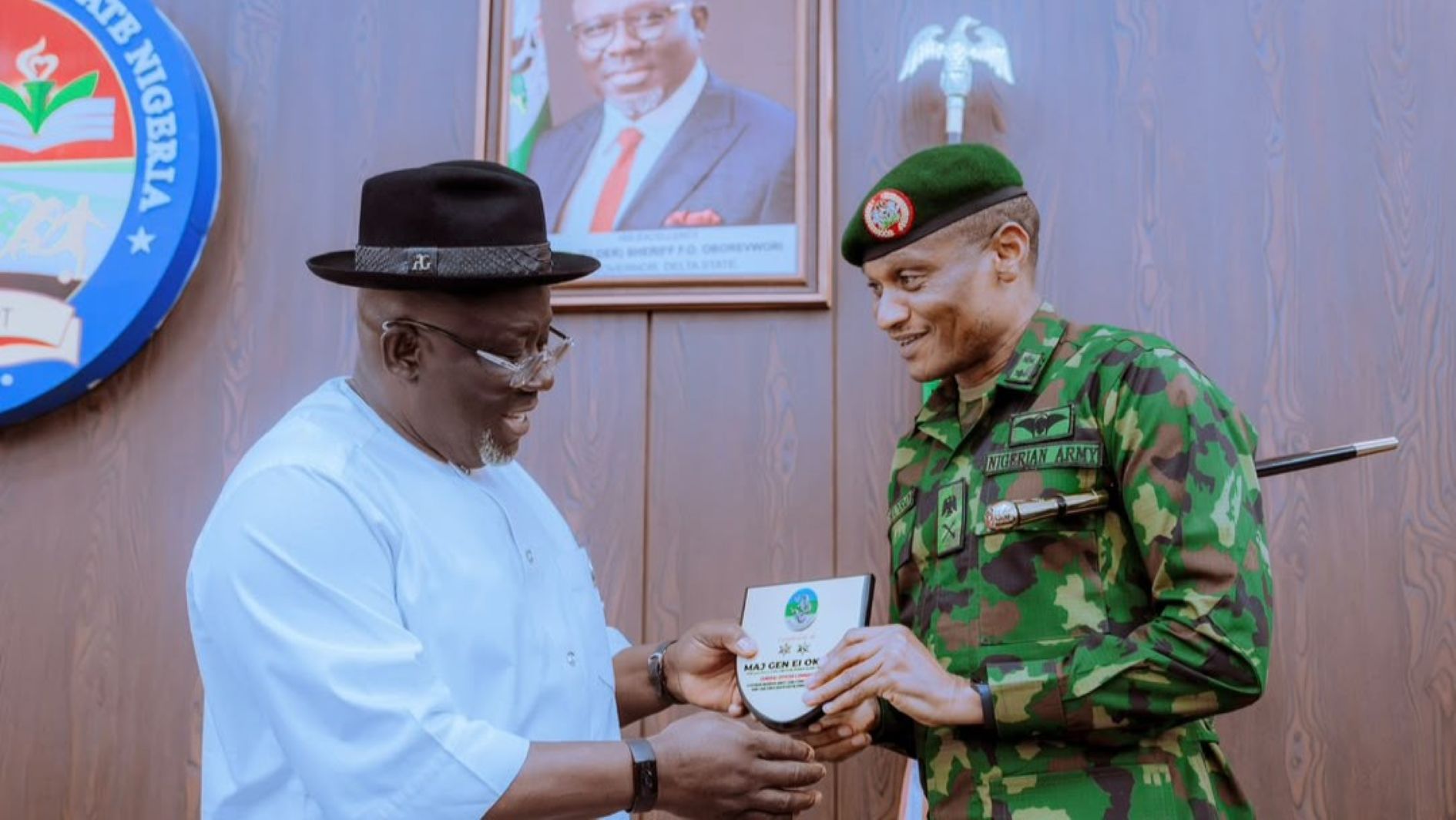
By Festus Ahon
Sheriff Oborevwori, governance is not simply about building roads, executing projects or announcing policies. It is also about creating the conditions in which people can live securely, institutions can function effectively and economic activities can flourish.
That philosophy was on display in Asaba this week as his administration simultaneously deepened its partnership with the security establishment, supported a newly established federal medical university and strengthened its relationship with the media.
Though the three engagements appeared different on the surface, they point to a common thread in the Oborevwori administration: the belief that sustainable development depends on collaboration among government, security agencies, educational institutions and the media.
Receiving the newly appointed General Officer Commanding, 6 Division, Nigerian Army, Port Harcourt, Maj. Gen.
Everest Okoro, who is also the Land Component Commander, Joint Task Force South-South, Operation Delta Safe, on a courtesy visit to Government House, Asaba, Oborevwori made a direct connection between security and economic prosperity.

He told the Army chief that Delta’s strategic importance to Nigeria’s economy made security in the state a national concern.
“Delta State is very, very key to the economy of Nigeria and we rely on the security agencies to do their work because the peace we are enjoying today is the result of collaboration between the state and the security agencies,” the governor said.
The statement captures a reality that is often overlooked in discussions about development in the Niger Delta. A region may possess abundant natural resources and immense investment opportunities, but without peace and security, those advantages can quickly become liabilities.
Delta, with its oil and gas infrastructure, waterways, industrial assets and strategic location, remains central to Nigeria’s energy and economic architecture. The protection of these assets therefore extends beyond the immediate interests of the state. It has implications for national revenue, energy security, employment and investor confidence.
Oborevwori’s message to Maj. Gen. Okoro was consequently both local and national: the preservation of peace in Delta is an investment in Nigeria’s economic stability.
“If this region is safe, the economy will go up. If there is unrest in this region, the economy will go down,” he said.
It was also significant that the governor did not present security as the exclusive responsibility of the military. Rather, he emphasised collaboration between the state government and security agencies, a model his administration has continued to promote.
The governor recalled that the state government had provided infrastructure and logistics to strengthen the operational capacity of security formations. Among the interventions, he disclosed, was the construction of one-unit flats at the Amphibious Army Barracks in Agbor, alongside sustained logistical support to the 63 Brigade.
Such interventions may appear modest when compared with the huge financial resources required for major infrastructure projects, but their strategic value can be substantial. Security personnel who operate in difficult environments require functional accommodation, mobility, logistics and institutional support to respond effectively to threats.
For Oborevwori, therefore, supporting security agencies is not an alternative to development; it is an essential component of development.
That position aligns with Okoro’s own assessment of the situation. The new GOC, who was on a familiarisation tour of formations and units under his command, identified the protection of critical national assets as one of his priorities.
He noted that Delta’s oil and gas infrastructure, waterways and other strategic assets made the state important to Nigeria’s economic and energy security.
His proposed approach built around credible intelligence, realistic training, disciplined leadership and seamless joint operations suggests a recognition that contemporary security challenges require more than conventional military responses.
The emphasis on intelligence and inter-agency cooperation is particularly important in a complex environment where criminality, illegal activities and threats to critical infrastructure can assume different forms.
Yet the significance of the governor’s engagements during the week extended beyond security.
On Tuesday, the Delta State Government presented a 30-seater Coastal Bus to the Federal University of Medical and Health Sciences, Kwale, in another demonstration of the administration’s willingness to support institutions whose activities have implications for the wider development of the state.
Representing the governor at Government House, Deputy Governor Monday Onyeme described the intervention as part of the administration’s commitment to supporting the university.
The gesture is important because the institution is expected to contribute to the development of medical manpower at a time when Nigeria continues to grapple with shortages of skilled healthcare professionals. By supporting the university’s operational needs, the state government is indirectly investing in human capital. A functional university requires more than lecture halls and academic programmes. Transportation, logistics, staff welfare, equipment and administrative support are all necessary to create an environment in which teaching, research and healthcare training can thrive.
Oborevwori acknowledged that the state could not meet every need of every institution, but said the government would continue to assist where it reasonably could.
That approach reflects a broader understanding of the role of state governments in a federal system. While the university is federally owned, its presence in Delta makes it part of the state’s educational and human-capital ecosystem.
The Vice-Chancellor, Prof. Abel Nze Onunu, appreciated the governor for fulfilling his promise and expressed optimism that the partnership would contribute to addressing the shortage of medical personnel in Delta and beyond.
If sustained, such collaboration could produce benefits far beyond the immediate value of the donated vehicle. The real dividend would be a stronger medical education system capable of producing doctors, nurses, researchers and other professionals needed to strengthen the health sector.
The third dimension of the administration’s collaboration agenda was evident in its engagement with the media. The governor presented a brand-new 18-seater Toyota Hiace bus to the Delta State Council of the Nigeria Union of Journalists, reinforcing what has become a significant relationship between the administration and the media community.
Presenting the vehicle on behalf of the governor, his Chief Press Secretary, Sir Festus Ahon, said the gesture was designed to improve the mobility and operational capacity of journalists across the state.
For journalists, mobility is not a luxury. Reporting government activities, community developments, emergencies, elections, infrastructure projects and other public-interest issues often requires movement across difficult terrain and multiple locations.
The intervention therefore has practical implications for journalism in Delta. But its symbolism may be even more significant. The media occupies a unique position in democratic governance. It informs citizens, scrutinises government policies, amplifies public concerns and provides a platform through which government communicates with the people.
A functional relationship between government and the media does not mean the media should surrender its independence. Rather, it creates room for better communication, wider public enlightenment and more informed coverage of policies and programmes.
NUJ Chairman, Churchill Oyowe, acknowledged this dimension, describing the intervention as evidence of a leadership that understands the needs of institutions and professionals contributing to the state’s development. He also commended the governor for the ongoing provision of solar power for the NUJ Secretariat in Asaba.
Taken together, the three engagements provide an insight into the broader architecture of the Oborevwori administration. Security, education and the media may belong to different sectors, but they intersect around the same objective: building a stable environment in which development can be sustained. Without security, investments are threatened.
Without quality education and medical training, human capital suffers. Without an effective media, citizens may remain poorly informed about government policies and their own rights and responsibilities.
This explains why the governor’s emphasis on collaboration is significant. His administration appears to be positioning government not as an isolated actor but as a coordinating force capable of bringing different institutions and stakeholders together around shared objectives.
The visit by Okoro also presented an opportunity for a new phase of security cooperation in the Niger Delta. With the new GOC assuming responsibility for a strategically important military division, the expectation will be that the existing relationship between Delta State and the Nigerian Army will be strengthened.
For the governor, the message is clear: Delta will continue to support security agencies because peace remains fundamental to the state’s economic aspirations.
For the university, the donated bus represents more than transportation; it is an investment in an institution expected to help solve one of Nigeria’s most pressing human-capital challenges.
For the NUJ, the vehicle represents recognition of the practical needs of journalists and the importance of media operations to democratic governance.
Ultimately, these interventions point to a development philosophy in which government support is deployed across sectors that reinforce one another.
The road to prosperity in Delta cannot be built by infrastructure alone. It requires peace, strong institutions, educated citizens, skilled professionals, credible information and productive partnerships. That is the larger significance of the governor’s engagements this week.
From the barracks to the university campus and the newsroom, the message from Asaba is that development is a collective enterprise. And if Delta’s peace, institutions and economy are to continue on an upward trajectory, collaboration rather than isolation will remain one of the most important instruments of governance.

