 Follow Us on Google News


 Follow Us on Google Discover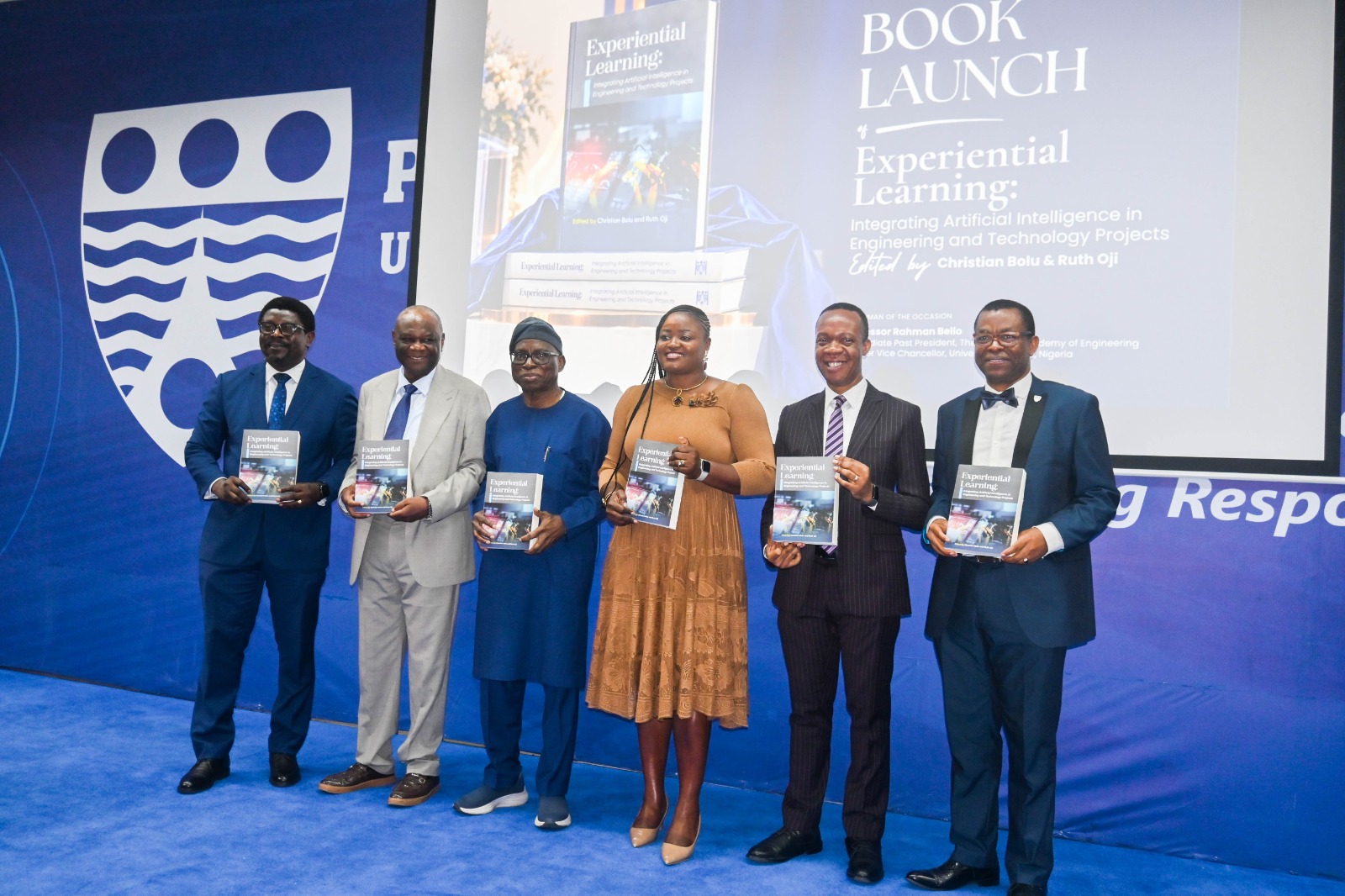
Experts have called for greater adoption of experiential and project-based learning to bridge the gap between theoretical knowledge and practical application in engineering education.
They made the call at the launch of a new book, Experiential Learning: Integrating Artificial Intelligence in Engineering and Technology Projects, authored by Prof. Christian Bolu and Dr Ruth Oji, at Pan-Atlantic University (PAU), Lagos.
The book, the first publication by PAU’s School of Science and Technology, guides educators, engineers, and technologists seeking to incorporate hands-on, project-based learning and artificial intelligence (AI) into engineering education.
It explores experiential learning principles, the role of AI in modern education and student-led projects designed to translate abstract engineering concepts into practical solutions.
The authors argued that as AI and digital innovation reshape how problems are approached and solved, the ability to learn by doing, reflect on experiences and apply knowledge to new challenges has become increasingly important.
Reviewing the book, the Dean, Faculty of Engineering, Bowen University, Prof. Christian Osueke, said it was organised into three parts covering the theoretical foundations of experiential learning, practical implementation and case studies.

He said the case studies included AI-enabled smart water meters, intelligent mechanical systems, carbon capture solutions, transport and infrastructure projects, and utility performance indicators.
Osueke said the book showed that engineering competence extends beyond theoretical knowledge and demonstrated how technology can be applied to address local challenges.
The Deputy Vice Chancellor (Academics), PAU, Prof. Uchenna Uzo, said about 70 per cent of engineers in Nigeria currently lacked the practical skills required to perform effectively, citing data on the country’s engineering skills gap.
He said PAU was working to produce engineers capable of creating solutions and making an impact, adding that the university had adopted a different approach to engineering education in its School of Science and Technology.
“Our experiential learning involves ‘Do, reflect and apply’,” he said, adding that engineering education should become more focused on problem-solving.
The Chairman of the occasion and former President of the Nigerian Academy of Engineering (NAEng), Prof. Ramon Bello, who represented the President of the Council for the Regulation of Engineering in Nigeria (COREN), commended the authors for the book.
He said the case studies would make the publication more useful to students and educators, adding that its approach aligned with COREN’s Outcome-Based Education (OBE) framework.
The Dean, School of Science and Technology, PAU, Dr Darlington Agholor, said AI had become integral to modern engineering education.
He disclosed that the school was collaborating with COREN to improve engineering education, adding that the book reflected the school’s focus on producing graduates capable of developing solutions to real-world problems.
The Head, Pan-Atlantic University Press, Dr Nwachukwu Egbunike, said publishing scholarly works remained challenging for African university presses because of limited markets, inadequate distribution networks, declining institutional purchases, small print runs and weak intra-African book trade.
One of the co-authors, Bolu, said the book sought to transform industrial attachment into work-integrated learning, enabling engineering students to identify and solve complex problems.
He said wider adoption of its approach by engineering educators could help produce more entrepreneurial engineers capable of creating opportunities rather than relying solely on paid employment.

