

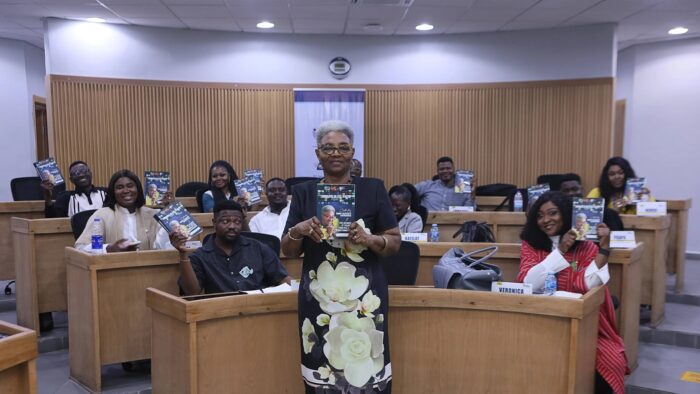
Veteran broadcaster Bimbo Oloyede has challenged media professionals to resist industry pressures that compromise journalistic integrity, urging them to focus on the legacy they want to leave as Nigeria’s media landscape becomes increasingly competitive.
Oloyede, who began her broadcasting career in 1975, gave the charge during an engagement with cohort five of the MTN Media Innovation Programme (MIP) at Pan-Atlantic University, Lagos, where she recounted her journey from an accidental newscaster to one of Nigeria’s respected media professionals.
Reflecting on her early beginnings, Oloyede said her entry into broadcasting was unexpected. Initially employed as an assistant in the drama department of the Nigerian Broadcasting Corporation (NBC), she was encouraged to read poetry as part of a talent initiative. Her performance soon attracted the attention of her superiors, who asked her to prepare for an appearance on network news.
By April 1976, she had become one of the first female newscasters on the network news programme.
However, her early newsroom experience also tested her professional convictions. After four years, she moved away from newscasting because she struggled with delivering reports that did not reflect what she believed to be true.
Her career subsequently took her into television production, entrepreneurship and advocacy. After leaving the Nigerian Television Authority, she co-founded a media production company with her husband. When advertising opportunities declined, she converted a proposed studio space in Festac Town, Lagos, into a supermarket, which she ran for about a decade while raising her children.

It was during this period that conversations with her customers, particularly women who shared their personal experiences, helped shape her next move. She returned to television with Crystal, a magazine programme that explored issues affecting women. But when advertisers showed little interest in programmes addressing substantive gender concerns, she decided to create an alternative platform.
In 1999, she established the Women’s Optimum Development Foundation (WODEF), using media and development partnerships to address issues including violence against women. The organisation worked with development partners, including the United Nations Population Fund, the United Nations Development Programme, the British Council, the Ford Foundation and the United States Agency for International Development.
Oloyede later returned to television news in 2002 as an anchor on Channels Television, where she worked until 2015. Alongside broadcasting, she trained presenters and producers, eventually expanding her work into professional communication, speech presentation and public speaking through her training initiative, Strictly Speaking.
For Oloyede, these transitions were not part of a predetermined career plan but reflected a willingness to adapt and identify opportunities to remain useful.
“Looking back, all these things were not planned, but I found myself responding to situations, seizing several opportunities and somehow evolving every 10 to 12 years into new roles,” she said.
Addressing the realities of contemporary broadcasting, she noted that the industry’s growing competition for audiences and advertising revenue had changed programming priorities. However, she urged practitioners not to allow commercial pressures to determine their professional standards.
“The environment does not have to dictate how you do your job. You will make the choice of how you want to do it,” she said, challenging journalists to consider how their work could improve the industry rather than focusing solely on personal benefits.
She also stressed the importance of effective communication, particularly for broadcasters whose credibility depends on their ability to convey information clearly.
“What is the point of broadcasting if you are not understood?” she asked, urging media professionals to pay attention to pronunciation, speech and the fundamentals of language.
On gender and workplace inclusion, Oloyede called on women in broadcasting to organise collectively to advocate better working conditions, particularly policies that accommodate maternity and caregiving responsibilities. She argued that women’s significant representation among on-air presenters could translate into greater negotiating power if they worked together to advance common interests.
Oloyede’s engagement with the MIP cohort came as she marked 50 years in the media. On September 1, 2026, she launched Communication and Media in Nigeria: Celebrating Bimbo Oloyede’s Contribution to Five Decades of Theory, Practice and Transformation, a 55-chapter book featuring contributions from 60 authors and aimed at bridging academic theory and professional practice.
