• Over 300 houses pulled down in Mile 12 fresh demolition in Lagos
• Regulatory lapses fuel over N2tr investment loss
• Building control agencies culpable, say stakeholders
• Lagos govt acted within law, explored corrective options’
• Lagos extends amnesty for illegal building till December 31
The rash of building demolitions that has recently affected at least 2,500 houses in major cities across the country is fuelling widespread anxiety among residents and investors alike.
The trend, now routine in Lagos, Abuja, Anambra, Abia, Ebonyi, Oyo and Kano, has stoked fears of property devaluation, job losses, homelessness and a decline in investors’ confidence in Nigeria’s real estate market.
What began as an isolated corrective measure against illegal buildings has now evolved into a sweeping campaign that has disrupted lives and shuttered businesses.
The economic and social costs are staggering, from destroyed assets worth trillions of naira to thousands of displaced families now living under bridges, in relatives’ homes, or temporary shelters.
Stakeholders argued that many of the demolitions lack transparency and adherence to due process. They warn that the arbitrary execution of such actions undermines confidence in Nigeria’s housing market and aggravates the already critical housing deficit.
In Lagos, where the destruction has been most pronounced, demolitions have affected communities along the Lagos-Calabar Coastal Road, Ikorodu, Ikota, Ebute-Metta, Bariga, Ibeju-Lekki, the Lagos Trade Fair Complex, FESTAC, Oworonshoki and Mile 2. Properties worth several billions of naira have been razed.
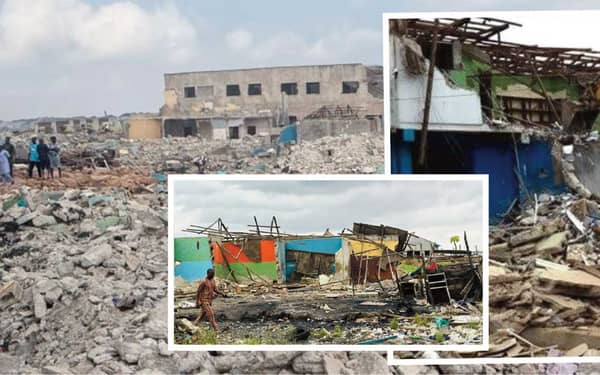
Just yesterday, residents of Mile 12 in Lagos, spanning Martins to Awodeyi Street, woke up to the roaring sounds of the Lagos State Building Control Agency (LABSCA) bulldozers knocking down their homes in quick succession. This was barely two months after residents of Oworonshoki swallowed the bitter pill of the government’s demolition orders.
The Mile 12 residents lamented yesterday that they were unjustly evicted without any notice or warning from the State authority.
The resident told The Guardian that at least 10 people died of shocks, while almost 300 houses, including community schools, hospitals, churches, and mosques, were pulled down.
Speaking with The Guardian, Chairman of the Community Development Area (CDA), Mile 12 Central, Ogundele Tunde Joshua, stated that no letter was served to indicate that demolition would take place, and no meeting was held with the residents before the exercise.
“We are law-abiding citizens, and we didn’t confront them when they deployed bulldozers. We visited the State House in Alausa, LASBCA, and members of the Lagos State Assembly. Members of the Assembly promised that they would halt the demolition, but when we returned, LASBCA officials continued the demolition.
“We are appealing to President Bola Tinubu and the Lagos State Governor, Babajide Sanwo-Olu, the Speaker of the House of Assembly, Mudashiru Obasa and other stakeholders to intervene. We have been rendered homeless. This is the Christmas period, a time when everyone should be celebrating, but they brought agony to the community; they gave us sadness,” Joshua said.
Also speaking, Youth Chairman, Mile 12 Connect, Arewa Committee, Samsudeen Dauda, said: “We woke up to noise from bulldozers, and we were left confused. Over 2000 Arewa were affected by the demolition.
“We have our documents, and we have been here for over 35 years. So, getting our homes, churches, mosques, hospitals and schools demolished is demoralising. There were about 25 patients in one of the hospitals when the demolition started. We pleaded with them to give the hospital some time, but they didn’t pay attention to us. We lost 10 patients in that process. We are pleading for intervention.”
A resident, Sulaiman Adekoya Sani, said: “A whole community has been demolished. We were not given any notice. Unfortunately, since the demolition began, the Kosofe Local Council Chairman, Moyo Ogunlewe, has visited to see what we are going through. We have a monarch, councillors, and members of both the national and state assemblies, but they all never showed up. They easily find their way into our community during the campaign, but they have abandoned us now.”
When The Guardian reached out to LASBCA spokesperson Ademuyiwa Adu, he said the demolition was in phases, and “the agency will soon speak on the demolition”.
The Guardian investigation revealed that Lagos alone accounts for more than 1,500 of the 2,500 recorded demolition cases nationwide in the past three years.
Since 2023, over 1,000 homes and shanties have been demolished in Oworonshoki; 17 buildings along the Ikota River alignment at Oral Estate II; and more than 15 structures in the new Mandela Plaza section of the Lagos Trade Fair Complex, reportedly over a lack of statutory approvals or structural defects.
Before yesterday’s development, over 25,000 residents had been rendered homeless via demolition, while 175 estates had been declared “illegal” and face clearance in Lagos.
A full plot of land in many of the affected areas now sells for around N200 million, while half-plots fetch over N80 million. The cumulative value of lost property in Lagos alone is estimated at over N2 trillion.
In the Federal Capital Territory (FCTA), Abuja, at least 100 houses were recently marked for demolition at Trade More Estate in Lugbe, Abuja. Out of the 100 houses marked, no fewer than 30 were demolished.
According to the FCT Taskforce Team led by the FCT Minister’s Senior Special Assistant on Monitoring, Inspection, and Enforcement, Ikharo Attah, the purpose of the demolition was to mitigate flooding. Other area affected by demolition in the city includes the Gishiri community.
In Anambra, locations such as Enekwasumpu, Obosi Area, Nkisi Layout, and Trans Nkisi, among others, have witnessed demolition exercises of the government.
The state government vowed to continue demolishing unapproved structures and prosecute owners of such buildings for gross violations of the law. Managing Director of Anambra State Physical Planning Board, Chike Maduekwe, said: “Anambra State Physical Planning Board Law, no.9, 2013 requires that builders must come for an approval, the reason is to determine if the land belongs to him, if the building is consistent with the scheme and its structural integrity.”
In Kano, over 10 structures classified as illegal buildings have been demolished in the state since 2024, with locations such as Kwankwasiya City and Rano Market affected.
For many who remain unaffected, the fear of being the next one looms large. The human and emotional toll is immense, financially ruinous for property owners and socially destabilising for communities.
But experts emphasised that the problem extends beyond regulation and government enforcement. Many developers and property owners, they say, build in contravention of planning regulations. “We plan after building, not before building,” one planning consultant noted, describing the outcome as “urban shock and development chaos.”
Under the Constitution and the Land Use Act, both federal and state governments are empowered to acquire land for public use. However, compensation is due only to property owners who hold valid approvals and titles.
Dozens of demolished structures lacked Certificates of Occupancy (C-of-O) or registered titles, which legally render them non-existent. Still, regulatory agencies that allowed such illegal developments to progress to completion are being criticised for negligence. Ideally, enforcement should happen during the foundation or construction stage, not after completion. Yet, tolerance and corruption persist at various regulatory levels.
In Lagos, the state government has introduced a planning permit amnesty for existing buildings constructed without approval and has extended the programme to the end of the month. During this period, owners of buildings without permits can regularise their properties, with the usual penalty fees waived.
The Commissioner for Physical Planning and Urban Development, Dr Oluyinka Olumide, disclosed that several Federal Government agencies, including the Nigerian Railway Corporation (NRC) and the Federal Airports Authority of Nigeria (FAAN), have already commenced the process of regularising their buildings under the ongoing amnesty programme.
The commissioner urged the management of the International Trade Fair Complex to take a cue from these agencies and promptly obtain planning permits for structures within the complex during the amnesty window.
He stressed that building approval remains mandatory for all structures in Lagos State, as provided under the Lagos State Urban and Regional Planning and Development Law 2019 (as amended).
Olumide emphasised that owners of buildings without approval should take advantage of the amnesty to avoid future enforcement, noting that planning approval is critical to achieving the state
The Chairman of the Nigerian Institute of Town Planners (NITP), Lagos Chapter, Oladele Akindele, observed, “In most affected locations where buildings were demolished, you will discover that many of those people settled illegally. The issue lies with non-compliance by developers and lax monitoring by officials.”
Property registration remains one of the biggest barriers in Nigeria’s real estate system. It is cumbersome, expensive and often discourages compliance.
A PricewaterhouseCoopers (PwC) report estimates that between $300 billion and $900 billion in Nigerian real estate assets are “dead capital” properties lacking formal documentation and therefore ineligible as collateral for bank loans.
Akindele said streamlining the process could drastically improve compliance.
“It’s possible to get a building permit within 10 days if all documents are in order. The problem is that many applicants don’t have their paperwork ready at the point of submission. But when you do, approvals can be issued in record time.”
He also urged the government to reduce documentation costs. “Some people can afford billions of naira per square metre, but many poor Nigerians can’t pay even N1,500 per square metre. The government should consider rebates for the poor while maintaining rates for the wealthy. Planning should serve all income groups.”
Environmental and human rights advocates argued that authorities are not considering the social consequences of demolitions amid rising unemployment, inflation, and insecurity.
The Foundation for Environmental Rights, Advocacy and Development (FENRAD) condemned the recent demolition of 17 buildings at the Lagos International Trade Fair Complex, describing it as a violation of the Land Use Act and physical planning regulations. Its Executive Director, Nelson Nwafor, said the move disregarded due process and traders’ rights.
President of the Association of Town Planners Consultants of Nigeria (ATOPCON), Hakeem Badejo, characterised the pattern as an “urban crisis.”
“It creates tension and instability. If a project costing N10 million is stopped at the foundation level, the loss is manageable. But when a N500 million building is demolished after completion, the impact is catastrophic. Why allow it to get that far?”
Badejo urged that district planning officers be empowered to intervene early and decisively. “In the developed world, you can’t flout building or traffic laws without immediate penalties. Our system should function similarly. Developers must obey planning laws, not engage in jungle development.”
Over time, controversies surrounding land regularisation and property approval in Lagos have intensified. Industry experts accuse some officials of complicity, allowing projects to progress in exchange for inducements.
One developer whose building was demolished alleged, “When you start building, they mark it. But once money exchanges hands, construction continues. If the government had enforced the law early, we wouldn’t face such massive losses. They wait until buildings are completed before acting.”
The Commissioner for Environment and Water Resources, Tokunbo Wahab, however, defended the state’s enforcement policy.
“Sometimes we ask developers to produce practical designs for stormwater discharge, but they must bear that cost, not taxpayers. It’s irresponsible for the government to fix problems created by private developers who profit from violating environmental laws,” he said.
Similarly, Commissioner for Physical Planning and Urban Development, Dr Oluyinka Olumide, maintained that due process guides every demolition.
“We operate a clear and transparent procedure for any demolition exercise, which includes issuance of all statutory notices and engagement with affected stakeholders.”
He explained that the ongoing enforcement drive is central to Lagos’ broader urban renewal and redevelopment strategy. “Illegal structures distort planning and hinder sustainability. Our duty is to protect the environment and the future growth of the city.”