

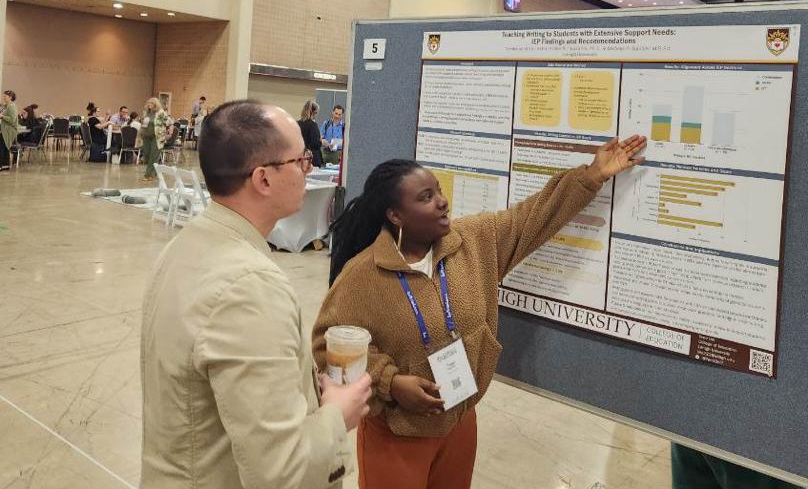
The call to “presuming competence” is a powerful movement currently gaining ground in the field of special education, championed by a growing number of educators and researchers. This movement is in response to the years of exclusion and lack of access that students with disabilities have endured for years. It is a call to reshape how we understand, teach, and support students with disabilities.
“Temiloluwa Oni, a doctoral student, is a leading voice in this movement. She is a special education researcher and dedicated advocate for students with intellectual and developmental disabilities (IDD) and extensive support needs (ESN). Her goal? To promote a shift in mindset across society, challenging teachers, administrators, and the public, to presume and believe that every student deserves equal access to quality education regardless of their needs or diagnosis.
At the core of Temi’s advocacy is a belief that every student is capable of learning if given the opportunity. “Presuming competence means that we stop assuming that students with disabilities are incapable of fully participating in their education, or accessing grade-aligned content” she explains. “Instead, we provide them with the tools, support, and accommodations that enable them to participate meaningfully with their peers.”
For Temi, presuming competence is not just another new buzz word or concept; it’s a commitment to creating classrooms and communities where students with disabilities are recognized for what they can achieve. Her approach, grounded in research, aims to dismantle the limiting perceptions that too often shape educational experiences for students with disabilities.
In her role as a research- and teaching assistant, Temi not only studies inclusive educational practices, but also teaches educators about the transformative power of believing in their students’ abilities. Her work emphasizes the importance of embracing a strengths-based approach rather than a deficit-based approach.
In her advocacy for systemic change, Temi emphasizes that “creating an environment where students can thrive involves more than individual teacher efforts; it requires policy-level shifts that ensure accessibility and inclusivity for all students with disabilities, including those with more extensive support needs, who are often denied access to quality education”.
Temi acknowledges that creating an inclusive educational system can be challenging, especially in environments with limited resources, support, and training. In many schools, underfunding, high student-to-teacher ratios, and a lack of specialized training can make it difficult for educators to provide the level of individualized support this approach requires.
“There’s a huge gap between what we know is possible and what schools are able to provide,” she says. “But that does not mean we should stop pushing for better.” Temi calls for more research-based training and resources to guide teachers in providing accommodations and modifications that promote student’s access to instruction.
One of her key recommendations is to provide alternate assessments for students with IDD who may not be able to participate in state or end-of-term exams. She explains “Just as traditional exams help mainstream teachers set appropriate expectations and teach grade-level content, alternate assessments guide teachers in setting high expectations for students with disabilities.”
These assessments ensure that teachers hold high expectations, challenging students with disabilities to reach their potential while meeting them where they are in their learning journey. By using alternate exams, teachers can be held accountable and can maintain standards that are tailored to each student’s unique needs
Temi’s approach to presuming competence is grounded in evidence. “Research shows higher expectations and better outcomes for students with disabilities when they are included in general education settings and held to high expectations. When educators presume competence, they are more likely to engage students in challenging and meaningful instruction, rather than merely providing over simplified materials,” she asserts.
Temi envisions a world where competence is assumed, where every student is granted the benefit of the doubt, and where educators and society believe in each individual’s potential. Through her presentations at multiple international conferences and her work in university settings, her message is clear: it’s time to rethink how we view students with disabilities. She challenges educators, parents, and policymakers to question their assumptions, to see potential rather than limitations, and to believe in the abilities of every student.
In her passionate advocacy, Temi offers more than just a vision for inclusive education. She provides a pathway toward a future where every student, regardless of ability, has the opportunity to learn, grow, and thrive.
