

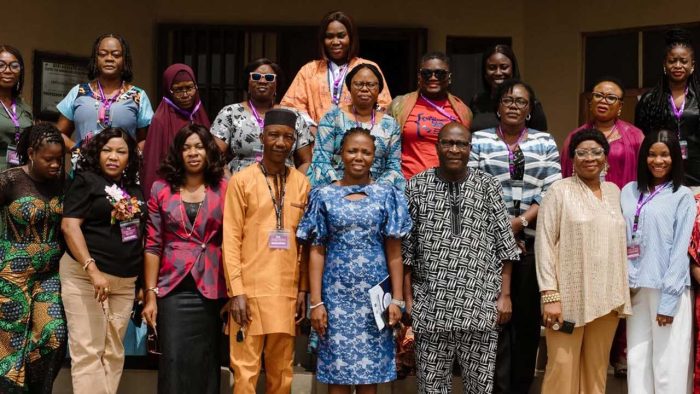
The Centre for Gender and Social Policy Studies, recently held its third bespoke hybrid Gender Development training with over 30 attendees across sectors certifying as Gender specialists. Established in 2014, the centre has grown beyond its foundational offerings of Master’s and Postgraduate courses.
The one-week training covered courses including Centering and decentering Gender; Public Policy; Gender, Health and Equity; Gender Responsive Monitoring and Evaluation; women and development issues amongst others.
Led by the Director of the Centre, Prof. Opeyemi Ekundayo, other lecturers who taught at the one-week programme include: Prof. Friday Eboiyehi; Dr. Paul Awoniyi; Dr. Mojirayo Afolabi; Prof. Kehinde Olayode; Prof. Morenike Folayan Ukpong; Dr. Ayobami Atijosan; Dr. Olajumoke Adeyeye and Dr. Oluwatoyin Olajide.
Speaking on the bespoke training, Prof. Ekundayo noted that the evolution has been driven by the need to address diverse professional and academic requirements. “The Centre has a lot more to give and offer and that birthed the word ‘Bespoke,’ which means tailored.”
The term ‘Bespoke’ encapsulates the idea of a personalised learning experience, one that recognises the unique needs of individuals or organisations. Prof. Ekundayo noted that the approach allows for customisation based on career paths: “As a lecturer or a scholar, you might focus more on theories and analysis. For someone in the NGO sector, theories combined with intervention methods, like Monitoring and Evaluation (M&E), might be more relevant.” This tailored approach ensures that gender and development education is not treated as a one-size-fits-all discipline.
Initially launched as ‘Bespoke,’ the programme has now adapted to a hybrid format in response to global trends. “With the rise of zoom and webinars, students can now learn from the comfort of their homes.”
She however emphasised the value of in-person interactions: “Coming physically helps more because you network and meet your lecturers. There’s just that personal touch when you engage face-to-face.”
Although the initiative began in 2014, after a halt, the programme has introduced innovative elements to enrich the learning experience. “We thought to entice students, not just with the academics, but by giving them opportunities to explore organisations where gender mainstreaming is practiced.”
Field trips, such as visits to museums, and events like formal dinners have added a layer of engagement and glamour to the programme. On the programme’s national impact, she emphasised its role in broadening perceptions of gender: “The more people know about gender, the better. Many assume they understand it, but through this programme, participants realise it’s far more nuanced.”
She highlighted practical ways of explaining gender to a lay audience, using simple examples like the toilet design. “A man is built to stand and a woman to squat. Gender is everywhere, even in such mundane considerations. The essence, however, is fairness: “Gender is not about fighting men or sidelining anyone. It’s about ensuring fairness so that neither men nor women are marginalised.”
Prof. Ekundayo advocated for recognising and celebrating differences between genders as complementary strengths. “A woman cannot fly without both wings. Similarly, you need both legs to walk. Men and women need each other for balance,” she stated. This balance is not about hierarchy but about harmonising unique perspectives to create a better world. Let’s allow these differences to make the world beautiful, not worse,” she concluded.
Through initiatives like the Bespoke Hybrid programme, the Centre for Gender and Social Policy Studies continues to challenge conventional notions, fostering a more inclusive understanding of gender and development.
