 Follow Us on Google News


 Follow Us on Google Discover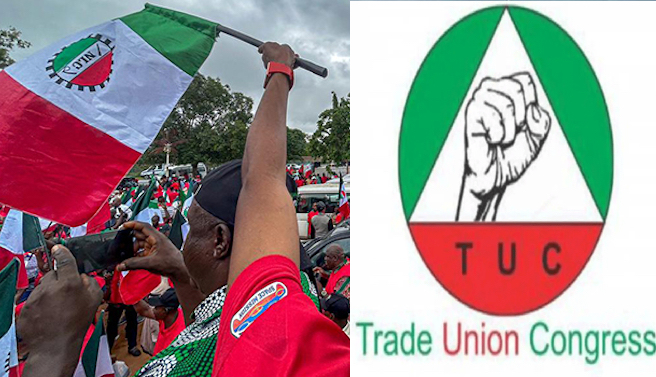
The Trade Union Congress of Nigeria (TUC) has warned that worsening poverty, rising inflation, and government policies prioritising austerity over people are pushing Nigerian workers and their families to the brink.
TUC President-General, Festus Osifo, described the situation as a grave threat not only to livelihoods but also to social stability and the unity of the labour movement.
Speaking on Tuesday at the First Quadrennial State Delegates’ Conference of the Oyo State Council, held at the International Conference Centre, University of Ibadan, Osifo stressed that the hardship confronting workers had reached alarming levels and demanded urgent, people-centred responses from all levels of government.
He was represented at the conference by the Acting Deputy General Secretary, Olawunmi Jimoh.
OCiting World Bank statistics, Osifo said about 56 per cent of Nigerians live below the poverty line. “Today, the average worker’s salary can no longer meet basic needs. Feeding, transportation, healthcare, rent and education have become luxuries rather than essentials,” he said. He added that insecurity, unemployment, and widening inequality were compounding the crisis for millions of households.
According to the TUC leader, these challenges reflect deeper structural problems in the national economy, including runaway inflation, food insecurity, unaffordable education, epileptic power supply, a weakened agricultural base, and an economy driven more by debt than productivity.

Calling on governments to act decisively and compassionately, Osifo urged a shift from policies that punish the poor to measures that protect livelihoods. He insisted that subsidies cushioning the most vulnerable should not be replaced by harsh austerity programmes and that robust social protection schemes and effective wage review mechanisms must be urgently implemented to restore dignity to labour.
Osifo also criticised legislative moves to transfer labour matters to the Concurrent Legislative List, describing the proposal as “anti-worker, retrogressive and a direct threat to the unity and strength of the Nigerian labour movement.” He announced that all state councils had been placed on “red alert” and warned that the TUC would resist the bill through all lawful means.
Reinforcing TUC’s stance, Prof. Omotoye Olorode, former president of the Academic Staff Union of Universities (ASUU) and veteran activist, warned that inflation, stagnant wages, and neo-liberal policies are steadily eroding the living standards of Nigerian workers, pensioners, and the unemployed.
Delivering a keynote titled: “The Impact of Inflation on Workers’ Wages and Living Standards in Nigeria: The Intervention Point of Labour Movement and Government,” Olorode argued that inflation cannot be understood merely as an economic phenomenon. He said it is a product of political power, class relations, and decades of IMF- and World Bank-inspired structural adjustment policies.
Citing the National Bureau of Statistics, he acknowledged that Nigeria’s inflation rate slowed to 16.05 per cent in October 2025, the lowest since March 2022, with food inflation at 13.12 per cent. However, he stressed that the slowdown had not relieved working Nigerians, as wages remain grossly inadequate relative to the cost of living.
Olorode blamed recent inflationary pressures on currency devaluation, subsidy removal, and privatisation, which intensified unemployment, weakened purchasing power, and widened inequality. “Workers’ wages are systematically suppressed because labour is treated as a commodity in an economy driven by private profit rather than public welfare,” he said.
He criticised the National Minimum Wage (Amendment) Act 2024, which pegged the minimum wage at ₦70,000, describing it as both inadequate and exclusionary. Many small establishments, part-time and casual workers, and segments of the informal sector remain excluded.
“One year after the law came into force, millions of workers are still left out by design,” he noted.
Olorode added that prices of goods and services in Nigeria are influenced not just by supply and demand, but also by monopolies, production costs, government policies, and class power. He argued that the commercialisation of public services under privatisation forces workers to pay out of shrinking incomes or face exclusion.
Linking Nigeria’s economic crisis to neo-colonial dependence, he invoked Kwame Nkrumah’s thesis, arguing that post-independence African economies remain subordinated to global financial institutions and compliant local elites. He said Structural Adjustment Programme policies and the Washington Consensus entrenched measures that devalue currencies, remove subsidies, shrink the public sector, and depress wages.
Olorode lamented the decline in ideological clarity and mass mobilisation since the late 1980s, recalling a period when labour, often allied with students and civil society, successfully opposed IMF loans, privatisation, and subsidy removal. He called for a revival of labour’s historic mission through stronger organisation, renewed working-class ideology, and the creation of an independent political platform.
He outlined an “Agenda for Tomorrow,” urging labour to campaign for state-led economic planning, public ownership of key sectors, reversal of privatisation, restoration of subsidies in education, healthcare, and agriculture, and recovery of public assets sold under privatisation.
Other speakers at the conference restated calls for unity. Former TUC Oyo Chairman Emmanuel Ogundiran lauded the collaboration between the TUC and Nigeria Labour Congress (NLC), urging labour to reclaim its critical voice on government policies. Olusola Olanipekun of the Joint Action Committee (JAAC) also praised the synergy.
Oyo State Head of Service, Mrs. Olubunmi Oni, represented by Mr. Waheed Ajuwon, commended TUC’s role in workplace safety and pledged continued collaboration. NLC Chairman Pastor Kayode Martins described Governor Seyi Makinde as “God-sent” for workers, highlighting industrial harmony in the state. Governor Makinde, represented by his Special Adviser on Labour Matters, Bayo Titilola-Sodo, reaffirmed the state’s commitment to improving workers’ welfare through cooperation.
The conference also saw the election of new TUC Oyo State Council executives, conducted by Acting General Secretary Comrade Olawunmi Jimoh. All outgoing executives were returned, except for two positions. The newly elected executives are: Comrade Bosun Olabiyi Agoro (Chairman); Comrade Ranti Oluwemimo (Vice Chairman); Comrade Babatunde Balogun (State Secretary); Comrade Abioye Adeyemi Emmanuel (Treasurer); Comrade Fatokun Ebenezer (Auditor); Comrade Olufemi Adewumi (Public Relations Officer); Comrade Funmilayo Sotuminu (Chairperson, Women Commission); Comrade Desmond Oguntuga (Financial Secretary); Comrade Toyin Adedokun (Secretary, Women Commission); Comrade Taiwo R. Alao (Assistant Secretary); and Comrade Olabampe Oladayo (Ex-officio Member).

