

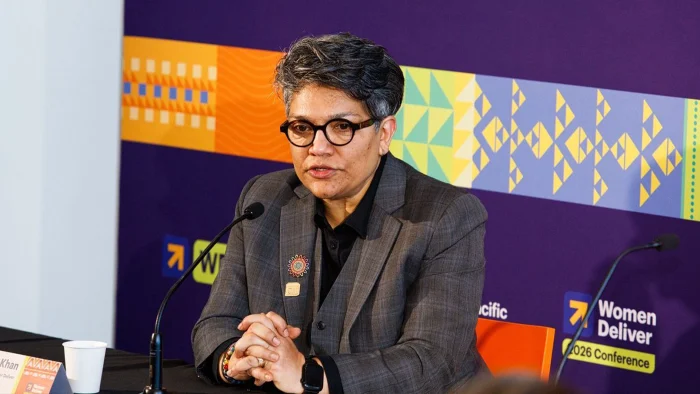
Dr. Maliha Khan is the President and Chief Executive Officer of Women Deliver, a global convening focused on accountable and inclusive outcomes for gender equality. With over three decades in global development, her work is grounded in advancing systems that better reflect and serve the realities of women and girls, particularly in underserved contexts.Her career began in Pakistan, working on development programmes in marginalised communities, and has since spanned leadership roles across major international institutions, including CARE, Oxfam, and the Malala Fund. She speaks with IJEOMA THOMAS-ODIA at the on-going Women Deliver conference.
It’s great to finally speak with you. Thank you for convening such a global gathering, bringing together women from diverse backgrounds around a shared agenda of gender equality, rights, and leadership. You’ve spent over three decades in the development space. How has that journey been for you?
It’s been an interesting journey and I feel very fortunate. I started my career in Pakistan, working with international agencies as local staff, trying to understand what was happening on the ground. We were implementing service delivery projects, but even then, I was questioning the model. Why are international agencies coming into countries like mine and doing this work in this way?Over time, it’s been a learning experience. And now here we are in Narrm, Melbourne, about to host nearly 6,000 people from around the world. That in itself is something to be excited about.
With all this experience, what are you bringing into Women Deliver?
Honestly, I think I’m the least important person in this space. The power of Women Deliver comes from the people who attend. We provide the platform. We bring people together, manage logistics, and set the stage, but the real energy comes from participants.They bring ideas, debates, disagreements, and perspectives. And what matters most is what happens after, how those ideas travel beyond these few days into real world action. The diversity here across age, sectors, and geographies is the strength. People come with different lenses, but with a shared belief that the world is not doing right by women, girls, and gender diverse people, and that we must do better.
Over the course of your career, what has changed for women and girls?
A lot has changed, tremendous progress in fact. Let me give you an example.Early in my career, I worked in rural Pakistan. We had to enter villages and speak with women and girls, but before that, we had to seek permission from the village elders, usually men. And they would ask two things. Are you here to talk about family planning? If yes, we were told to leave. Or are you here to start a girls’ school? Again, we were told to leave.That was the reality then.Today, we understand that resistance to girls’ education is not about unwillingness. It is about access, infrastructure, and quality. That shift has happened within one lifetime. Back then, I could not have imagined it.So, when we talk about the next 10 or 20 years, I do not think we can fully predict what is coming. But I do know this. Younger generations will demand far more than what we have achieved so far, and the world will be better for it.

Bringing this to Africa, particularly Nigeria, what should be done differently when it comes to policy and implementation? Many frameworks exist, but they often do not translate into action.
I would challenge the idea that things are not working. There is significant progress happening across Africa, arguably some of the most dynamic change globally.What we need to stop doing is being overly critical of ourselves without acknowledging how far we have come, especially given historical and structural disadvantages, colonial extraction, and now ongoing neocolonial dynamics.That said, one major issue is dependency. Countries like Nigeria remain reliant on international systems, even for essential services like reproductive health. That is not sustainable.The priority should be rebuilding the social contract between citizens and government. Governments must be accountable for delivering education, healthcare, security, and economic opportunity. And citizens must demand that accountability consistently.No external agency can replace that responsibility.
With Nigeria heading into the 2027 elections and ongoing challenges around women’s political representation, what is your perspective?
Two things are happening simultaneously.First, there has been real progress. Nigeria has a vibrant civil society, strong cultural identity, and dynamic political engagement. No democracy is perfect. Even so-called established democracies are facing serious challenges right now. Second, there is a growing, well-funded global anti rights movement. This agenda, often exported from parts of the Global North, is targeting regions like Africa. It frames rights issues as foreign impositions, which is simply not true.Rights are not Western, they are fundamental. What is happening is the use of fear-based narratives to roll back progress, particularly around gender and bodily autonomy. But I do not believe this will hold. Young people are not going to accept regression. They will find ways around it.
Conferences like this often face criticism for being all talk. How do we move from conversation to impact?
That criticism fundamentally misunderstands how change happens.Human progress is built on conversation. It is built on dialogue, disagreement, connection, and collective thinking, not just technical reports or predefined solutions.Look at religion, politics, even sports. These are all built on congregation, shared language, repeated ideas, and collective identity. That is how movements are formed.The development sector has underestimated this. Conversations are not separate from impact; they are the starting point of it.Impact may not be immediate. But years from now, people will trace real change back to moments like this, just as we do with the Beijing Declaration.
Speaking of declarations, what gives strength to something like the Melbourne Declaration?
Its strength lies in resonance.If people read it and think this reflects what I believe, and then carry those ideas into their own spaces, that is where power comes from. Not everyone needs to know the name of the declaration. What matters is whether its ideas spread.When people begin to collectively say this is not right, whether it is inequality, climate injustice, debt burdens, or lack of opportunity, that is when momentum builds.Real power comes from repetition, from shared belief, and from a growing movement demanding a different kind of world, one that works for women and girls in meaningful ways.And I genuinely believe we are moving in that direction.
