 Follow Us on Google News
 Follow Us on Google Discover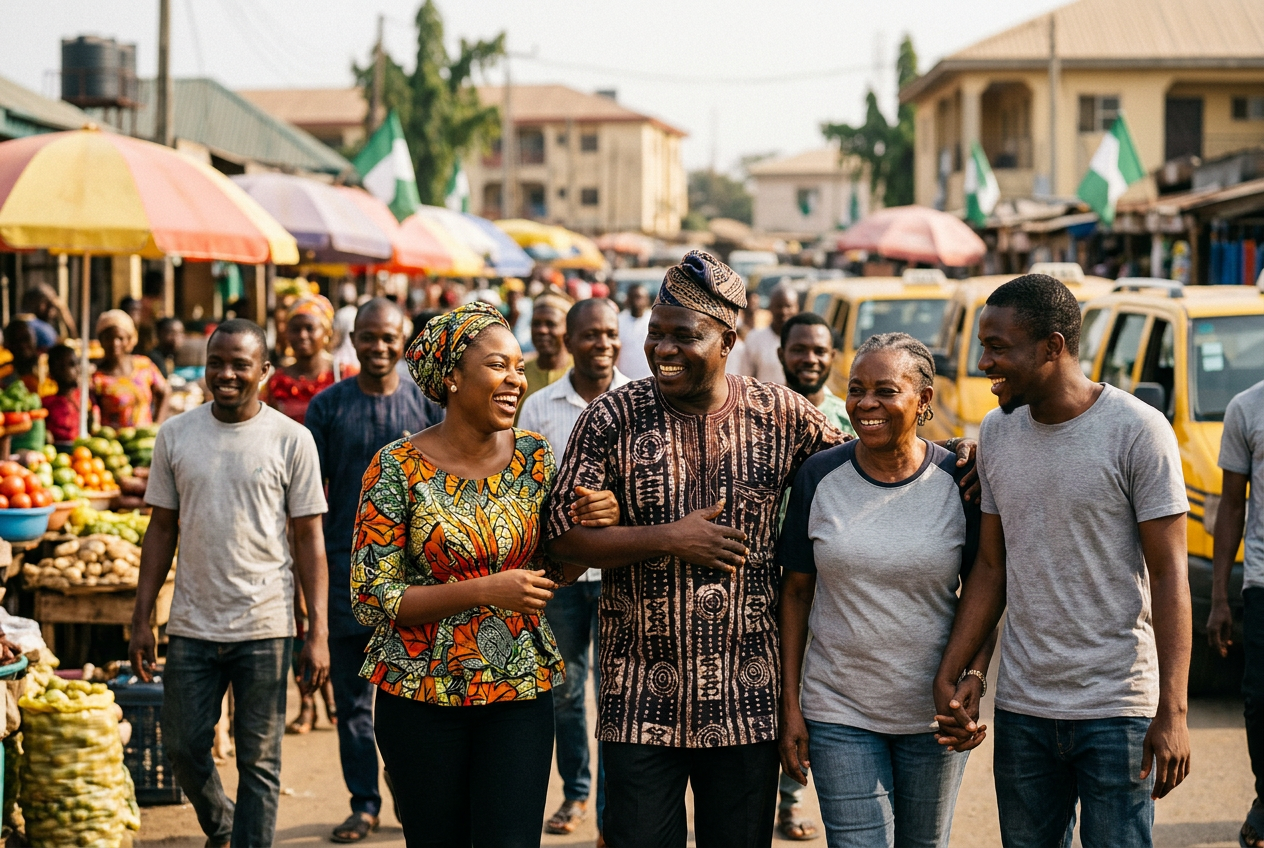
Hello, and thank you for stopping by. This article is the conclusion of several months of research into national wellbeing data, drawing on years spent writing about how Nigerians genuinely live rather than how a spreadsheet says they live.
Let us begin with the figure itself. The happiness rate in Nigeria currently sits at 4.8 out of 10, placing the country 106th of 147 nations in the 2026 edition of the yearly wellbeing study produced by Oxford’s Wellbeing Research Centre with Gallup and the United Nations.
That is the number. Now for the part that matters more.
If you landed here after seeing a headline back in March, raised an eyebrow and wondered what the figure underneath it actually means for you, your family and the people queuing beside you at the filling station, you are asking exactly the right question.
Because here is the thing that struck me hardest during the research: 4.8 out of 10 is not a verdict on the Nigerian spirit. It is a measurement of circumstances. And once you understand what is actually being measured, the number stops feeling like an insult and starts feeling like a diagnosis, which is a far more useful thing to have.
I have spent a good part of my working life writing about Nigerian life, culture and economics, and I can tell you that no statistic has ever provoked as much argument in my WhatsApp groups as this one. Half the people insist the score is far too low, pointing to a Saturday owambe in Ikeja where nobody looks like they are ranked 106th at anything. The other half insist it is far too generous, and they usually have a fuel receipt in hand to prove it.

Both groups are right, in their way. Let me show you why.
How Nigeria’s Happiness Rate Is Actually Measured
Before we argue about the score, we should agree on what the score is.
The measurement is not a mood ring. It is a single survey question known as the Cantril Ladder, and it works rather like asking someone to mark where they stand on a staircase. Respondents are asked to imagine a ladder with steps numbered zero at the bottom and ten at the top. Ten represents the best possible life they can envisage for themselves. Zero represents the worst. They are then asked which step they personally feel they are standing on today.
That is it. One question, roughly a thousand people per country, averaged across three years to smooth out the noise. The 2026 figure covers responses gathered between 2023 and 2025.
Notice what is missing. Nobody is asked whether they laughed yesterday, whether they enjoy their neighbours, or whether jollof rice improves their afternoon. Those things are measured separately as positive emotions, and Nigerians tend to score respectably on them. The ranking you see in headlines is built entirely on that ladder question, which is an evaluation of one’s whole life situation rather than one’s mood on a given Tuesday.
This distinction explains the WhatsApp argument perfectly. Nigerians are, by most emotional measures, a joyful and socially rich people. But when asked to evaluate their life as a whole, against what they believe a good life should look like, they mark themselves lower. Joy and life satisfaction are simply not the same instrument.
The report also publishes six explanatory variables alongside the score: GDP per capita, social support, healthy life expectancy, freedom to make life choices, generosity and perceptions of corruption. These do not create the ranking. They help explain it.
And in Nigeria’s case, several of those variables have taken a beating. When the National Bureau of Statistics surveyed more than 56,000 households across all 36 states and the Federal Capital Territory, it found that 63 per cent of people, roughly 133 million Nigerians, were experiencing overlapping deprivations across health, education, living standards, work and shocks. Rural areas fared considerably worse than urban ones, at 72 per cent against 42 per cent.
Then there is the psychological toll of all this, which is finally being taken seriously at policy level. The Federal Ministry of Health has reaffirmed its commitment to making services affordable and accessible, pointing to the National Mental Health Act 2021, the revised National Mental Health Policy 2023 and the National Suicide Prevention Strategic Framework running to 2030. The process of decriminalising attempted suicide, begun with a national task force in 2024, has reached an advanced stage.
Colleagues at this paper have written thoughtfully about the connection between hunger, hardship and psychological strain, and their argument holds up against the international data rather well. Empty pockets and empty stomachs do not stay in the wallet and the belly. They travel upward.
So, What Is the Happiness Rate in Nigeria, Precisely?
Here is the direct answer, in one paragraph, with the closely related figures gathered in one place.
The happiness rate in Nigeria is 4.8 out of 10 on the Cantril Ladder, based on a three-year average of Gallup World Poll responses collected between 2023 and 2025, which places Nigeria 106th out of 147 countries surveyed in the 2026 World Happiness Report. This continues an unbroken three-year slide: the country ranked 102nd in 2024 and 105th in 2025. Within Africa, Nigeria sits 11th, just behind Tunisia and just ahead of Senegal. For scale, Finland leads the world on 7.8 and Afghanistan trails it on 1.4, meaning Nigeria’s score falls roughly in the lower-middle band of the global distribution rather than at the bottom of it.
The entities you will see quoted around this number are worth knowing, because headlines often muddle them:
- The Cantril Ladder is the survey question that produces the score, not an index of emotions
- Gallup World Poll collects the raw responses, around a thousand per country
- The Wellbeing Research Centre at the University of Oxford publishes the report
- The UN Sustainable Development Solutions Network is the partner that ties the work to the International Day of Happiness on 20 March
- The six explanatory variables are descriptive companions to the score, not ingredients of it
Now, why 4.8 and not 5.8? Three pressures show up repeatedly in the underlying data.
The first is cost of living. Headline inflation stood at 15.91 per cent in June 2026, easing gently from 15.93 per cent in May, which sounds like good news until you notice food inflation running at 17.52 per cent year on year and accelerating month on month. Pepper, tomatoes, crayfish, beef, garri and yam have all been climbing. Meanwhile the national minimum wage remains ₦70,000, a figure the Presidency itself has publicly acknowledged is no longer adequate to the economic realities workers face.
The second is the gap between headline economic performance and lived experience. Macroeconomic indicators have improved in places. Household experience has not caught up, and life evaluation is a household measurement, not a Bloomberg terminal.
There is a counterweight worth naming here, and it is one of the few things propping the score up rather than dragging it down. Diaspora transfers reached an estimated 23 billion dollars in 2025, the highest level in five years, and the Nigerians in Diaspora Commission has long argued that these flows should be treated as national infrastructure rather than as pocket money. For millions of households, a monthly transfer from an aunt in Houston or a cousin in Croydon is the difference between school fees paid and school fees deferred. That cushion shows up quietly in the social support variable.
The third pressure is what economists politely call the reference point problem. Nigerians are ambitious, well informed and extremely online. When you can see, hourly, what life looks like on the top rungs of the ladder, your own rung feels lower than it did twenty years ago. This is not weakness. It is arithmetic.
An editorial in these pages argued that the decline is entirely reversible, and having spent months in this data, I find that position defensible. The variables driving Nigeria’s score are almost all policy-responsive. None of them are cultural.
The Top 10 Happiest Countries in Africa and Where Nigeria Sits
This is where the conversation gets genuinely interesting, and slightly uncomfortable.
Nigeria is the Giant of Africa by population, by economy, by cultural output and by sheer noise. It is not the giant of African life satisfaction. In the 2026 rankings, ten African nations placed ahead of it, several of them countries a Lagos trader would be surprised to lose to.
Mauritius leads the continent at 73rd globally, which is no accident. A small island economy with a functioning tourism sector, a growing financial services industry and healthcare that people can actually reach will produce contented citizens. Libya follows at 81st despite years of political turmoil, largely because dense family and community networks absorb shocks that formal institutions elsewhere would have to handle.
That pattern repeats across the continent. The countries beating Nigeria are rarely richer per head. They are steadier, or smaller, or better networked socially, or all three.
Africa’s Ten Happiest Countries in the 2026 Rankings, With Nigeria for Comparison
| Africa Rank | Country | Global Rank (of 147) | Score (0 to 10) |
|---|---|---|---|
| 1 | Mauritius | 73 | 5.9 |
| 2 | Libya | 81 | 5.7 |
| 3 | Algeria | 83 | 5.7 |
| 4 | Mozambique | 93 | 5.3 |
| 5 | Gabon | 96 | 5.2 |
| 6 | Côte d’Ivoire | 98 | 5.1 |
| 7 | Cameroon | 100 | 5.1 |
| 8 | South Africa | 101 | 5.0 |
| 9 | Niger | 103 | 4.9 |
| 10 | Tunisia | 105 | 4.8 |
| 11 | Nigeria | 106 | 4.8 |
The table tells a story that the ranking alone hides: the distance between first and eleventh in Africa is just 1.1 points on a ten-point scale, which is remarkably narrow. Nigeria and Tunisia are effectively tied at 4.8, separated by decimal places rather than by any meaningful difference in daily life, so the gap to close is smaller than the headline positions suggest.
That last point deserves emphasis, because it is easy to read “106th” and conclude that the situation is hopeless. It is not. Nigeria is a rounding error away from Tunisia, less than a point away from South Africa, and about 1.1 points away from topping the continent. In a measure this slow-moving, a sustained improvement in food prices and public services could move the needle noticeably within a single reporting cycle.
The Top 10 Happiest Countries in the World and What They Do Differently
Now let us look at the other end of the ladder, because the global leaders are not mysterious. They are boringly consistent.
Finland has held first place for nine consecutive years, scoring 7.8. Iceland and Denmark follow on 7.5 each. Then comes the surprise of the 2026 edition: Costa Rica at fourth on 7.4, the highest position a Latin American country has ever achieved in the report’s history, having climbed from 23rd as recently as 2023. Sweden takes fifth on 7.3, followed by Norway and the Netherlands on 7.2, Israel on 7.2, Luxembourg on 7.1 and Switzerland rounding out the ten on 7.0.
Notice something about that list. With the exception of the Netherlands, every single one of the top ten has a population under twenty million. Most are well under it. Small, high-trust societies with dense institutional coverage find it easier to make individual citizens feel looked after, which is not an excuse for Nigeria so much as a description of the challenge at 237 million people.
Notice something else. The English-speaking heavyweights are absent. The United States sits 23rd, its lowest position on record and a long fall from 11th in 2011. Canada is 25th. The United Kingdom is 29th. Australia is 15th. Wealth alone plainly does not buy the top of this ladder.
Costa Rica is the one I find most instructive for Nigeria, and I say that as someone who has followed Latin American development closely. It is not a wealthy country by Nordic standards. What it has is social cohesion, environmental quality, and a strong sense that people can make their own life choices. Those three things are considerably cheaper to build than a Norwegian sovereign wealth fund.
Mexico is the other outlier worth watching, sitting 12th with a population of nearly 132 million, having climbed from 36th in 2022. Large, middle-income, family-oriented and improving. That is a template, not a fantasy.
The Top 10 Unhappiest Countries in the World and What They Reveal
Context is a kindness, so let us look downward for a moment.
Afghanistan remains at the very bottom on 1.4, a score so low it sits in a category of its own, having collapsed from 3.8 in 2016. Above it come Sierra Leone, Malawi and Zimbabwe, all on 3.3. Botswana and Yemen follow on 3.5, Lebanon on 3.7, the Democratic Republic of the Congo on 3.8, and Egypt and Tanzania on 3.9.
Look at what those countries share. Active conflict, institutional collapse, currency crisis, or some combination of the three. This is what a genuinely broken life evaluation looks like, and Nigeria at 4.8 is not in that territory. Nigerians are struggling. They are not, statistically speaking, in freefall.
There is a warning buried in that list, though, and it would be dishonest of me to skip it. Several of those countries were once middle-of-the-table performers. Lebanon in particular was a comfortable regional average before its currency and banking system came apart. Life evaluation scores can slide slowly for years and then fall off a cliff when institutions give way.
Nigeria’s three-year slide from 102nd to 106th is slow. Slow is survivable. Slow is also a signal worth reading properly rather than dismissing as a foreign ranking that does not understand us.
Which Country Loves Nigeria the Most?
Right, this is the question I get asked most often, and I have to be honest with you about something first: there is no official index of national affection. Nobody publishes a “Countries That Love Nigeria” league table, and anyone who tells you otherwise is selling something.
What we can do is measure affection by its effects. And by that standard, three proxies give a fairly clear answer.
Money sent home. Nigerian remittance inflows reached an estimated 23 billion dollars in 2025, the highest level in five years. The United States is comfortably the largest single corridor, accounting for somewhere between 7.5 and 8.5 billion dollars, roughly a third of everything that comes in. The United Kingdom follows with an estimated 3.5 to 4.5 billion. Between them, those two countries send more than half of all inflows. Canada, Germany, Saudi Arabia, the United Arab Emirates, South Africa and Australia make up much of the remainder, with Dubai emerging as a genuine regional hub. Money, it turns out, is a reasonably honest measure of attachment.
Music listened to. Afrobeats listenership grew 22 per cent globally in 2025 alone, on top of years of triple-digit growth, and the genre has expanded by more than 5,000 per cent on Spotify since 2021. Nigerian artistes generated over 30 billion streams in 2025, earning north of ₦60 billion from that platform alone. My colleagues have documented how Nigerian artistes turned the streaming boom into global stardom, and the export map is telling. The United States and the United Kingdom dominate consumption, but Brazil has seen an Afrobeats listenership spike of around 500 per cent, which is the kind of number that makes you sit up.
Affection returned. Here is the twist I did not expect. When Morning Consult surveyed 45 countries in January 2026 on how they view the United States, Nigeria tied with Israel for first place, with 83 per cent of Nigerian respondents expressing a favourable opinion. Nigerians also register unusually warm views of China. In other words, we are one of the most affectionate populations on earth toward the major powers, whether or not that affection is returned in equal measure.
So the honest answer? By the measurable proxies of money, migration and music, the United Kingdom and the United States love Nigeria most, with the United States marginally ahead on financial terms and the United Kingdom ahead on depth of historical and cultural entanglement. Within Africa, Ghana and South Africa host the deepest ties. And Brazil is the fastest-rising newcomer to the list.
Rather like a large family, the relationships are complicated, occasionally tense, and unmistakably real.
Practical Steps for Protecting Your Own Wellbeing Score
National statistics are useful for policy and almost useless for Tuesday. So here is the part I would actually want a friend to read.
The six explanatory variables behind the global rankings include several that individuals genuinely can influence, particularly social support and freedom to make life choices. These steps will not fix inflation. They will meaningfully protect the rungs of your personal ladder while the national picture sorts itself out.
- Build a three-month cash buffer before anything else. Aim to hold three to six months of essential expenses in accessible naira savings, and treat it as untouchable. Financial shocks damage life evaluation far more than a permanently modest income does, because unpredictability is what the mind actually struggles with.
- Cap housing at 30 per cent of take-home pay. If rent, service charge and generator diesel exceed that share, every other decision in your life becomes constrained. Moving to a slightly longer commute for a materially cheaper rent is one of the highest-return wellbeing trades available in Lagos or Abuja.
- Protect two social contacts per week that are not transactional. Not a work call, not a favour request, not a WhatsApp broadcast. Social support is the single variable where Nigerian culture already outperforms most of the world, and it is quietly eroded by long commutes and hustle culture.
- Get 150 minutes of moderate movement weekly and seven to nine hours of sleep nightly. These are the World Health Organisation’s general adult guidelines, and they are unglamorous, free and startlingly effective. Walking counts.
- Set a hard boundary on comparison media. Try capping social feeds at 45 minutes daily for a fortnight and see what happens to your mood. The 2026 report devotes considerable attention to social media’s effect on youth wellbeing, and the finding is not flattering to the algorithm.
- Treat professional support as ordinary maintenance. Nigeria now has a legal framework for mental healthcare under the 2021 Act, and stigma is falling faster than most people realise. Speaking to a doctor or counsellor about persistent low mood is no more dramatic than seeing a dentist about a persistent ache.
Would every one of these work for everyone? Of course not. But four out of six, held consistently for six months, will move your personal rung more reliably than any policy announcement.
Final Thoughts on the Happiness Rate in Nigeria
If you take one thing from all of this, let it be this: the happiness rate in Nigeria measures conditions, not character.
A score of 4.8 out of 10 and a rank of 106th out of 147 is a genuinely disappointing result for a country with this much talent, this much cultural reach and this much youthful energy. It is also, on closer inspection, a shallower hole than the headlines suggest. Nigeria is 1.1 points from leading Africa and a rounding error from Tunisia. The three pressures dragging the score down, which are food prices, the gap between macroeconomic recovery and household reality, and eroding trust in institutions, are all things that policy can address within a few reporting cycles.
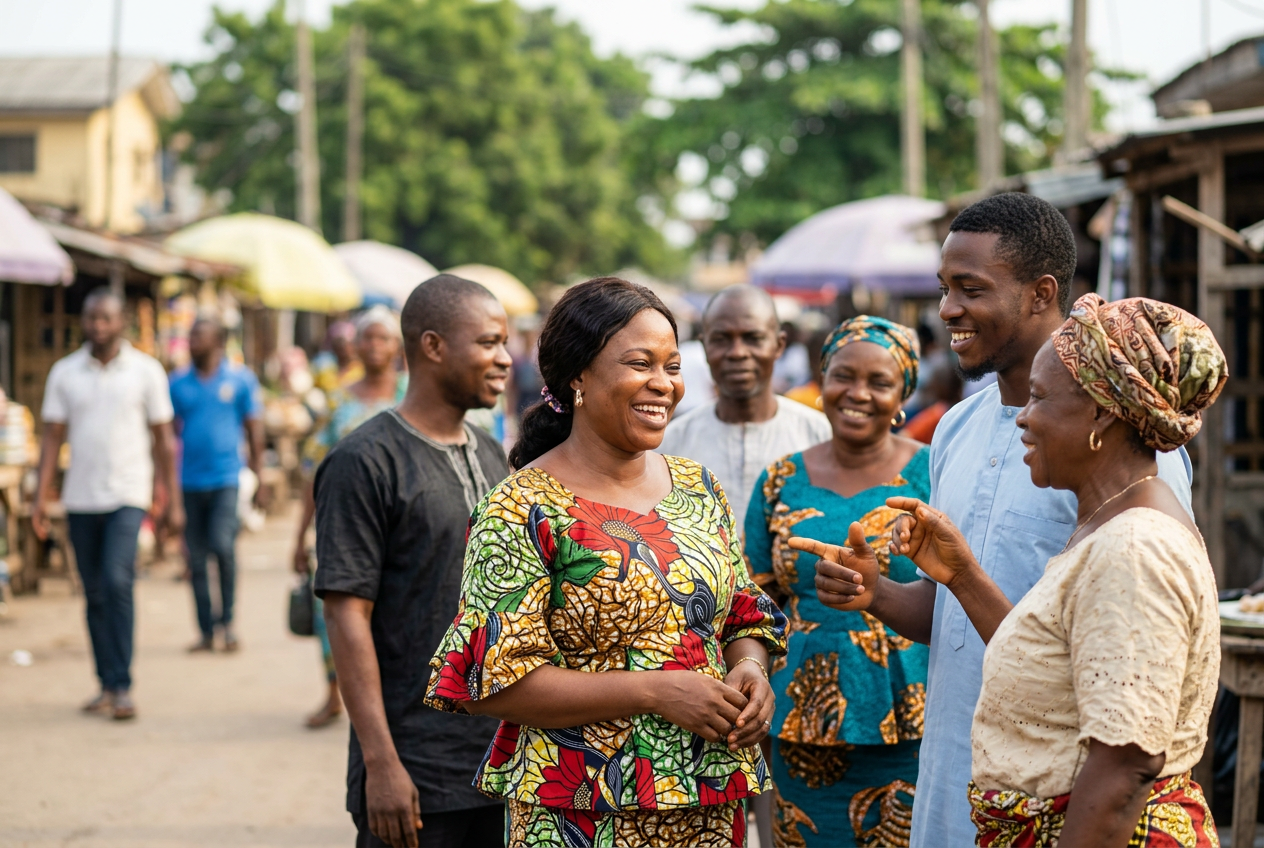
Meanwhile the asset that no ranking captures properly is still fully intact. The social density, the humour, the willingness of Nigerians to show up for each other at weddings and funerals and hospital bedsides, the sheer refusal to be defeated by a bad week. That is the raw material other countries spend decades trying to manufacture.
So what should you actually do with this article? Three things. Bookmark the ranking and check it each March, because the trend matters far more than any single year. Pick two of the six steps above and start this week rather than next month. And when someone tells you Nigerians are the unhappiest people on earth, you now have the numbers to correct them politely, because ninety-nine countries score higher and forty-one score lower, which is a very different sentence from the one people usually repeat.
The ladder has more rungs above us than below us. That is worth knowing.
Related Articles
If this piece interested you, you may enjoy two others I have written for this paper. The first explores the qualities that Nigerians are best known for around the world, which makes an illuminating companion to the wellbeing data here, since so much of what the world admires about Nigerians never shows up in a life evaluation score. The second examines why the country carries the continental title it does, and it is worth reading alongside this one to see how size, influence and contentment do not always travel together.
Key Takeaways
- Nigeria scores 4.8 out of 10 and ranks 106th of 147 countries in the 2026 World Happiness Report, continuing a slide from 102nd in 2024 and 105th in 2025, though the gap to Africa’s leader is only 1.1 points.
- The score measures life circumstances through a single ladder question rather than mood or emotion, which is why Nigerians can be socially joyful and still rate their overall life situation modestly.
- Individuals can protect their own position by building a three to six month cash buffer, keeping housing under 30 per cent of income, and safeguarding two non-transactional social contacts each week.
FAQs About the Happiness Rate in Nigeria
What is the happiness rate in Nigeria?
Nigeria’s happiness rate is 4.8 out of 10, based on a three-year average of Gallup World Poll life evaluations gathered between 2023 and 2025. That score places Nigeria 106th out of the 147 countries covered by the 2026 World Happiness Report.
Is Nigeria’s happiness ranking getting better or worse?
It is getting worse, though gradually rather than sharply. Nigeria ranked 102nd in 2024, 105th in 2025 and 106th in 2026, which represents three consecutive years of decline.
Where does Nigeria rank among African countries?
Nigeria sits 11th in Africa, immediately behind Tunisia and immediately ahead of Senegal. Mauritius leads the continent at 73rd globally with a score of 5.9.
How is national happiness actually measured?
Respondents answer a single question called the Cantril Ladder, rating their current life on a scale where ten is the best possible life and zero is the worst. Roughly a thousand people per country respond, and results are averaged across three years to reduce volatility.
Which country is the happiest in the world right now?
Finland holds first place with a score of 7.8, its ninth consecutive year at the top. Iceland and Denmark follow on 7.5 each, with Costa Rica taking fourth on 7.4.
Which country is the unhappiest in the world?
Afghanistan ranks last of 147 countries with a score of just 1.4, down from 3.8 in 2016. Sierra Leone, Malawi and Zimbabwe follow, each scoring 3.3.
Why is Nigeria’s score lower than countries that are poorer?
Because the ladder question measures how people evaluate their whole life situation, not their income alone. Countries with steadier institutions, stronger informal support networks or lower expectations of change often score higher despite thinner wallets.
Does the ranking mean Nigerians are unhappy people?
No, and this is the most common misreading of the data. The report measures life evaluation rather than daily emotion, and Nigerians consistently score well on measures of positive feeling such as laughter and enjoyment.
What is driving the decline in Nigeria’s score?
Food inflation running at 17.52 per cent year on year in June 2026, a national minimum wage of ₦70,000 that the Presidency has publicly acknowledged is inadequate, and a widening gap between headline economic recovery and household experience. Perceptions of corruption and uneven access to public services also weigh on the underlying variables.
Which country loves Nigeria the most?
There is no official index, but by the measurable proxies of remittances, migration and cultural consumption, the United States and the United Kingdom lead. The United States sends roughly a third of Nigeria’s 23 billion dollars in annual remittance inflows, while the United Kingdom holds the deepest historical and cultural ties.
How does mental health policy affect these numbers?
Mental health provision shapes several underlying variables, particularly healthy life expectancy and freedom to make life choices. Nigeria’s National Mental Health Act 2021 and the revised 2023 policy provide a legal foundation, though implementation and access remain uneven across states.
Can Nigeria realistically improve its ranking?
Yes, and faster than most people assume. The gap between Nigeria and the highest-ranked African country is only 1.1 points on a ten-point scale, and sustained improvement in food prices, public service delivery and institutional trust could shift the score within two or three reporting cycles.

