 Follow Us on Google News
 Follow Us on Google Discover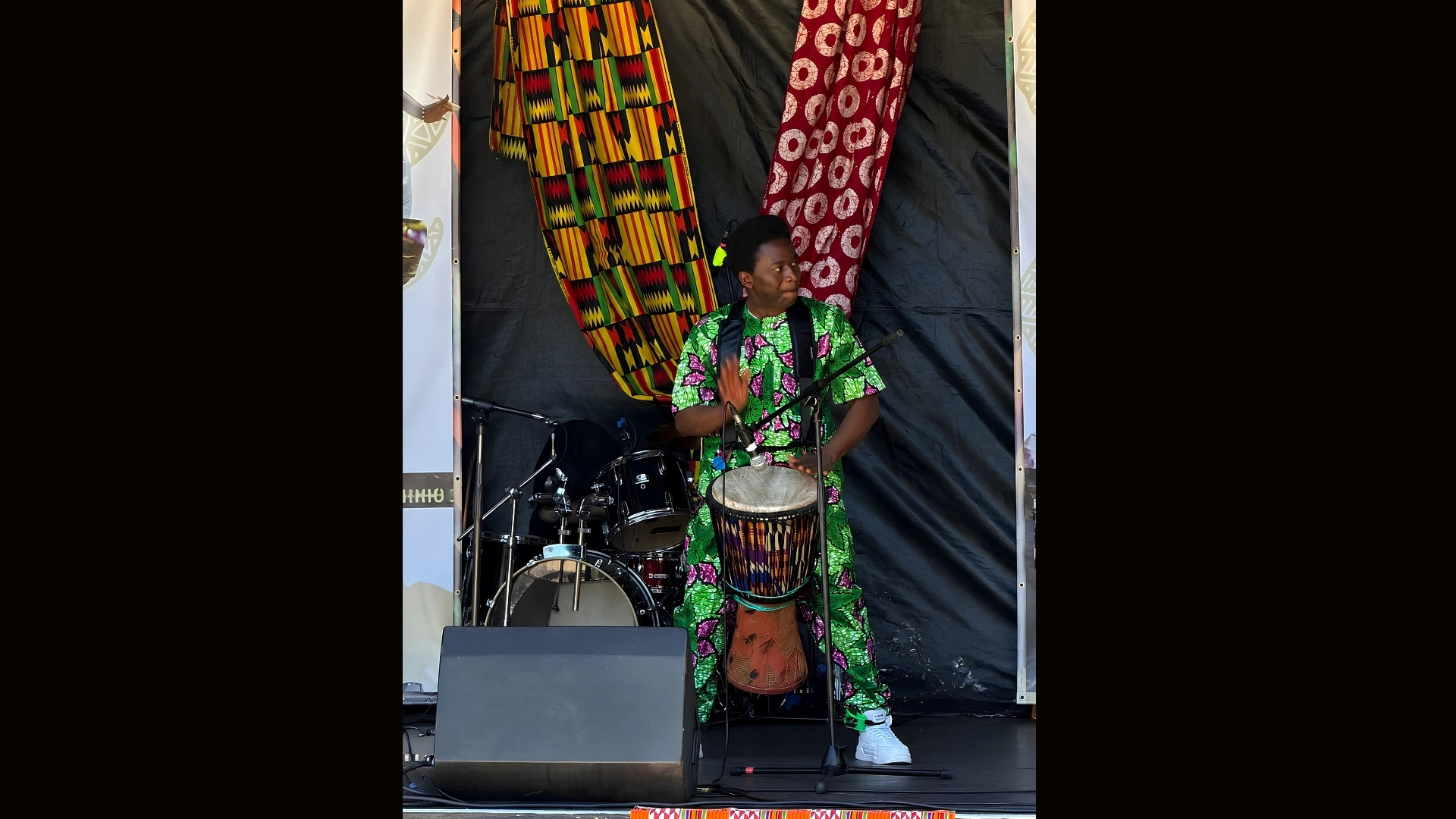
The initial mood at the inaugural edition of the Bradford African Festival of Arts is sombre, but it turns electric as the percussionist Aradojo James Abayomi (Aby Drumz) and his collective, the Afro Rhythm Ensemble, take the stage.
Aby Drumz dresses in a matching green floral Ankara print, his white trainers only breaking from the colour. He is in the middle of the collective, with his Djembe drum wedged tight between his knees, waiting for the first strike to get into full-blown action. But it needs to wait until the female singer among the collective begins.
The set isn’t a musical performance, but a spoken word poem, akin to a speech.
The collective’s only female singer stands on the right side of the stage, sporting a green-patterned Ankara gown, holds a book and reads. “Nkoso!, she begins, “do you know what that means?” She rhetorically asks the audience. “No, I will tell you!” She adds, before proceeding to tell the meaning of the Alan/Twi word from Ghana: it means progress, advancement, or development. The poem is an African-inspired piece urging the continent to keep making progress and never stop celebrating its successes, in spite of its many differences and difficulties.
With the reciter stopping in between stanzas, the ritualistic play-and-stop drumming pattern requires expertise not to disrupt the flow of the recitation and the poem’s message.
Between her stanzas, when the reciter’s voice drops away and the stage falls quiet, it’s Aby Drumz and his fellow percussionists who are left to hold the audience’s attention, filling every pause with drumming drawn from the African folk orchestra tradition.

As the leader of the ensemble, who builds the rhythm and guides the set, Aby Drumz’s approach is unmistakably ritualistic. He monitors the flow of the reader’s delivery and doesn’t drum continuously underneath her the way a backing band might. He waits, studies her pauses, and interjects only when she has stopped, using the drum to answer a question the poem has just asked.
Aby Drumz’s playing of the Djembe rises, ebbs, and falls like a tide, always gathering toward the next silence instead of settling into a fixed pattern. A spoken-word poem about a continent’s resilience doesn’t need a fixed backbeat to push it. It needs drums that communicate in the same tone as the voice, rising when the words rise and receding when they recede. Aby Drumz’s tidal phrasing does exactly that, and the accompanying drums give the ensemble something close to a second voice answering the poet’s first.
Up close, for reasonable delivery, he leans slightly forward into the djembe. He lets his shoulders loose, his palms coming down in quick alternating slaps, open-handed on the rim for the sharp, cracking tones. Then a cupped, muted strike at the dead centre for the bass that hits the heart and catches the ears.
Fellow percussionists, alongside him, play the Gangan (talking drum), Omele, and an auxiliary Djembe. Their pitch, together, bends and slides to build a coherent rhythm threading through the spaces the reader leaves during the pauses between stanzas. It’s the right combination for a piece this ritualistic.
Aby Drumz ‘s attention, surprisingly, falters slightly in the handoffs. On at least one occasion, he enters a beat before the reader has fully finished her final syllable. So, his first strike briefly overlaps her voice when it should be answering it cleanly. The set, as we know it, is built entirely on that call-and-response discipline; the effect is a small blur, easy to miss but audible if you’re listening for the silences as closely as the sound.
There are also stretches where his fills lean toward volume over shape, a flurry of quick strikes that reads as impromptu. The more considered tidal build he demonstrates elsewhere, moments that impress the ear without disposing the poem’s meaning, is lost.
These missteps, insignificant as they seem to the common audience, almost ruin an otherwise disciplined performance.
Working to fill the gaps the poet leaves him, what Aby Drumz achieves is a subtle commentary to accentuate what the poet doesn’t say. The tide-like rhythm, rising and falling, is Nkoso: a continent gradually progressing, despite its political and socioeconomic upheavals.

