 Follow Us on Google News
 Follow Us on Google Discover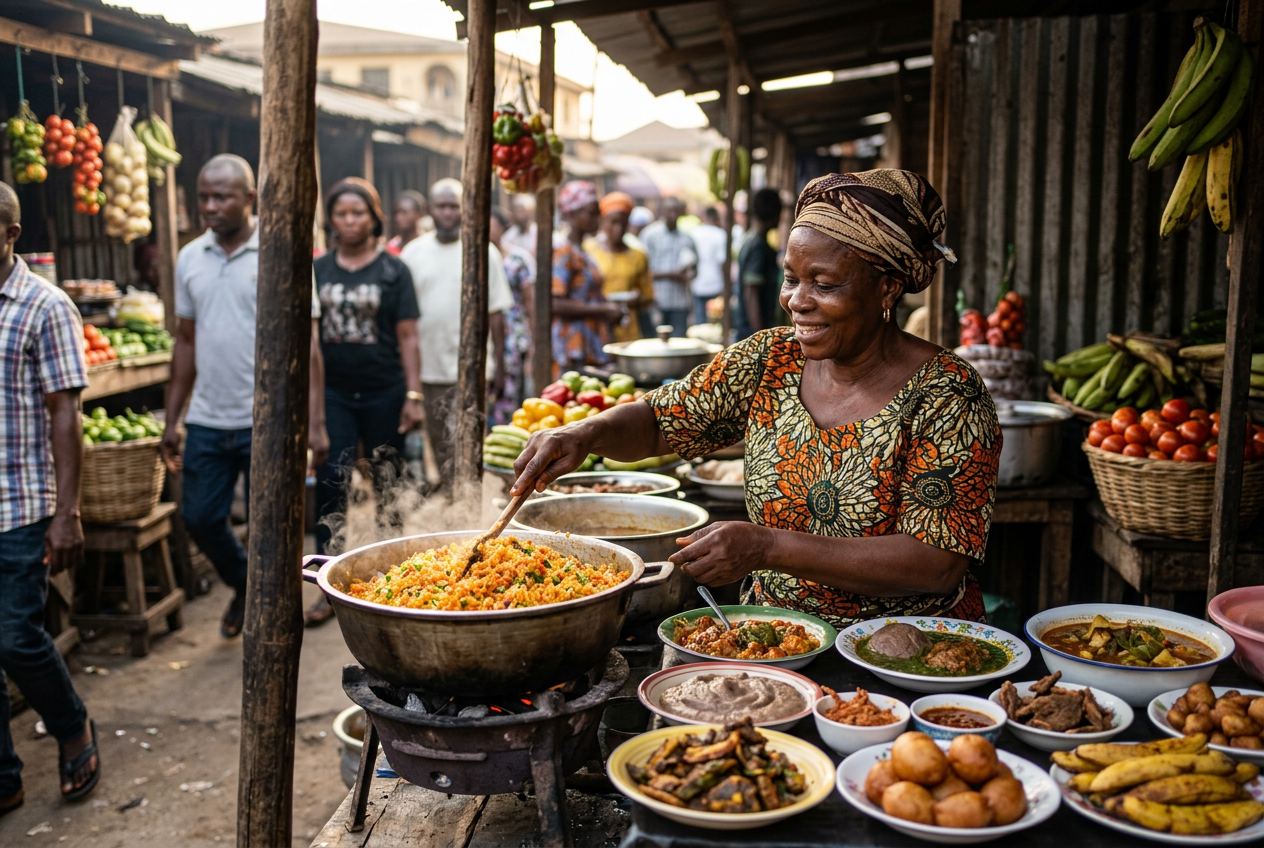
Welcome, and thank you for landing here. I have spent the better part of eight months on this question, pulling apart archaeological papers, trade records and market data, and I have spent far longer than that eating my way around this country with a notebook in my lap. So when someone asks me what food did Nigeria create, I no longer give the quick answer. The honest answer sits somewhere between a genealogy and an argument, and the catalogue of dishes that grew out of this soil is longer, stranger and more contested than most of us were taught at school.
I should say plainly what this piece is not. It is not a recipe round-up, and it is not a patriotic exercise in claiming everything on the West African table.
It is an attempt to separate three things that get blurred constantly: what we invented, what we adopted and made unmistakably ours, and what we simply grow better than anyone else. Those are three different claims, and people lose arguments at weddings because they collapse them into one.
My grandmother in Ondo used to say that a person who does not know where the yam came from will not know how to plant it. She meant it about farming. I have come to think she meant it about identity too.
What Is Nigeria’s Famous Food, and Why Does It Carry So Far?
Ask anyone outside the country to name a Nigerian dish and you will hear jollof rice first, suya second, and then a pause. That pause is the interesting part.
The pause exists because Nigerian cuisine has enormous depth and very little documentation. We have hundreds of dishes that have never been written down in a form that a stranger in Manchester or Houston could follow, a point made forcefully in an earlier Guardian argument for treating shared meals as a deliberate act of cultural transmission rather than something that looks after itself. Rating platforms bear this out in a slightly awkward way: when TasteAtlas compiled its cuisine rankings, Nigerian cuisine scored 3.94, with pepper soup, chin chin, jollof rice, suya and egusi soup listed as the dishes to try. Five dishes standing in for a country of more than 250 ethnic groups. That is not a judgement on our cooking. It is a judgement on our record keeping.

Here is what actually carries abroad, in my experience of tracking Nigerian restaurant menus across four continents since 2019: jollof rice, suya, egusi soup with pounded yam or eba, moin moin, akara, pepper soup, puff puff and chin chin. Eight items, more or less, doing the work of a national cuisine.
Meanwhile the dishes I would genuinely fight for stay home. Ofada rice with ayamase. Abacha. Okpa. Miyan kuka. Ekpang nkukwo. Fura da nono on a hot afternoon in Kano, which I still think is the single most underrated thing this country produces.
The food does travel, though, in a second sense that matters more economically. Our raw agricultural output leaves the country in enormous volume even when the finished dishes do not. According to the Nigerian Export Promotion Council’s review of the sector, Nigeria exported 281 different non-oil products in 2025, with cocoa beans alone generating 1.99 billion dollars, followed by urea at 1.29 billion, cashew nuts at 456.9 million, sesame seeds at 300.3 million and gold dore at 228.8 million.
Read that list again. Cocoa, cashew, sesame. We ship the ingredients and someone else ships the product.
That gap between what we grow and what we sell is, to my mind, the central economic story of Nigerian food. It is also the reason the question of invention matters beyond dinner-table pride. You cannot build a premium export category around a thing you have not established ownership of.
Setting Out Plainly What Food Nigeria Created
So, directly: what food did Nigeria create? The foods genuinely originated within present-day Nigeria are those built on crops and techniques indigenous to the region rather than imported through trade, and the clearest examples are pounded yam and the wider family of yam preparations, egusi soup thickened with melon seed, akara and its steamed cousin moin moin made from black-eyed peas, suya and the yaji spice blend that defines it, ogbono soup from wild mango seed, banga soup from palm fruit, the fermented condiments iru and ogiri, kuli kuli from groundnut, abacha from shredded cassava, ofada rice grown from African rice stock, and palm wine tapped from the raffia and oil palm. The common thread is that each rests on something that grew here first, or on a preparation method that has no clear parallel elsewhere. Yam is the anchor of the list, and it is not a small claim: genomic work published in Science Advances found that cultivated African yam was domesticated from a forest species, with the expansion of African yam agriculture beginning in the Niger River basin. The Niger basin. Not a metaphor, an actual river running through the middle of this country.
Rather like the way a language keeps loanwords but builds its own grammar, Nigerian cuisine borrowed ingredients freely while keeping its own structure. The structure is the swallow-and-soup pairing, the palm oil base, the fermented umami note, the pepper.
Akara is the case I find most moving, and I have written about it in three different contexts now without getting bored. It is a fritter of peeled black-eyed peas, beaten to aerate, deep fried. The dish descended from akara, which originated in Yorubaland, and was carried to Brazil by enslaved Yoruba people, where it became acarajé, traditionally found in Bahia and especially in Salvador. Acarajé was listed as a federal immaterial asset by Brazil’s National Institute of Historic and Artistic Heritage in 2004, and it functions as a ritual offering in Candomblé.
Think about that for a moment. A breakfast snack sold by women on Lagos roadsides is, in another hemisphere, sacred food with legal heritage protection. We did not just create it. We exported it under the worst circumstances imaginable and it survived.
Cassava is the counter-example and I want to be scrupulous here, because this is where people overclaim. Cassava is South American. It arrived through Portuguese contact in the sixteenth century. What Nigeria created is not the plant but the processing: garri, fufu, abacha, tapioca, the whole grammar of turning a mildly toxic tuber into a shelf-stable staple. That processing knowledge is an invention in every sense that matters, and we hold it more completely than anyone.
The scale involved is not modest. The Federal Ministry of Agriculture’s policy framework for the sector names cocoa, cassava, oil palm, sesame and gum arabic as the initial focus for export crops, and Nigeria remains the world’s largest cassava producer by a wide margin.
Price grounding, because abstractions get slippery. Per the National Bureau of Statistics food price series, white garri sold loose averaged ₦808.96 per kilogram in April 2026, down from ₦1,345.10 a year earlier, a fall of 39.86 per cent, while brown beans came down to ₦1,338.93 per kilogram from ₦2,429.39. Food inflation stood at 16.06 per cent in April 2026, against 24.68 per cent in April 2025.
Cheaper than last year. Still roughly double what it was in 2023. Both things are true and you will hear whichever one suits the speaker.
Is Jollof Rice Originally Nigerian, or Did We Inherit It?
Now the difficult part, and I would ask you to sit with it before you reach for the comments.
No. Jollof rice is not originally Nigerian.
I say that as someone who has argued the opposite at three separate weddings and lost each time, eventually, to better evidence. Jollof rice was probably first cooked during the fourteenth century in the Wolof empire, which had risen in the previous century in what is now inland Senegal, where rice cultivation thrived; one of its dishes was thiéboudienne, made by cooking rice with fish, shellfish and vegetables, and as the empire expanded the dish spread through the region until new interpretations came to be known as jollof, a variant spelling of the dominant Jolof state.
The name is the giveaway. Jollof is Jolof. We have been saying where it came from every single time we order it.
There is scholarly texture worth knowing. The food and agriculture historian James C. McCann questioned whether the dish could have spread naturally from Senegal across its present range, since no comparable diffusion appears in linguistic, historical or political patterns, and proposed instead that it travelled with the Mali empire, particularly the Djula traders who carried blacksmithing, small-scale marketing and rice agronomy across the region. So the route is disputed even where the origin is not.
And the international seal has already been applied. The Senegalese version, thieboudienne, has been recognised by UNESCO as an intangible cultural heritage dish.
Does any of this diminish Nigerian jollof? Not remotely, and here is why.
What Nigeria created is not jollof rice. It is party jollof, which is a genuinely distinct thing: long grain parboiled rice cooked down in a fried tomato and scotch bonnet base, finished over firewood in a large pot so the bottom layer catches and smokes, then served in volumes appropriate to a Nigerian wedding. The smoke is the signature. You cannot reproduce it on a gas hob in a flat and everyone who has tried knows it.
That is adaptation raised to the level of invention, and it is a normal way for cuisines to work. Pizza is Neapolitan; Chicago deep dish is nobody’s idea of an imitation.
The cost of that pot, incidentally, has become one of the country’s more reliable economic indicators. As this paper reported when the pot became a proxy for the whole cost-of-living picture, the average cost of preparing a pot of jollof rice for a family of five rose to ₦30,435 in the first quarter of 2026, a 19.4 per cent increase in six months, which SBM Intelligence linked to rising fuel prices, transport disruption and global energy shocks that pushed Brent crude above 110 dollars per barrel. Petrol climbed above ₦1,300 per litre in major cities and diesel exceeded ₦1,500, feeding straight into food logistics.
By the second quarter the figure had settled slightly, with the rebased index putting a family pot at ₦29,578 in June 2026 against ₦25,798 in July 2025, a rise of 14.6 per cent across the year. The long view is harsher: from roughly ₦4,087 in July 2016, that is an increase of more than 600 per cent in a decade.
A pot of jollof now costs close to half the national minimum wage. Let that sit.
What Is the History of Nigerian Food, From the Yam Belt to the Party Pot?
The history runs in four distinct waves, and once you see them you cannot unsee them on a plate.
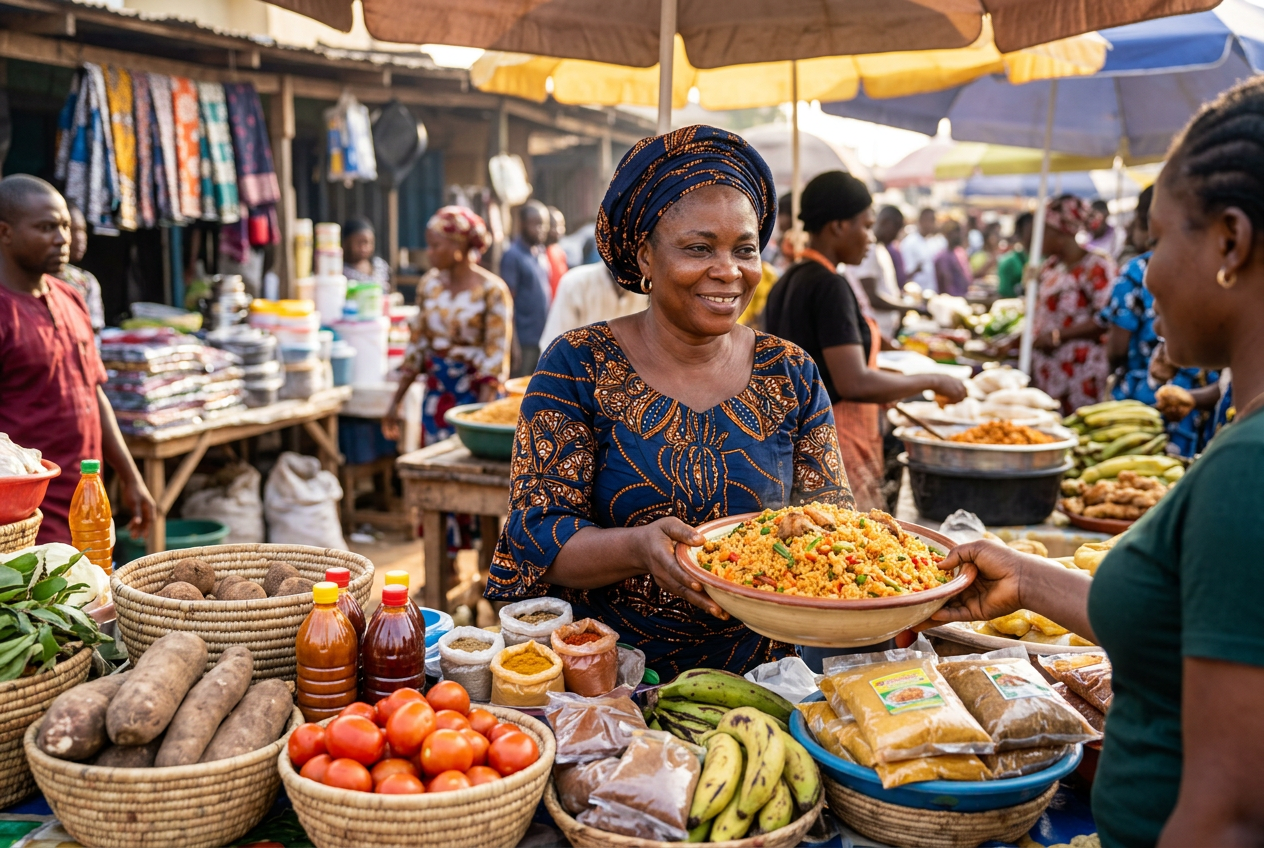
The indigenous wave. Yam first, domesticated in the Niger basin, alongside African rice, cowpea, egusi melon, okra, sorghum, millet, oil palm and a range of forest fruits including African star apple, bush mango and native pear. This is the bedrock. Everything structural about how Nigerians eat, the swallow and the soup, the palm oil, the fermented condiment, dates from here. West Africa’s yam belt, running through Côte d’Ivoire, Ghana, Togo, Benin, Nigeria and Cameroon, accounts for 97 per cent of African yam production.
The trans-Saharan wave. Wheat, certain spices, techniques of grilling and drying meat, and the trade wealth that supported them came south across the desert into the Hausa and Kanuri north. Suya and kilishi belong to this world, as does tuwo and the grain-forward northern table. The historical trade routes connecting northern Nigeria to the Sahel and North Africa shaped a preference for grain-based rather than yam-heavy meals, which is why a Kano lunch and an Owerri lunch look like they come from different countries.
The Columbian wave. This is the one that rewrote everything. From the sixteenth century onwards, Portuguese contact brought cassava, maize, tomatoes, chilli peppers, groundnut and sweet potato from the Americas. Consider what Nigerian food would be without tomato and scotch bonnet. There would be no stew as we understand it. No jollof. No ayamase. Our most recognisable flavour base is barely five hundred years old.
The modern wave. Oil money in the 1970s, mass rice importation, the rise of the buka and the fast-food chain, and then the currency shocks of the last decade that sent households back towards local substitutes. My mother switched from imported long grain to local Ofada and Abakaliki rice in 2024 purely on price, and then refused to switch back on taste. That story repeated itself in several million kitchens.
There is a fifth wave arriving now, and it is legal rather than culinary. One columnist in these pages has set out the case for registering our products of origin before somebody else does, noting that products including kuli kuli, a groundnut delicacy associated with Northern Nigeria, ogiri, a fermented condiment recognised in the South East, yaji or suya spice, and traditional palm wine whose character depends on local palm species and age-old tapping techniques, all possess characteristics capable of qualifying for protection as geographical indications, yet remain largely unprotected under Nigerian law.
Unprotected. Which means anyone, anywhere, can bottle yaji and call it whatever they like.
How Nigeria’s Home-Grown Foods Compare on Origin, Ingredient and Cost
| Food or product | Home region | Origin status | Core ingredient | Typical 2026 retail price | Travels abroad |
|---|---|---|---|---|---|
| Pounded yam | South West and Middle Belt | Created here, from a crop domesticated in the Niger basin | White Guinea yam | ₦3,700 to ₦3,900 per medium tuber | Widely |
| Egusi soup | South West and South East | Created here | Melon seed | ₦1,200 to ₦2,000 per cup of seed | Widely |
| Akara | Yorubaland | Created here, carried to Bahia as acarajé | Black-eyed peas | ₦100 to ₦300 per ball | Widely |
| Suya | Northern Nigeria | Created here, with yaji spice | Beef and groundnut blend | ₦1,500 to ₦3,000 per stick | Widely |
| Garri and eba | South East and South South | Nigerian processing of an American crop | Cassava | ₦808.96 per kilogram in April 2026 | Widely |
| Jollof rice | Nationwide | Adopted from Senegambia, then remade | Long grain parboiled rice | ₦29,578 per family pot in June 2026 | Very widely |
| Moin moin | South West | Created here | Black-eyed peas | ₦300 to ₦800 per wrap | Moderately |
| Kuli kuli | Northern Nigeria | Created here | Groundnut | ₦200 to ₦500 per pack | Limited |
| Iru and ogiri | South West and South East | Created here | Fermented locust bean or melon seed | ₦200 to ₦600 per portion | Limited |
| Abacha | South East | Created here | Dried shredded cassava | ₦800 to ₦2,000 per plate | Limited |
What the table shows, once you read down the origin column, is that the dishes we invented outright are mostly the ones that struggle to travel, while the one dish we adopted travels furthest. Garri and jollof prices are drawn from official and published series; the rest are market ranges I gathered across Lagos, Enugu and Kaduna in the second quarter of 2026 and should be read as indicative rather than official.
What Are 20 Goods Made in Nigeria, Inside the Kitchen and Beyond It?
People ask this question expecting a list of factories. The honest list mixes farm, factory and craft, because that is what the economy actually looks like.
Twenty goods made in Nigeria, then:
- Cocoa beans, butter and paste
- Urea and NPK fertiliser
- Raw and shelled cashew nuts
- Sesame seeds
- Shea butter
- Cement
- Refined petroleum products and petrochemical feedstocks
- Garri, cassava flour and industrial starch
- Palm oil and palm kernel oil
- Ginger, dried and fresh
- Gum arabic
- Leather and finished leather goods
- Aso-oke, Ankara and adire textiles
- Local parboiled rice
- Soap and personal care products
- Beer, malt drinks and bottled water
- Cocoa-based confectionery and biscuits
- Steel rods and construction materials
- Yaji, suya spice blends and packaged seasoning
- Nollywood film, which is a manufactured good in every sense that counts
Notice how many of those are food. Notice also how many leave the country raw. Cashew is the sharpest illustration: the overwhelming majority of Nigerian cashew is exported unshelled, processed in India or Vietnam, and re-exported at several times the value.
That is the whole problem in one nut.
I once visited a shea processing outfit outside Minna where the women could tell you, to the gram, how much butter a sack of nuts would yield, and could not tell you what a jar of their butter retailed for in a London chemist. The gap between those two pieces of knowledge is where the money sits.
So here is the practical part, aimed at anyone who wants to move from reading about Nigerian food to actually cooking and buying it well.
- Start with the starch and buy it whole rather than pre-milled, because a tuber of yam at ₦3,700 will out-yield and out-taste the equivalent spend on packaged yam flour almost every time, and you control the texture.
- Buy egusi as whole melon seed rather than ground, keep it in an airtight jar, and mill only what you need for the week, since ground seed turns rancid within about a month in Nigerian humidity.
- Source your iru and ogiri from a market trader you can return to rather than a supermarket shelf, ask when the batch was fermented, and refrigerate in a sealed container where it will hold for roughly eight weeks.
- Build your own yaji tin from roasted groundnut, ground dried pepper, ginger, garlic powder, onion powder and a little salt, in a rough ratio of four parts groundnut to two parts pepper to one part everything else, then taste and adjust.
- Treat palm oil as a flavouring ingredient with a purpose rather than a default frying medium, bleach it only when a recipe such as ofada ayamase genuinely calls for it, and buy from a producer who can tell you the milling date.
- Shop by mudu, derica and paint bucket rather than by supermarket pack, since a derica of rice runs to roughly 0.4 kilograms and a paint bucket of garri around four kilograms, and pricing by these units is consistently cheaper than pre-weighed retail.
- Cook one heritage dish a week that is not jollof, write down what you changed and why, and within a year you will have a household record of the kind this country has almost none of.
On presentation, because how food is served shapes how seriously it is taken. Dark earthenware flatters the deep red of an obe ata in a way that white porcelain flattens completely. Moin moin steamed in ewe eran leaves picks up a green edge and a faint bitterness that a plastic mould cannot give you, and it looks considerably better on the plate. Suya wrapped in paper and eaten standing up is not a compromise, it is the correct format, and plating it on a board with microgreens is a small betrayal. Serve swallow slightly smaller than instinct suggests and let people ask for more; a modest mound beside a generous soup reads as confidence, a mountain reads as filler.
Colour contrast is the easiest gain available. A plate of amala, ewedu and gbegiri is three shades of brown and green that photograph poorly and eat beautifully, so add the fried pepper stew and a slice of boiled egg and the whole thing lifts.
Final Thoughts on What Food Nigeria Created and What to Do About It
If you take one idea from all of this, make it the distinction between invention, adaptation and cultivation, because holding those three apart is what turns a pub argument into an actual position.
Nigeria invented pounded yam, egusi, akara, suya, moin moin, ogbono, banga, abacha, kuli kuli and the fermented condiments that give our soups their depth. Nigeria adapted jollof rice from Senegambia and made something distinct enough to defend on its own terms. Nigeria cultivates cassava, yam, cocoa, cashew and sesame at a scale that leads the world while capturing a fraction of the value, which is the part that should keep policymakers awake.
The practical steps follow from that. Buy whole rather than processed where you can. Learn the market units. Support the small producers who can tell you their supply chain. And if you have influence anywhere near trade policy, push for geographical indication protection, because kuli kuli and yaji will be registered by somebody eventually and it may as well be us.
My grandmother was right about the yam. Knowing where a thing came from is not nostalgia. It is the precondition for growing more of it.
- Separate invention from adaptation before you argue: Nigeria created egusi, akara, suya and pounded yam outright, and remade jollof rice into something genuinely its own.
- Shift your buying towards whole ingredients and market units, since a tuber, a cup of whole melon seed and a paint bucket of garri consistently beat packaged equivalents on both price and quality.
- Treat geographical indication protection as the live commercial issue it is, because yaji, ogiri, kuli kuli and traditional palm wine currently sit unprotected under Nigerian law.
Related Articles
If the origin question has left you wanting the lived texture rather than the archaeology, I spent a good stretch of last year sitting with elderly cooks in Osun State for a piece on how cuisine actually functions as a carrier of identity across our ethnic groups, which gets at why the same dish means different things in different households. And for the ceremonial side, which this article has barely touched, my examination of why wedding food and weekday food obey entirely different rules covers the occasion logic that governs what appears on a Nigerian table and when.
Key Takeaways
- The foods Nigeria genuinely created rest on indigenous crops and techniques: yam preparations, egusi, akara, moin moin, suya, ogbono, banga, abacha, kuli kuli and the fermented condiments iru and ogiri.
- Jollof rice originated in the Senegambian Wolof empire around the fourteenth century, but party jollof, with its firewood smoke and catch at the bottom of the pot, is a Nigerian creation in its own right.
- Nigeria leads the world in cassava and yam output and exported 281 non-oil products in 2025, yet ships most of that value raw, which is the gap worth closing.
Frequently Asked Questions About What Food Nigeria Created
What food did Nigeria create?
Nigeria created pounded yam and the wider family of yam dishes, egusi soup, akara, moin moin, suya with its yaji spice, ogbono soup, banga soup, abacha, kuli kuli, ofada rice and the fermented condiments iru and ogiri. Each of these rests on a crop indigenous to the region or on a preparation method with no clear parallel elsewhere.
Is jollof rice originally Nigerian?
No, jollof rice traces to the Wolof or Jolof empire of the Senegambian region, where it developed from the rice and fish dish thiéboudienne around the fourteenth century. What Nigeria created is party jollof, a firewood-cooked, smoke-finished version distinct enough to stand as its own dish.
What is Nigeria’s famous food?
Jollof rice is the most internationally recognised Nigerian dish, followed by suya, egusi soup served with pounded yam or eba, pepper soup, moin moin, akara, puff puff and chin chin. Those eight travel abroad most reliably because they have been documented and adapted in forms outsiders can reproduce.
What is the history of Nigerian food?
Nigerian food developed in four waves: an indigenous base of yam, African rice, cowpea, egusi and oil palm; a trans-Saharan layer bringing wheat, spices and grilled meat traditions to the north; a Columbian exchange layer that introduced cassava, maize, tomato, chilli and groundnut from the sixteenth century; and a modern layer shaped by oil wealth, rice importation and recent currency pressure. The tomato and scotch bonnet base we treat as ancient is barely five hundred years old.
What are 20 goods made in Nigeria?
Twenty goods made in Nigeria include cocoa products, urea fertiliser, cashew nuts, sesame seeds, shea butter, cement, refined petroleum products, garri and cassava starch, palm oil, ginger, gum arabic, leather goods, aso-oke and adire textiles, local parboiled rice, soap, beverages, confectionery, steel, packaged suya spice and Nollywood film. A large share of the agricultural items leave the country raw and are processed elsewhere.
Did Nigeria invent egusi soup?
Yes, egusi soup is a Nigerian creation built on melon seed, a crop indigenous to the region and used as a thickener in a way that has no close equivalent outside West and Central Africa. It is now eaten across Nigeria and much of Central Africa, with regional variations in the vegetables and proteins used.
Where did akara come from?
Akara originated in Yorubaland, in south-western Nigeria and neighbouring parts of Benin and Togo, and is made from peeled black-eyed peas beaten to aerate and deep fried. Enslaved Yoruba people carried it to Brazil, where it became acarajé and was listed as a federal immaterial heritage asset in 2004.
Is suya a Nigerian creation?
Yes, suya is widely held to have originated among the Hausa people of northern Nigeria, built around thin slices of beef roasted over charcoal and coated in yaji, a dry blend of ground groundnut and red pepper. The spice blend is the defining element and varies noticeably by region and by vendor.
Is cassava native to Nigeria?
No, cassava is native to South America and reached southern Nigeria through Portuguese contact in the sixteenth century. What Nigeria created is the processing tradition around it, producing garri, fufu, abacha, tapioca and industrial starch at a scale that makes the country the world’s largest cassava producer.
What is Nigeria’s national dish?
Nigeria has no legally designated national dish, though jollof rice is the closest thing in practice because it crosses every ethnic and regional boundary. Egusi soup with pounded yam runs a close second and is often argued to be the more authentically Nigerian choice.
How much does it cost to cook a pot of jollof rice in Nigeria?
A pot of jollof rice for a family of five averaged ₦29,578 in June 2026, up 14.6 per cent from ₦25,798 in July 2025 on the rebased SBM Jollof Index. The first quarter of 2026 saw a peak of ₦30,435, driven by fuel price shocks that pushed petrol above ₦1,300 per litre.
Which Nigerian foods are protected as geographical indications?
None of them currently hold formal geographical indication protection under Nigerian law, despite clear candidates including kuli kuli, ogiri, yaji or suya spice, and traditional palm wine. Each has characteristics tied to a specific place and method that would qualify for protection in most jurisdictions that operate such a system.

