

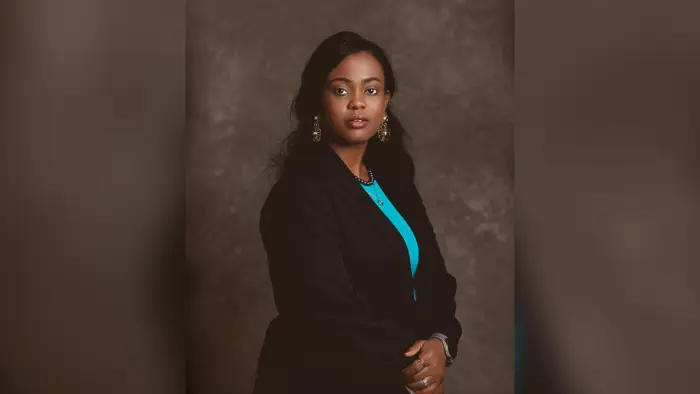
Olukemi Ibikunle is a Nigerian Correctional Officer, Engineering Geologist and Project Management Professional whose work in the Democratic Republic of the Congo is redefining the role of correctional infrastructure in peacebuilding, security and rehabilitation. With over 15 years of experience in corrections, Ibikunle currently serves with the United Nations Organisation Stabilisation Mission in the Democratic Republic of the Congo (MONUSCO).
Her work spans Kinshasa, Bukavu, Kabare and Beni, where she has led projects aimed at strengthening prison security while improving the welfare and rehabilitation prospects of detainees. She supported the development of a national prison blueprint, leading the construction of a high-security prison block in Kabare, and managing the reconstruction of Beni Prison’s perimeter wall. She has also championed green corrections initiatives, including biogas, solar energy, food security and gardening projects that equip prisoners with practical skills.
In 2025, Ibikunle received the United Nations Trailblazer Award for Women Justice and Corrections Officers, recognising her exceptional contribution to corrections and peacebuilding.
In this interview, she speaks on her innovative leadership and a commitment to humane detention for sustainable peace.
You were named the 2025 United Nations Trailblazer Award recipient for Women Justice and Corrections Officers. What did that recognition mean to you personally?
The recognition is a source of satisfaction and motivation. Satisfied that the work behind the scenes does not go unnoticed and that more people can contribute to the work due to better awareness. I am happy about the light that the award has shed on Corrections work, especially demonstrating the impact of Corrections and Justice on national security and sustainable peace. The recognition is also a source of motivation to do more, keeping in mind that the participation of women in Peacekeeping is essential and that gender is not a barrier to career growth.
You have described your belief that “peace begins behind prison walls.” What does that mean in practical terms?
Peace begins behind the wall means that no member of society is left behind, irrespective of their past choices or lifestyle. The way we treat people behind the wall determines the way they turn out in society after their release. People who enjoy humane treatment behind the wall are generally favourably disposed towards rehabilitation programmes, and they in turn contribute to national economic growth after release. Furthermore, the Sustainable Development Goal 16 (SDG 16) talks about creating peaceful, inclusive societies and equal access to Justice for all. This can only be achieved when we treat everyone equally and fairly in the area of dispensation of justice.

How do you balance the need for security with the need to ensure humane conditions for people in detention?
This is a very good question; security considerations always seem to conflict with humane detention conditions, but I say categorically that this is a myth. With my years of experience in prison, it is evident that secured prisons can be humane. Finding innovative ways to create the needed balance is what makes a difference between mediocrity and excellence in prison management. A prison dormitory can have large enough windows for natural light and aeration while the windows are reinforced with metal bars for security purposes. A secure prison can have green areas for recreational activities and gardening activities to support detainees’ physical and mental health. Prison security is not only about physical infrastructure but also about security procedures and dynamic security, where mutual trust is established between the detainees and the prison administration. This is why I continue to advocate for the needed balance between the concept of security and humane prison conditions.
What inspired your green corrections initiatives and what measurable difference have these initiatives made to prisoners, prison staff and surrounding communities?
The Green Corrections Initiative was inspired by difficulties. In a conflict/post conflict setting where resources are scarce, and the prison infrastructure is not a top priority of the government, it became imperative to look for ways of creating a humane environment despite the infrastructural deficit. With power shortages from the national grid, solar panel installations became a viable option for lighting up the prison dormitories and offices and lighting up the premises to support security patrols at night. Rising cases of malnutrition in the prison gave rise to gardening activities where detainees can produce vegetables to fortify their daily ration. This initiative impacted the detainees directly, as their nutrition improves through the products of gardening. The physical activity also gives them hope for a better tomorrow as they develop a sense of meaning in life, a reason to be alive for another day. Taking in fresh air in the garden frees them from the pain of confinement in the cells/dormitories. They also learn useful skills for economic autonomy after release. The prison staff benefit from improved working conditions through renewable energy from solar installations; prison management is easier with healthy and happy detainees having little or no interpersonal conflicts. The community benefits from crime prevention, reduced recidivism, and meaningful contribution of ex-offenders to national economic growth. Families also receive their relatives back into the community in good mental and physical health, facilitating family reunification.
The biogas project at Uvira Prison transforms human waste into clean cooking energy while reducing deforestation and giving prisoners practical skills. How important is it to you that correctional facilities become places where people acquire skills and a sense of purpose rather than simply serve time?
Having a sense of purpose in detention ties back to dynamic security and peacebuilding behind the wall. The Biogas project is another Green prison initiative with a holistic approach; consideration for the environment, the prison staff and detainees. The environment is protected by reduced deforestation when biogas replaces firewood in the kitchen. Food can be prepared in a clean environment where the kitchen staff and detainees working with them do not face the risk of long-term medical conditions caused by prolonged exposure to smoke from firewood. Correctional facilities should be places of skill acquisition because that is the main purpose of Corrections – to correct, to improve, to rehabilitate, to prepare for social reintegration after incarceration. We should be reminded that an incarcerated person loses his freedom of movement and has to follow laid-down rules and regulations. This in itself is enough punishment, and no other degrading treatment should be added. Instead of people just ‘serving term’, we should maximize the taxpayer’s money being used to fund Correctional facilities by turning the detainees into useful citizens who understand privileges and responsibilities in society. These priorities reflect ongoing calls for humane, innovation-driven correctional practices.
You have spent more than 15 years in corrections and have worked in some of the most challenging environments in the DRC. What have these experiences taught you about women’s capacity to lead in security, corrections, engineering and peacekeeping fields traditionally dominated by men?
Having spent more than five years in peacekeeping, in addition to my experience in the Nigerian Correctional facilities, I have experienced firsthand the resilience and the capacity of women to lead in difficult situations. Women are natural nurturers; we have the instinct to protect and to make things better. We are wired to look for ways of improving something even when the chances are bleak. The saying that when there’s a will, there’s a way is the driving force of women who have flourished in male-dominated industries. I have been in situations where everyone accepted the status quo because changing things was perceived to be too difficult or unattainable, but I had to think through a solution and attempted the ‘impossible’. This is another advantage of having a science background: as I work in humanitarian settings, I am analytical in my thinking; I can play out different scenarios of what-ifs, which gives me the confidence to attempt to change things. If we never try, we never know what is possible. As a Geologist, I know that you don’t break a rock with the first hammer; you keep at it until something breaks.
As a Nigerian woman working within a complex UN peacekeeping environment, have you encountered barriers or stereotypes because of your gender, and how have those experiences shaped the way you lead and deliver projects?
Gender stereotypes exist everywhere in the world. Passively or actively, messages are passed to women about how they do not belong in certain fields or rooms of decision-making. The United Nations is structured to give an equal playing field to all genders, so I don’t have issues with colleagues in that regard; everyone is seen as capable and able to deliver in his/her area of expertise. However, the larger community sometimes has difficulty accepting this approach. When I lead projects, I interact with different stakeholders, including government authorities, contractors, local community leaders and civil society groups. This is where competence becomes a vital tool; people who respond to you initially with gender bias begin to warm up to and even recommend you to others when they experience your competence. My message to women is to develop competence and invest in continuous growth because competence has no gender!
Beyond the physical infrastructure, what do you believe must change within correctional systems across Africa for prisons to genuinely contribute to rehabilitation and social cohesion?
I talked about dynamic security earlier; this should become an integral part of our prison systems in Africa. Treat detainees like human beings that they are and build trust. Beneath every ‘hardened criminal’ is a human being who just wants to be loved and understood. Detainees are humans first; let us treat them as such in every aspect of prison management: respect their rights, speak to them with respect, reason with them instead of just dishing out orders. There’s a need for balance in this approach because the detainee still has to know who the ‘boss’ in the facilities is; discipline must be instilled, and respect for authority is non-negotiable. We also need to invest more in alternatives to imprisonment; let’s explore restorative justice, parole, community service and so on, to ensure that only people who really need to be behind bars are locked up. This will reduce overpopulation of our facilities and increase the impact of our rehabilitation efforts. A change of mindset is needed, so we do not see incarceration as the end of life but rather as a rehab center to salvage our citizens and have their contribution to the economic growth of the nation.
Your journey from engineering geology in Nigeria to leading corrections infrastructure projects under a UN peacekeeping mission, what legacy do you hope to leave?
I would like to be remembered for excellence and resilience. I want to leave a legacy of building prison facilities centered around humanity, a place for rehabilitation and not for punishment. I want to be remembered for getting results in the face of difficult situations and as one who played her part well in the grand scheme of peacebuilding and sustainable development.
