
 Get Guardian on Google
Welcome, and do pull up a chair. What is the African food stereotype? I have been asked some version of that question at a buka in Surulere, in a draughty office kitchen in London and once, memorably, by a customs officer in Frankfurt who wanted to know why my suitcase smelt of crayfish. This piece is the conclusion of months of research into how outsiders picture the cooking traditions of a continent with 54 countries, and years of experience writing about Nigerian food from the market stalls upwards, so I promise you something better than a one-line answer.
The short version is uncomfortable. Ask a room of people who have never set foot on the continent what “African food” means, and you tend to get the same four pictures: a hungry child, a bowl of something beige, a pot of something red and dangerous, and (if the room is feeling brave) a nervous joke about bushmeat.
None of those pictures is entirely invented, which is exactly why they stick.
But each one is a crop, rather like a photograph trimmed so tightly that you cannot see the kitchen, the market or the grandmother standing just out of shot with a wooden spoon and an opinion. My job in this article is to widen the frame. We will look at what “African cuisine” actually means, what the continent’s food is genuinely known for, a straight answer to the stereotype question itself, the vexed matter of which African country has the best food (I am Nigerian, so adjust for bias accordingly), and finally what our own proverbs reveal about how seriously we take a meal.
Shall we?
What Does “African Cuisine” Actually Mean?
Here is the whole problem in one shop sign. Somewhere in south London, Houston or Dubai there is a restaurant with “African Food Served Here” painted across the window, and inside you will find jollof rice, fried plantain, egusi, perhaps pepper soup and a fridge full of malt drinks.

That is not African food. That is a Nigerian menu with a borrowed passport.
Nobody walks into a Thai restaurant and says they fancy some “Asian food” expecting sushi, biryani and dim sum on one plate. Nobody in Lagos orders “European food” and expects pierogi, paella and a full English to arrive together. Yet the word African gets used as though a cook in Fez, a cook in Addis Ababa and a cook in Onitsha all share one pantry. They do not, and the gap between them is wider than most people imagine.
Consider what actually sits on tables across the continent. In Morocco and Algeria you find slow tagines, couscous steamed over broth and pastries soaked in honey and orange-blossom water. In Ethiopia, the sour, spongy teff flatbread called injera doubles as plate and cutlery, carrying berbere-spiced stews and shiro. Kenyans eat ugali with sukuma wiki and nyama choma, South Africans gather round the braai with chakalaka and pap, Senegalese families share thieboudienne (the rice and fish dish from which jollof descends), and Ghanaians will defend kenkey with fried fish and shito to the last breath. Then there is us.
Nigeria alone carries more than 250 ethnic groups, and almost every one of them has a soup it considers the correct soup. Even the Federal Ministry of Art, Culture and the Creative Economy makes this point on its own page about Nigerian gastronomy, where it describes our culinary practice as being as varied as our ethnic groups and lists dishes from ugba, edikaikon and nkwobi to kilishi, gbegiri, fura de nunu and ofe oha. That is one country, and the list is far from complete.
I learnt this the humbling way during my youth service year. I had grown up between Lagos and Ibadan believing I knew Nigerian food, then I was posted north and met masa sold warm at dawn, miyan kuka with its grey-green baobab leaf, and a kunu so cold and gingery it felt like a minor miracle in March. Nobody there called any of it African food. They called it breakfast.
So what does “African cuisine” mean, properly understood? It is a geographic umbrella, useful in a library catalogue or a university course, covering dozens of separate national and regional food cultures that share some ingredients and techniques but are no more one cuisine than Europe is one cuisine. Used carelessly, it becomes the first and most stubborn layer of the stereotype.
Interestingly, Nigerians abroad tend to know this in their stomachs even when the signage says otherwise. In a lively dispatch from Kigali by Dolapo Aina, the writer describes Nigerians arriving in Rwanda and asking, almost before they have unpacked, where they can find Nigerian food, then crossing the city for a plate of amala and gbegiri if that is what it takes. Nobody in that story is searching for “African food.” They want the taste of home, and home has a specific address.
The government has noticed the commercial value of that specificity. When the National Institute for Hospitality and Tourism launched the Oríkì cultural and culinary showcase at Eagle Square in Abuja in November 2025, the event was built around regional food pavilions rather than a single “African” buffet, and the Minister of Art, Culture, Tourism and Creative Economy, Hannatu Musa Musawa, described food as a tool for cultural diplomacy. Whether the follow-through matches the speeches is another matter (it usually is), but the instinct is right. You sell a cuisine by naming it.
What Is African Food Really Known For?
Strip away the caricature and the continent’s cooking is known for a handful of genuine strengths, and they are worth naming precisely.
First, starch done with real skill. Cassava, yam, plantain, cocoyam, maize, millet, sorghum, teff and rice are pounded, fermented, grated, dried and stirred into an astonishing range of textures. The outsider sees “just starch,” rather like someone dismissing bread without knowing the difference between a baguette and a sourdough. The insider knows that a good wrap of pounded yam has no lumps, that eba should be stirred hot and fast, and that amala from the wrong flour is a family scandal.
Second, soups and stews built in layers. Egusi thickened with ground melon seed, ogbono with its famous draw, efo riro heavy with leaves, Ethiopian wats simmered for hours and Senegalese mafé enriched with groundnut all depend on patience and sequence rather than a single dominant flavour.
Third, fermentation. Iru (locust bean), ogiri (fermented oil seed), dawadawa in the north and the many fermented cassava products give West African cooking a deep savoury note that chefs in Copenhagen now pay good money to imitate.
Fourth, the communal pot. Most of our dishes are built to be shared, which is why a Nigerian host considers a half-empty serving bowl a personal failure.
And Nigeria sits at the heart of the ingredient story. We grow more cassava than any other country on earth, well over 60 million tonnes a year by Food and Agriculture Organization figures, together with roughly two-thirds of the world’s yams and more cowpeas (the brown and black-eyed beans behind akara and moin moin) than anyone else. I explored where many of these dishes originate in my piece on what food Nigeria created, and the short answer is that a great deal of what the world now calls “African food” began in soil a few hours’ drive from wherever you are reading this.
Now for the hard part, because a fair article cannot skip it.
Hunger is real. The famine image did not come from nowhere: the Ethiopian famine of the mid-1980s, broadcast to the world through charity appeals and the 1985 Live Aid concerts, fixed a picture of the continent in Western minds that has never fully faded. Here at home, the latest Cadre Harmonisé analysis put roughly 36 million Nigerians in crisis-level food insecurity or worse during the June to August 2026 lean season, the worst figure in about a decade, concentrated in the conflict-hit north-east. Food inflation stood at 19.59 per cent in September 2026, according to the National Bureau of Statistics. Those numbers are not a stereotype. They are a policy failure, driven by insecurity on farmland, climate shocks and prices, and I wrote about the wider paradox in why Africa is rich but poor.
What the stereotype gets wrong is the cause. Hunger in Borno is not evidence that Nigerians cannot cook or do not eat well; it is evidence that farmers cannot reach their fields. Treating poverty as a feature of the cuisine is rather like blaming a fire on the furniture.
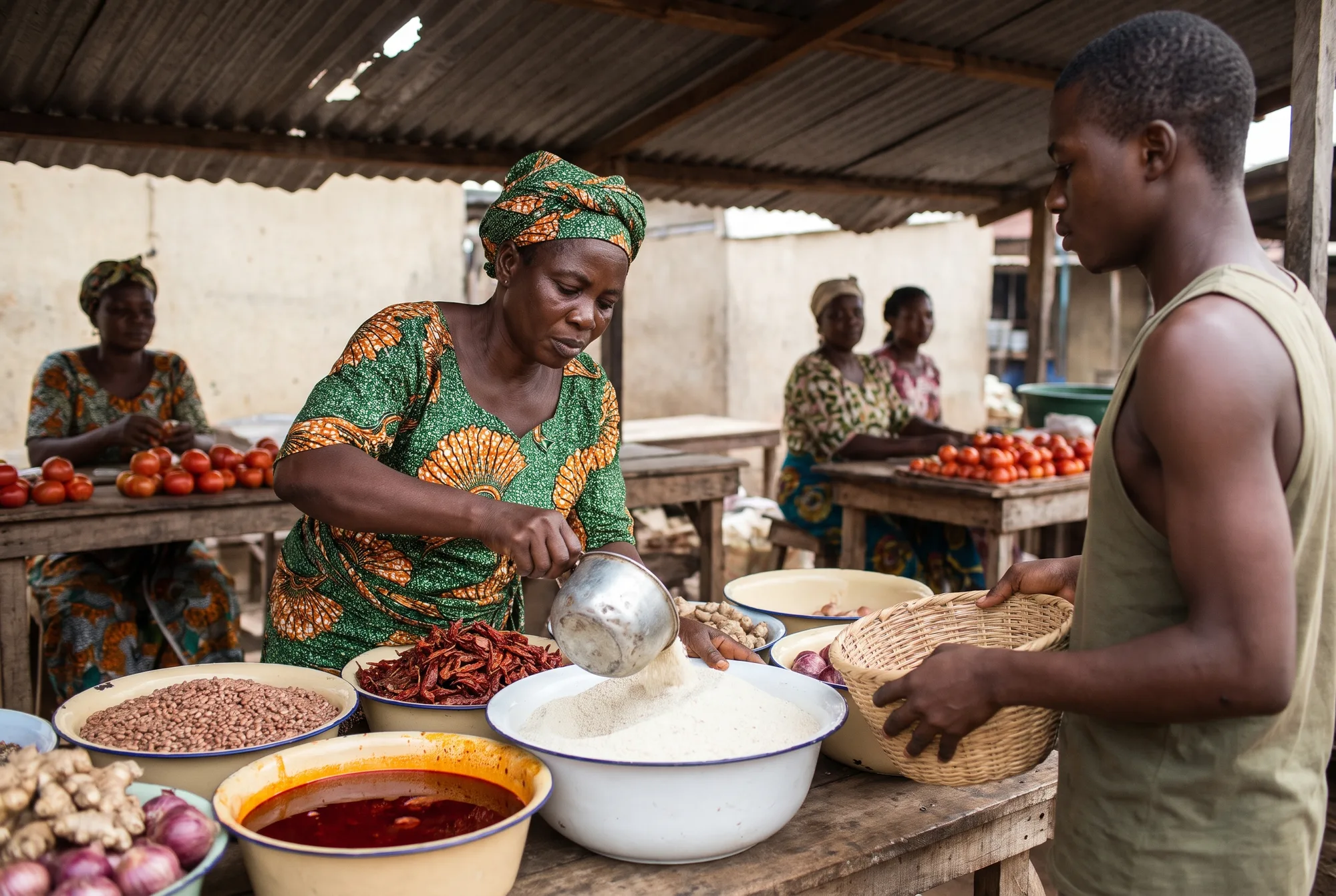
Prices tell the everyday side of that story. Every month the bureau compiles the Selected Food Price Watch, which records average prices for staples gathered across all 774 local government areas. When I walked through Bodija market in Ibadan in the middle of this year, the traders’ quotes for beans and garri sat within a whisker of the official averages, while tomatoes swung wildly depending on whether a lorry from the north had arrived that morning. If you want to understand what Nigerians really eat, start with that list rather than a charity poster.
The Staples Behind the Stereotype: Prices and Plain Facts (April 2026)
| Staple | What the stereotype says | What it actually brings to the plate | NBS average price, April 2026 | Where you will find it |
|---|---|---|---|---|
| Brown beans (1kg) | “Poor people’s food” | Roughly 23g of protein per 100g dry weight, plus fibre and iron | ₦1,338.93 | Akara, moin moin, ewa agoyin, gbegiri |
| White garri (1kg) | “Just starch” | Fermented, roasted cassava; a cheap, filling carbohydrate that keeps for months | ₦808.96 | Eba, soaked garri with groundnut, garri foto |
| Palm oil (1 litre) | “Greasy and unhealthy” | Unrefined red palm oil is one of the richest plant sources of provitamin A | ₦2,396.32 | Banga, ofe owerri, ayamase, ewa agoyin sauce |
| Tomatoes (1kg) | “Everything is just pepper” | The sweet, sharp base of stews, balanced with onion and pepper | ₦1,177.92 | Jollof, obe ata, fish stew |
| Onions (1kg) | “Plain and basic” | Sweetness and depth in nearly every soup and stew | ₦1,164.39 | Pepper sauce, suya garnish, stews |
| Fresh ginger (1kg) | “Primitive spice cupboard” | Nigeria is one of the world’s largest ginger producers | ₦5,581.82 | Pepper soup, zobo, kunu, suya spice |
The table’s conclusion is simple: the staples that the stereotype mocks as poverty food are cheap, nutritious and built into dishes of real complexity. Price pressure is a genuine problem, but the cupboard itself is anything but primitive.
So, What Is the African Food Stereotype? A Straight Answer
Let me answer the question directly, because you came here for an answer rather than a lecture. The African food stereotype is the widespread assumption, mostly held outside the continent but sometimes repeated within it, that Africa has one shared cuisine defined by hunger, plain starch, overpowering pepper, oily stews and strange or unsafe meat, and that this cuisine is rustic survival food rather than a serious culinary tradition. In practice it shows up as a bundle of related clichés:
- The famine picture: Africans are imagined as people who barely eat, shaped by decades of charity imagery.
- One continent, one menu: jollof, fufu and “spicy stew” stand in for 54 countries.
- Stodge and pepper: the food is assumed to be heavy starch drowned in chilli, with no subtlety.
- Strange meat: bushmeat, snails and insects are treated as the everyday diet rather than regional or occasional foods.
- Dirty or unsafe: street food and open markets are assumed to be unhygienic by default.
- Oily and unhealthy: palm oil and frying are blamed for everything.
- Not “real” cuisine: African food is seen as home cooking that cannot sit in fine dining.
Every item on that list contains a grain of something true, inflated until it hides the rest.
Take meat. Yes, some Nigerians eat grasscutter, snails and, in a few places, dog. But the everyday proteins in most Nigerian homes are chicken, goat, beef, fish and the much-loved ponmo, as I set out in detail in my guide to what animals Nigerians eat. The roadside antelope hanging by the Lagos to Ibadan expressway is memorable precisely because it is unusual.
Or take hygiene. Food safety in open markets is a genuine concern, and I would never tell you to ignore it. But the woman frying akara at dawn in Mushin has usually been doing it for twenty years, with a reputation in her street that no Western food-hygiene sticker could match. Would she pass every inspection? Probably not. Would many takeaways in Europe? Also probably not.
Where does all this come from? The roots run through colonial travel writing, missionary accounts, the famine broadcasts of the 1980s and decades of documentaries that filmed the village and skipped the city. The Kenyan writer Binyavanga Wainaina skewered the habit in his satirical essay “How to Write About Africa,” advising writers to show starving people and never to mention ordinary meals. That essay is now more than twenty years old, and the habit is still with us. (The deeper history of those stereotypes deserves its own article, and it will get one.)
There is also an uncomfortable home-grown layer. Some of us reinforce the caricature ourselves, piling on pepper and palm oil as proof of authenticity, or labelling our own restaurants “African” because it feels broader. The stereotypes people hold about Nigerians more generally, which I examined in this piece on the stereotypes about Nigerians, often travel the same way: half imposed, half absorbed.
The honest summary? The stereotype is less a lie than a lazy edit.
Which African Country Has the Best Food, and Where Does Nigeria Stand?
Ah. The question that has ended friendships.
If you want a data-led answer, the most quoted source is TasteAtlas, the online food guide that ranks cuisines from user ratings. In its 2024/25 ratings, Algeria came top in Africa with a score of 4.31, and Nigeria placed seventh on the continent at 3.88. In its earlier list of Africa’s best dishes, Algerian rechta took first place while jollof rice, credited to Nigeria, came ninth. North African cuisines tend to do well on these lists, partly because they are well documented in French and English and partly because their dishes photograph beautifully.
Should that settle it? Hardly.
Rankings built on online votes measure visibility as much as flavour. A different 2026 study by Chef’s Pencil measured cuisines by social media presence across Instagram, TikTok and Facebook, and as Musa Adekunle reported for Guardian Life, Nigerian food came twelfth in the world and first in Africa, ahead of French and Spanish cuisine on that measure. The report itself was careful to say this does not mean “best.” It does mean that the world is watching Nigerian kitchens more closely than ever.
Then there is the fine-dining argument, which the stereotype says we cannot win. Tell that to Ikoyi. Founded in London in 2017 by Lagos-born Iré Hassan-Odukale and chef Jeremy Chan, and named after the Lagos district where Hassan-Odukale was born, it has held two Michelin stars since 2022, was named Best Global Restaurant by Food and Wine in April 2026 and sits on the World’s 50 Best Restaurants list. Its menu has wandered far from its West African starting point over the years, but the spice-led thinking that built it came from our side of the map. Closer to home, chefs such as Michael Elégbèdé, who built his Lagos tasting-menu kitchen Ìtàn on exactly this idea, have spent years plating Nigerian ingredients for diners who once assumed our food was only for the pot.
And then there is the spectacle. In September 2025, Hilda Baci and her team cooked a single serving of Nigerian-style jollof weighing 8,780kg on Victoria Island, a record confirmed by Guinness World Records, as Azeez Kareem documented for Guardian Life. It is hard to sustain the “Africans have nothing to eat” picture when a Lagos chef is cooking rice by the tonne and feeding thousands of plates to a cheering crowd.
My verdict, for what it is worth? The best food in Africa is whichever cuisine you were raised on, eaten in the home of someone who loves you. If you push me for a country, I will say Nigeria for range, Ethiopia for depth of spice, Morocco for technique and Senegal for the dish that started the jollof family. Ghana gets the kenkey vote and nothing more (my Ghanaian friends will forgive me eventually).
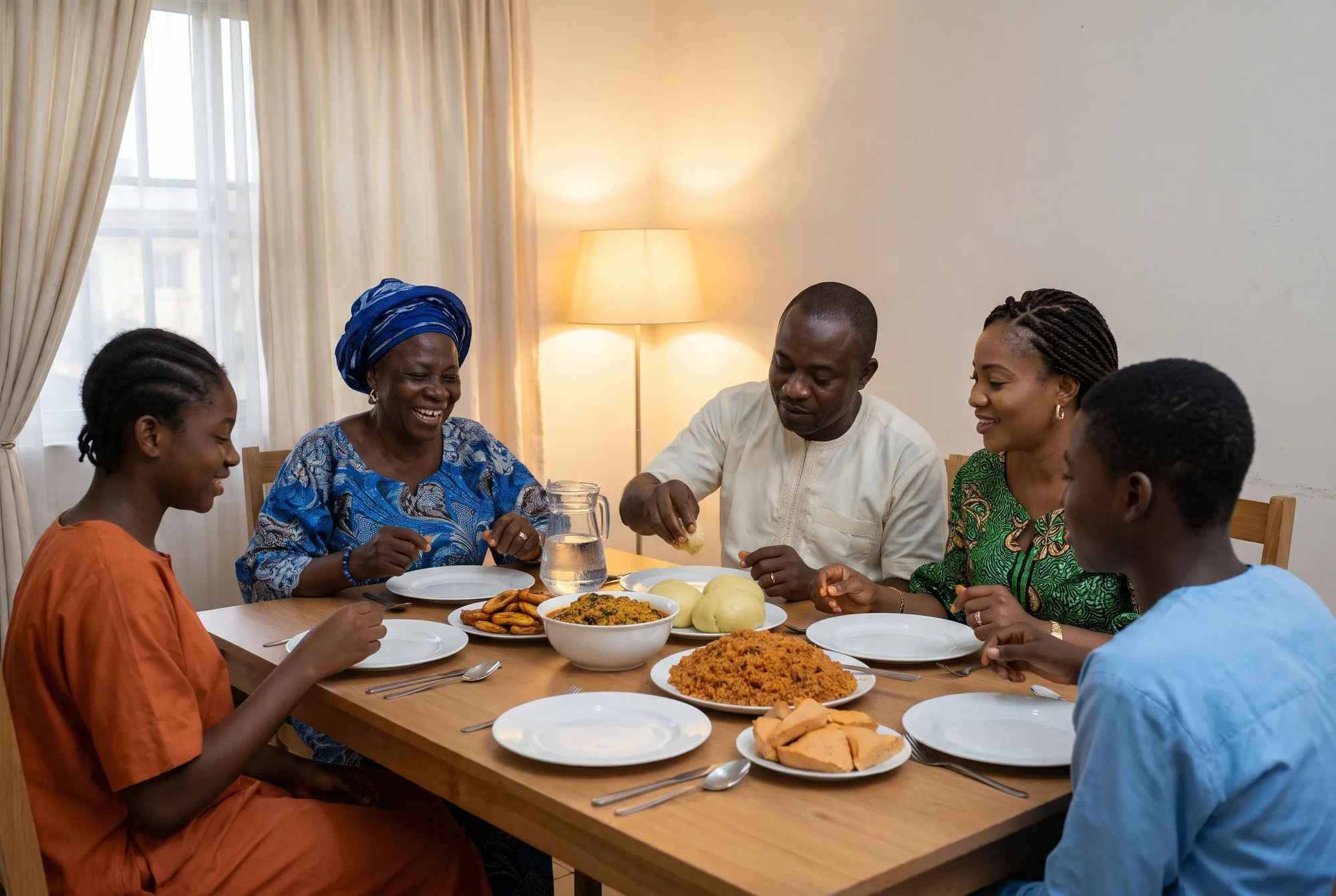
Rankings are one thing, though. A sceptical guest at your own table is another, and that is where stereotypes really fall. If you want to introduce a friend, colleague or in-law to Nigerian food in a way that breaks the caricature rather than confirming it, this is the approach I have refined over many years of feeding nervous first-timers:
- Plan a menu that shows range, not just the greatest hits. Pick one rice dish, one swallow with a soup, one bean dish and one street snack, such as jollof, eba with egusi, moin moin and suya, so your guest sees four different techniques rather than four versions of red rice.
- Control the pepper rather than abandoning it. For a “mild” pot, use about one ata rodo (scotch bonnet) for every two litres of stew, then serve ata dindin or yaji in a small bowl on the side so heat-lovers can add their own and nervous guests are never ambushed.
- Get the portions right. Allow about 150g of uncooked rice per adult, 80g to 100g of dry garri per person (it swells into a wrap roughly the size of a fist), and 250ml to 300ml of soup per guest, because overloading a first-timer’s plate turns curiosity into defeat.
- Budget honestly in naira. At mid-2026 Lagos prices, a meal for six built on the dishes above costs roughly ₦40,000 to ₦55,000, with protein the biggest swing; the NBS staples in the table above account for under ₦10,000 of that, which is itself a useful lesson about where the money goes.
- Plate it like you mean it, because our food suffers from bad photography as much as bad press. Use plain white or earthenware plates of around 26cm to 28cm, keep a 2cm to 3cm rim clear, serve soup in a separate small bowl beside the swallow, add a few leaves of fresh ugu or scent leaf for colour, and photograph by a window in mid-morning or late afternoon light, at a 45-degree angle for rice and directly overhead for soups.
- Teach the etiquette as part of the welcome. Offer a bowl of warm water and a small towel, show your guest how to pinch a morsel of swallow with the right hand and scoop the soup, and name every dish by its real name rather than inventing a translation like “melon seed stew.”
- Tell one short story per dish and finish cold. A single sentence on where a dish comes from does more than any lecture, and ending with zobo or kunu chilled to about 4°C to 6°C cools the palate and leaves a lasting impression, especially if you send leftovers home in a takeaway pack, which is simply good Nigerian manners.
I have watched a Scottish colleague arrive at my flat convinced she would “only manage the rice,” then ask for a second wrap of eba and the recipe for the egusi before she left. Stereotypes do not survive a well-hosted meal. They never have.
What Do African Sayings About Food Reveal About the Stereotype?
If you really want to understand how a culture thinks about food, do not read its menus. Read its proverbs.
African languages are crowded with sayings about eating, hunger, sharing and the pot, and they paint a picture almost exactly opposite to the stereotype. Rather than a continent of people grateful for any scrap, the proverbs describe cultures where food carries manners, philosophy and law.
The Yoruba have a saying that much talk does not fill the basket (ọ̀rọ̀ púpọ̀ kò kún agbọ̀n), a reminder that words are no substitute for work. Another Yoruba proverb holds that when hunger enters the stomach, no other matter can enter after it, which is a rather sophisticated observation about how deprivation crowds out everything else, including good judgement. Anyone who has tried to hold a serious family meeting before the food arrives will recognise the truth of it.
The Igbo saying that a child who washes his hands may eat with elders is famous well beyond Nigeria, partly because Chinua Achebe placed it in Things Fall Apart. It is a proverb about merit and social mobility, using the shared meal as the image of belonging. Achebe also gave us the line that proverbs are the palm-oil with which words are eaten, which may be the most Nigerian sentence ever written in English.
In Hausa there is a saying that many hands are the cure for a difficult soup (hannu da yawa maganin ƙazamar miya), meaning that a hard task becomes easy when everyone helps.
Further east, Swahili speakers say that little by little fills the measure (haba na haba hujaza kibaba), the kibaba being a small grain measure, and they warn that the palm-wine tapper who is praised too much begins to water down his wine. That second one should be pinned above every Nigerian restaurant that has just received a glowing review.
What do these sayings reveal? Three things, I think. Food in African cultures is social before it is nutritional, so eating alone is faintly suspicious and feeding guests is a duty of honour. Hunger is understood as something that distorts behaviour, not as a natural state. And the kitchen is a place of craft and discipline, where diluting the wine or rushing the soup is a moral failure as much as a culinary one. None of that fits the picture of a continent with no food culture worth naming.
If you want to see how these values play out in daily life, my earlier piece on the food culture in Nigeria traces how hospitality rules shape who eats first, what guests are offered and why refusing food can cause offence.
Final Thoughts on the African Food Stereotype
So, what is the African food stereotype? It is a single picture of famine, stodge, pepper and strange meat laid over 54 countries and thousands of dishes, built from old media images and kept alive by lazy menus on both sides of the ocean. The reality is a set of distinct national and regional cuisines, resting on ingredients that Nigeria grows in world-leading quantities, eaten by people who can face real hunger without lacking any culinary skill, and increasingly celebrated from Michelin-starred dining rooms in London to record-breaking pots in Lagos.
The stereotype will not disappear because one article says so. It fades one plate, one properly named dish and one honest conversation at a time, and every Nigerian with a kitchen and a phone camera is now part of that work. You have more influence over how our food is seen than any charity poster ever did.
A few things you can do this week:
- Next time a menu or a friend says “African food”, ask which country and which region it comes from, and encourage the answer to be specific.
- Cook one dish this month from a Nigerian region that is not your own, so your own picture of our food grows as wide as the one you want others to hold.
- When you post food online, write the dish’s real name and the place it comes from in the caption, so every share teaches rather than flattens.
Related Articles
If this has set you thinking about the wider assumptions people carry about us, my earlier piece on the stereotypes about Nigerians that refuse to die works through the scam, hustle and loudness clichés with the same mix of data and lived experience. And if the bushmeat question in this article caught your attention, what animals Nigerians actually eat sets out the real protein picture, from chicken, goat and ponmo to the regional meats that make the headlines.
Key Takeaways
- The African food stereotype squeezes 54 countries into one picture of hunger, starch and pepper, so always name the country and dish you mean.
- Hunger affects around 36 million Nigerians in the lean season, but it stems from conflict, climate and prices rather than any lack of cooking skill, and should be discussed that way.
- Nigerian food already holds global recognition through Ikoyi’s two Michelin stars, Hilda Baci’s 8,780kg jollof record and a top ranking in Africa for social media visibility, so host, plate and share it with confidence.
Frequently Asked Questions About the African Food Stereotype
What is the African food stereotype?
The African food stereotype is the habit of picturing one continent-wide cuisine of hunger, plain starch, fiery pepper, palm oil and strange meat, usually served in a single “African restaurant” with jollof and a couple of soups. It flattens 54 countries and thousands of regional dishes into a caricature that says more about old media images than about what Africans actually cook.
What are common stereotypes about Africa?
The most common stereotypes about Africa treat it as one country, picture it as permanently poor and hungry, and imagine it as rural, wild and cut off from modern life. Food stereotypes grow out of those bigger images, which is why famine photographs and jokes about jungle food tend to travel together.
What does African cuisine mean?
African cuisine is an umbrella term for the cooking of 54 countries, from Moroccan tagines and Ethiopian injera to Nigerian egusi and South African braai. It works as a geographic label in the same way Asian cuisine does, but it describes many separate food cultures rather than one shared menu.
What is African food known for?
African food is known for slow-cooked soups and stews, starchy staples such as fufu, ugali, injera and couscous, and bold seasoning built on chilli, ginger, onion and fermented condiments. It is also known for hospitality, because most dishes are designed to be shared from a common pot.
Which African country has the best food?
On TasteAtlas ratings for 2024/25, Algeria scored highest in Africa with 4.31, while Nigeria came seventh on the continent with 3.88. Rankings like these depend heavily on who votes, which is why Nigeria topped Africa for social media food visibility in a separate 2026 study.
What do you call African food?
Most Africans simply call their food by its country, region or dish name, such as Nigerian, Ghanaian or Ethiopian food, or egusi, kenkey and injera. The catch-all phrase African food is mostly a label used abroad, and many Nigerian cooks would rather see their dishes named properly.
What is known as the poor man’s meat in Nigeria?
Ponmo, the boiled and softened hide of cattle, is the food most Nigerians jokingly call poor man’s meat, and beans earn the same nickname for their high protein and low price. Both are eaten across every income group, so the nickname reflects cost rather than status.
Is African food unhealthy?
Traditional African diets are built largely on legumes, vegetables, tubers, grains and fish, which nutrition researchers generally regard as a sound foundation. Health problems come mostly from large portions, heavy frying and the spread of processed imported foods rather than from traditional dishes themselves.
Is all African food spicy?
No, heat levels vary enormously, from fiery Nigerian pepper soup and Ethiopian berbere stews to mild North African couscous and plain roasted plantain. Even in Nigeria, most cooks adjust the pepper to suit the household and serve extra chilli on the side for those who want it.
Do Nigerians really eat bushmeat?
Some Nigerians eat bushmeat such as grasscutter and antelope, mostly in rural areas and at roadside markets, but the everyday proteins in most homes are chicken, goat, beef and fish. The image of Africans living on wild animals is an exaggeration that ignores both modern diets and growing conservation rules.
Why is Nigerian food called African food abroad?
Many restaurants abroad use the word African because it sounds broader and more familiar to customers who cannot tell Nigerian, Ghanaian and Senegalese dishes apart. Nigerian chefs increasingly reject that habit, arguing that naming dishes by country and region sells them better and respects where they come from.
What are some famous African sayings about food?
Well-known examples include the Yoruba saying that much talk does not fill the basket, the Igbo proverb that a child who washes his hands may eat with elders, and the Swahili warning that a praised palm-wine tapper waters down his wine. Chinua Achebe summed up the tradition when he wrote that proverbs are the palm-oil with which words are eaten.