 Get Guardian on Google
Nigerian youths have been tasked to establish a countrywide movement to rescue the country from corruption, insecurity and poor governance, declaring that the responsibility for Nigeria’s renewal rests on citizens rather than government alone.
Rector and Chief Executive Officer of Danubius International University (DIU), Romania, Prof. Steve Michael, made the call while delivering the university’s seventh convocation lecture titled, ‘Vision to Reality: The Role of Faith and Excellence in Nation Building’.
He lamented that successive governments had failed to meet the expectations of Nigerians, citing persistent unemployment, poor healthcare, inadequate infrastructure, insecurity, unreliable electricity and an underfunded education system among the country’s major challenges..
The don said the country’s development challenges required urgent collective action, noting that the country continued to perform poorly on key global development and governance indicators.
Citing 2025 rankings, he said Nigeria ranked second globally on the poverty scale, 142nd out of 143 countries in order and security, 118th in corruption, 122nd in regulatory enforcement and 117th in fundamental rights.
He argued that while government had a critical responsibility in addressing the challenges, national renewal would remain elusive without sustained commitment and participation from citizens across different sectors.
In what he described as a call to duty, Michael challenged young Nigerians to reject apathy, fear and the temptation to abandon the country, urging them instead to organise against what he called entrenched networks of political exploitation and bad leadership.
Presenting the options before the younger generation, he said Nigerians must decide whether to repeat the failures of previous generations, leave the country, accept their circumstances as inevitable or rise to challenge those undermining its development.
“Let this be the generation that says enough is enough. A coward dies many times before his death. So what should we do?” he asked.
He specifically called for the establishment of a broad-based organisation with a clearly defined national vision, which he proposed should operate under the banner of a Save Nigeria Movement.
Prof. Michael said such a movement should mobilise young, educated and talented Nigerians through churches, schools and other grassroots platforms to articulate a common vision for the country’s future.
“I have often wondered whether Christian Nigerians share a coherent, unifying vision for the country. If there is one, we don’t know it. Therefore, let’s create one that galvanises the nation towards a Save Nigeria Movement,” he said.
He also urged Nigerians at home and in the diaspora to support the proposed organisation financially and strategically, arguing that a movement committed to national redemption deserved greater support than religious institutions that prioritise commercial interests.
Drawing lessons from international experiences, the lecturer cited the non-violent civil rights movement led by Martin Luther King Jr. in the United States, particularly its grassroots networks for challenging injustice, as a model Nigerian youths could adapt.
He challenged Christian leaders to speak with one voice against insecurity and poor governance, urging them to publicly acknowledge the killings, abductions and other attacks affecting Christian communities and demand greater accountability from government.
He further urged church leaders to support the proposed Save Nigeria Movement, warning that religious institutions should not remain indifferent to the country’s deteriorating security and governance challenges.
On the role of young people, Michael said social media should be deployed to expose corruption, political sycophancy and the misuse of public funds, insisting that resources stolen by public officials represented opportunities denied to ordinary Nigerians.
He also challenged Nigerians to overcome fear, arguing that excessive dependence on religious activities without corresponding commitment to nation building would not transform the country.
Citing Estonia, Japan, Sweden, China and Singapore, he argued that national development depended more on adherence to sound governance and development principles than religious identity alone.
“Nation building is not the prerogative of Christian principles, but of building principles; ask the Singaporeans,” he said.
Comparing Nigeria’s challenges to the biblical confrontation between David and Goliath, Michael said the country’s problems, including corruption, terrorism and the failure of government institutions, required courage, unity and collective determination to overcome.
He also cautioned Nigerians against relying excessively on foreign intervention, particularly the involvement of United States President Donald Trump, arguing that external support could not provide a lasting solution without Nigerians taking responsibility for their country’s security and future.
The convocation lecturer called on citizens to organise to protect their families and communities where government security arrangements had failed, suggesting that ordinary Nigerians might need to acquire arms for self-defence.
Citing former United States President John F. Kennedy, he warned against leadership that leaves citizens with no peaceful means of demanding change.
He maintained that Nigerians could no longer afford to remain passive while insecurity claimed lives and public resources were allegedly diverted, insisting that young people must take the lead in demanding a country that works for its citizens.
“God has done His part with abundant resources, a conducive climate and highly resourceful, talented people. What else do you want Him to do?” he asked, declaring that the time had come for Nigerians, particularly the younger generation, to rise to the challenge of nation building.
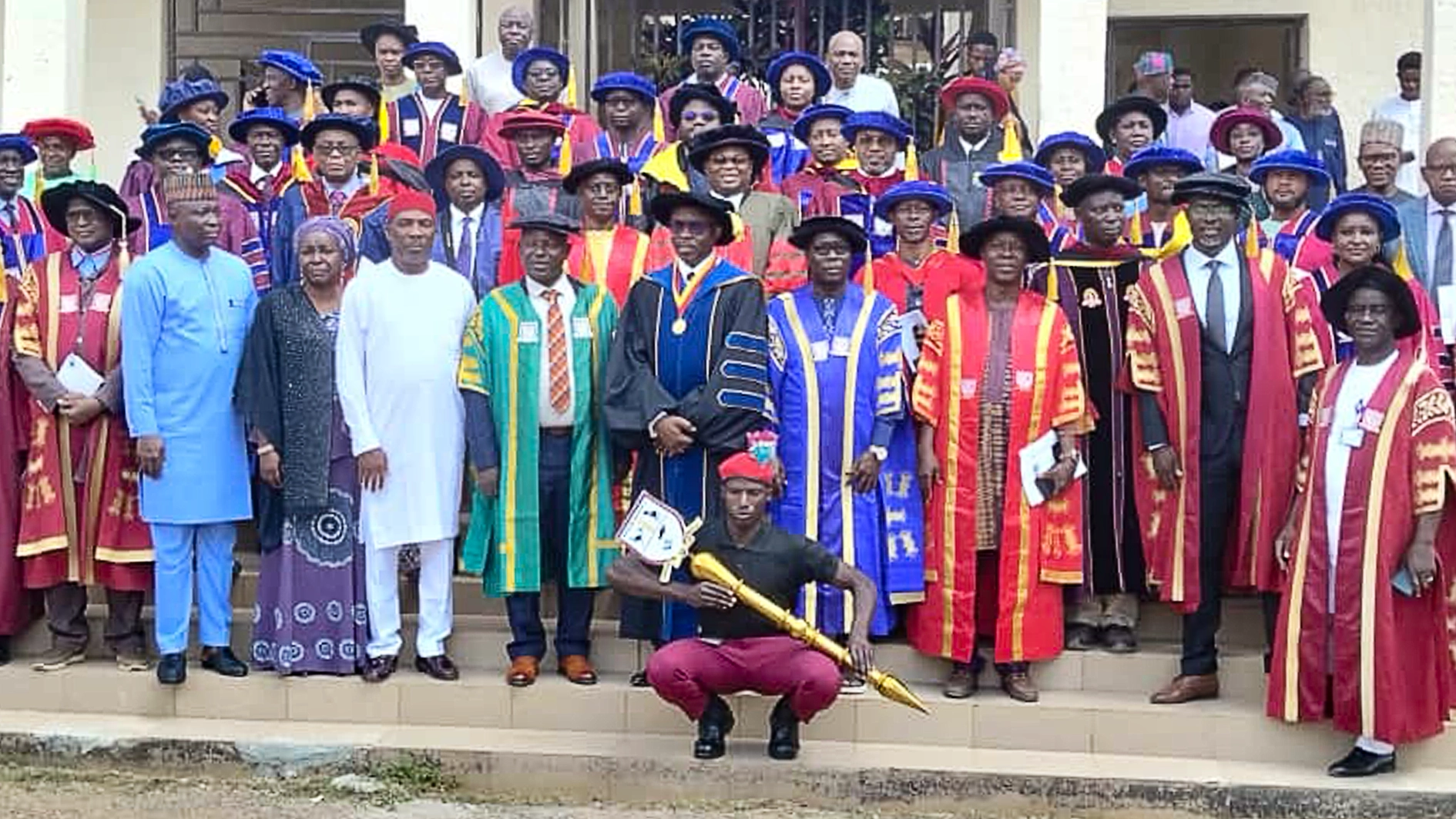
Earlier, Vice-Chancellor of Bingham University, Prof. Haruna Kuje Ayuba, said Nigeria’s progress depended not merely on its abundant resources but on the character, creativity and commitment of its people to excellence, identifying vision, faith and excellence as critical pillars of national transformation.
Ayuba said vision inspired possibilities, faith provided the courage to pursue them, while excellence supplied the discipline, competence and integrity required to translate aspirations into reality.
Prof. Ayuba also highlighted the growing international partnership between the University and Danubius International University, Romania, disclosing that both institutions signed a functional Memorandum of Understanding in 2025 under the Erasmus+ partnership framework to promote staff mobility and academic collaboration.
He recalled that Michael’s visit to Bingham University preceded the agreement, adding that he subsequently visited the Romanian institution within six months of signing the MoU, while the university’s Director of Advancement also visited DIU this year under the same programme.
He described the partnership as evidence of the importance of personal relationships in strengthening international academic cooperation, recalling Michael’s observation that “institutions don’t forge partnerships, individuals within the institutions do.”
Addressing the graduating students, Ayuba urged them to look beyond the certificates they would receive and embrace the responsibility of deploying their knowledge and skills to serve humanity. He said their achievements should not be measured solely by personal accomplishments but also by the positive impact they make in their communities and society.
He also challenged the Church to translate its convictions into meaningful service and its values into practical action, stressing that Nigeria needed more than ambitious ideas to achieve sustainable development.
According to him, the country requires strong institutions, responsible leadership, an educated citizenry and a collective commitment to integrity, adding that faith must inspire service while excellence guides action for national progress.